Private inspections of food companies seen as weak
March 20, 2009 By RICARDO ALONSO-ZALDIVAR , Associated Press Writer
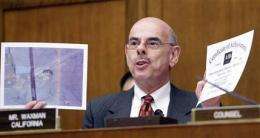
Rep. Henry Waxman, D-Calif., holds a photo of a dead rodent, left, and a certificate of achievement, both from Peanut Corporation of America, while speaking on Capitol Hill in Washington, Thursday, March 19, 2009, during a House Oversight and Investigations subcommittee hearing on the salmonella outbreak. (AP Photo/Alex Brandon)
(AP) -- The mortgage meltdown exposed the weakness of self-regulation in financial markets. Now the salmonella outbreak is doing the same for the food industry.
A House subcommittee Thursday released new documents that showed how private inspectors contracted by Peanut Corp. of America failed to find long-standing sanitary problems at company facilities. Peanut Corp. is at the center of a nationwide outbreak that has sickened nearly 700 people and is blamed for at least nine deaths.
Lawmakers said the food industry's private inspection system failed to catch filthy conditions because the company itself hired the inspectors.
"There is an obvious and inherent conflict of interest when an auditor works for the same supplier it is evaluating," said Rep. Bart Stupak, D-Mich., chairman of the House Energy and Commerce investigations subcommittee. He termed it a "cozy relationship."
Last summer, Peanut Corp.'s private inspector, a company called AIB, awarded the peanut processor a certificate in 2008 for "superior" quality at its Plainview, Texas, plant. This year, salmonella was discovered there.
The outbreak was initially traced to a Peanut Corp. facility in Blakely, Ga. Later, contamination was found at the Texas plant. Peanut Corp. is under criminal investigation for allegedly shipping products it knew to be tainted.
Owner Stewart Parnell has refused to answer questions from lawmakers, citing constitutional protections against self-incrimination. On Thursday, Parnell told The Associated Press he couldn't comment on the allegations and referred questions to his attorney, who was not immediately available.
Federal law does not require food companies to pay for their own inspections of suppliers. Nor are industry labs and inspectors required to tell the government about any problems they find.
At least one food company that used its own inspectors, Nestle USA, ultimately decided not to do business with Peanut Corp. Nestle USA had no recalls. But a Nestle affiliate in Puerto Rico recalled some ice cream products, and Nestle HealthCare Nutrition - another affiliate - recalled a nutritional bar.
The committee released a 2002 Nestle USA inspection report of Peanut Corp.'s Blakely plant. "They found that the place was filthy," said Rep. Henry Waxman, D-Calif.
A second audit by Nestle USA of Peanut Corp.'s Texas facility in 2006 also found major pest control and other problems. The audit said that would disqualify the plant from supplying chopped peanut pieces to sprinkle atop Drumstick ice-cream cones.
Auditors found at least 50 mouse carcasses in and around the plant and also a dead pigeon "lying on the ground near the peanut-receiving door."
The audit also said the plant had no pathogen-monitoring plan and noted that one needed to be developed for the plant to be in compliance with audit standards.
Companies that bought ingredients from Peanut Corp. said they had no way of defending themselves against a supplier they accuse of deliberately breaking the rules and covering up.
"I think we did everything we could do," Kellogg Co. chief executive David Mackay told the committee.
"The issue was that (Peanut Corp.) acted in a dishonest and unethical way," he added.
Lawmakers and the Obama administration say the problem goes beyond a rogue company, and major reforms are needed. Legislation has been introduced in Congress to take food safety oversight away from the Food and Drug Administration and give it to a new agency with stronger legal powers and more funding.
Peanut Corp. produced not only peanut butter, but peanut paste, an ingredient found in foods from granola bars and dog biscuits to ice cream and cake. More than 3,490 products have been recalled, including some millions of Kellogg's Austin and Keebler peanut butter sandwich crackers.
---
On the Net:
FDA salmonella page: http://tinyurl.com/8srctw
©2009 The Associated Press. All rights reserved. This material may not be published, broadcast, rewritten or redistributed.
-
Kellogg CEO: Food safety must be strengthened
Mar 19, 2009 |
not rated yet |
0
-
Engineers build first sub-10-nm carbon nanotube transistor
Feb 01, 2012 |
4.9 / 5 (33) |
30
-
Something old, something new: Evolution and the structural divergence of duplicate genes
Jan 31, 2012 |
4.6 / 5 (7) |
1
-
The hidden nanoworld of ice crystals: Revealing the dynamic behavior of quasi-liquid layers
Jan 30, 2012 |
5 / 5 (5) |
1
-
Stock market network reveals investor clustering
Jan 27, 2012 |
3.9 / 5 (23) |
8
-
Of microchemistry and molecules: Electronic microfluidic device synthesizes biocompatible probes
Jan 26, 2012 |
5 / 5 (2) |
0
-
Classical and Quantum Mechanics via Lie algebras
Apr 15, 2011
- More from Physics Forums - Independent Research
More news stories
Cognitive impairment in older adults often unrecognized in the primary care setting
A new study published in the Journal of the American Geriatrics Society reveals that brief cognitive screenings combined with offering further evaluation increased new diagnoses of cognitive impairment in older veterans two to ...
57 minutes ago |
not rated yet |
0
Primary care program helps obese teen girls manage weight, improve body image and behavior
Teenage girls gained less weight, improved their body image, ate less fast food, and had more family meals after participating in a 6- month program that involved weekly peer meetings, consultations with primary care providers ...
47 minutes ago |
not rated yet |
0
Botox developer rues missing out on billions
Botox developer Alan Scott says he rues the day he handed over rights to the best-selling wrinkle-smoothing drug to a US company for just $4.5 million, saying he might have become a billionaire.
Medicine & Health / Medications
1 hour ago |
not rated yet |
0
Young adults allowed to stay on parents' health insurance have improved access to care
Researchers from Mount Sinai School of Medicine have found that laws permitting children to stay on their parents' health insurance through age 26 result in improved access to health care compared to states without those ...
1 hour ago |
not rated yet |
0
Cancer rate 4 times higher in children with juvenile arthritis
New research reports that incident malignancy among children with juvenile idiopathic arthritis (JIA) is four times higher than in those without the disease. Findings now available in Arthritis & Rheumatism, a journal publis ...
1 hour ago |
not rated yet |
0
Rapunzel, Leonardo and the physics of the ponytail
(PhysOrg.com) -- New research provides the first mathematical understanding of the shape of a ponytail and could have implications for the textile industry, computer animation and personal care products.
AT&T customers surprised by 'unlimited data' limit
(AP) -- Mike Trang likes to use his iPhone 4 as a GPS device, helping him get around in his job. Now and then, his younger cousins get ahold of it, and play some YouTube videos and games.
Climate change causes harmful algal blooms in North Atlantic: study
Warming oceans and increases in windiness could be causing of an abundance of harmful algal blooms in the North Atlantic Ocean and North Sea, according to new research.
Hacker claims porn site users compromised
A hacker claims to have compromised the personal information of more than 350,000 users after breaking into a disused website operated by pornography provider Brazzers.
Integrated pest management recommendations for the southern pine beetle
The southern pine beetle, Dendroctonus frontalis Zimmermann, is a chronic insect pest within pine forests in the southeastern United States. Under favorable environmental and host conditions, it is an agg ...
Scientists discover molecular secrets of 2,000-year-old Chinese herbal remedy
For roughly two thousand years, Chinese herbalists have treated Malaria using a root extract, commonly known as Chang Shan, from a type of hydrangea that grows in Tibet and Nepal. More recent studies suggest that halofuginone, ...