Plant biologists discover gene that switches on 'essence of male'
March 20, 2009
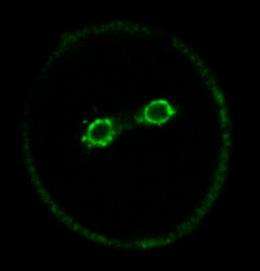
Pictured is a confocal image of an Arabidopsis pollen grain showing sperm cell-specific expression of the GFP-tagged plasma membrane protein Generative Cell Specific1 that is required for double fertilisation in flowering plants. The GCS1-GFP fusion protein appears in the periphery of the sperm cell pair (spectacles) present in each pollen grain. The authors show that germ cell division and specification, including the expression of GCS1 are regulated by the germline-specific transcription factor DUO POLLEN 1. Thus DUO1 has an integrative role linking germ cell division and sperm cell differentiation in flowering plants. Credit: Image generated by Lynette Brownfield (University of Leicester)
Biologists at the University of Leicester have published results of a new study into plant sex - and discovered that a particular gene switches on 'the essence of male'.
The study takes to a new level understanding of the genes needed for successful plant reproduction and seed production.
Professor David Twell and colleagues in the Department of Biology at the University of Leicester reported the discovery of a gene that has a critical role in allowing precursor reproductive cells to divide to form twin sperm cells.
Their study is reported in the journal Public Library of Science Genetics (PLoS Genetics) and was funded by the Biotechnology and Biological Sciences Research Council (BBSRC).
Professor Twell said: "Flowering plants, unlike animals require not one, but two sperm cells for successful fertilisation. One sperm cell to join with the egg cell to produce the embryo and the other to join with the central cell to produce the nutrient-rich endosperm tissue inside the seed. A mystery in this 'double fertilisation' process was how each single pollen grain could produce the pair of sperm cells needed for fertility and seed production.
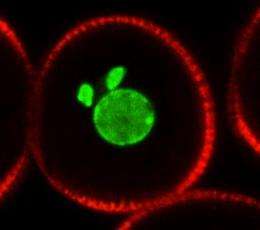
Pictured is a confocal image of an Arabidopsis pollen grain showing ectopic GFP expression in the pollen vegetative cell (outlined in red with large single green nucleus) under control of the normally male germ cell-specific histone H3 (MGH3) promoter (pair of green sperm cell nuclei). The MGH3 promoter is induced by the ectopic expression of the germline-specific transcription factor DUO1 in the pollen vegetative cell. The authors show that germ cell mitosis and specification are regulated by DUO1, including the expression of cell cycle and gamete fusion proteins. Thus DUO1 has a key integrative role linking germ cell division and sperm cell differentiation in flowering plants. Credit: Image generated by Lynette Brownfield (University of Leicester)
"We now report the discovery of a dual role for DUO1, a regulatory gene required for plant sperm cell production. We show that the DUO1 gene is required to promote the division of sperm precursor cells, while at the same time promoting their specialised function as sperm cells. It effectively switches on the essence of male."We show that DUO1 is required for the expression of a key protein that controls cell division and for the expression of genes that are critical for gamete differentiation and fertilisation.
"This work provides the first molecular insight into the mechanisms through which cell cycle progression and gamete differentiation are coordinated in flowering plants.
"This knowledge will be helpful in understanding the mechanisms and evolution of gamete development in flowering plants and may be useful in the control of gene flow and crossing behaviour in crop plants."
The researchers also report on the presence of genes closely related to DUO1 in a wide variety of flowering plants and even in lowly land plants such as moss, which suggests that DUO1 may be part of an ancient sperm cell regulatory network that evolved even before pollen and flowers appeared on the scene.
Interestingly, DUO1 is also related to a super class of Myb regulator proteins also present in animals that have an important role in controlling cell proliferation and that are implicated in certain human cancers such as leukemias. So like animal cell Myb proteins, DUO1 is needed for control of cell proliferation, but DUO1 is distinguished by its specific role in plant reproduction, namely its dual role in sperm cell production and switching on their ability to fertilize.
Professor Twell added that the study could help to unravel the evolutionary origins of plant sperm cells and provide new molecular tools for the manipulation of plant fertility and hybrid seed production - as well as to control gene flow in transgenic crops where the male contribution may need to be eliminated.
Source: University of Leicester
-
Biologists discover gene behind 'plant sex mystery'
Oct 22, 2008 |
not rated yet |
0
-
Biologists find unusual plant gene: abstinence by mutual consent
Dec 20, 2007 |
not rated yet |
0
-
A new male-specific gene in algae unveils an origin of male and female
Dec 18, 2006 |
not rated yet |
0
-
Scientists find unexpected key to flowering plants' diversity
Jul 28, 2008 |
not rated yet |
0
-
Sperm proteome gives 'tantalising glimpse' towards the origin of sex
Nov 13, 2006 |
not rated yet |
0
-
Engineers build first sub-10-nm carbon nanotube transistor
Feb 01, 2012 |
4.9 / 5 (33) |
30
-
Something old, something new: Evolution and the structural divergence of duplicate genes
Jan 31, 2012 |
4.6 / 5 (7) |
1
-
The hidden nanoworld of ice crystals: Revealing the dynamic behavior of quasi-liquid layers
Jan 30, 2012 |
5 / 5 (4) |
1
-
Stock market network reveals investor clustering
Jan 27, 2012 |
3.9 / 5 (23) |
8
-
Of microchemistry and molecules: Electronic microfluidic device synthesizes biocompatible probes
Jan 26, 2012 |
5 / 5 (2) |
0
-
Factors affecting beet root cell membrane
17 hours ago
-
Stem cell question.
Feb 10, 2012
-
Protease cleavage
Feb 10, 2012
-
Pertubance in a model
Feb 10, 2012
-
Cancer drugs and Alzheimer's, Oh my!
Feb 09, 2012
-
Squishing cells
Feb 09, 2012
- More from Physics Forums - Biology
More news stories
A mitosis mystery solved: How chromosomes align perfectly in a dividing cell
Although the process of mitotic cell division has been studied intensely for more than 50 years, Whitehead Institute researchers have only now solved the mystery of how cells correctly align their chromosomes during symmetric ...
14 hours ago |
4.5 / 5 (22) |
0
|
Researchers find extensive RNA editing in human transcriptome
In a new study published online in Nature Biotechnology, researchers from BGI, the world's largest genomics organization, reported the evidence of extensive RNA editing in a human cell line by analysis of RNA-seq data, demons ...
14 hours ago |
5 / 5 (4) |
0
|
The proteins ensuring genome protection
Researchers from the University of Geneva (UNIGE), Switzerland, have discovered the crucial role of two proteins in developing a cell 'anti-enzyme shield'. This protection system, which operates at the level of molecular ...
14 hours ago |
5 / 5 (3) |
0
|
Entire genome of extinct human decoded from fossil
(PhysOrg.com) -- In 2010, Svante Pääbo and his colleagues presented a draft version of the genome from a small fragment of a human finger bone discovered in Denisova Cave in southern Siberia. The ...
Feb 07, 2012 |
4.7 / 5 (60) |
51
|
Why are there so few fish in the Earth's oceans?
(PhysOrg.com) -- A Stony Brook University researcher has found that, contrary to popular belief, there are not plenty of fish in the sea.
Feb 08, 2012 |
4.3 / 5 (19) |
27
|
Japan's Fukushima reactor may be reheating: operator
Temperature readings at one of the crippled Fukushima nuclear reactors have risen above Japan's stringent new safety standard but there was no immediate danger, its operator said Sunday.
Scientists discover molecular secrets of 2,000-year-old Chinese herbal remedy
For roughly two thousand years, Chinese herbalists have treated Malaria using a root extract, commonly known as Chang Shan, from a type of hydrangea that grows in Tibet and Nepal. More recent studies suggest that halofuginone, ...
New method to examine batteries -- MRI from the inside
There is an ever-increasing need for advanced batteries for portable electronics, such as phones, cameras, and music players, but also to power electric vehicles and to facilitate the distribution and storage of energy derived ...
Google might launch Drive for cloud storage soon
(PhysOrg.com) -- Google's next big move, according to the Wall Street Journal, is a cloud storage service called Drive. Hardly first to the plate, Google is simply catching up to introducing its cloud reposi ...
Lab study raises questions over nano-particle impact
Tests involving chickens have raised questions about the impact on health from engineered nano-particles, the ultra-fine grains commonly used in drugs and processed foods, scientists said on Sunday.
Starve a virus, feed a cure? Findings show how some cells protect themselves against HIV
A protein that protects some of our immune cells from the most common and virulent form of HIV works by starving the virus of the molecular building blocks that it needs to replicate, according to research published online ...
