The human brain is on the edge of chaos
March 20, 2009
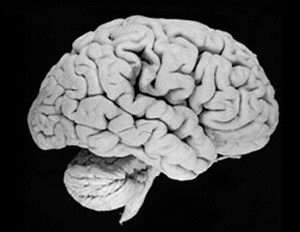
Modern human brain. Image source: Univ. of Wisconsin-Madison Brain Collection.
Cambridge-based researchers provide new evidence that the human brain lives "on the edge of chaos", at a critical transition point between randomness and order. The study, published March 20 in the open-access journal PLoS Computational Biology, provides experimental data on an idea previously fraught with theoretical speculation.
Self-organized criticality (where systems spontaneously organize themselves to operate at a critical point between order and randomness), can emerge from complex interactions in many different physical systems, including avalanches, forest fires, earthquakes, and heartbeat rhythms.
According to this study, conducted by a team from the University of Cambridge, the Medical Research Council Cognition & Brain Sciences Unit, and the GlaxoSmithKline Clinical Unit Cambridge, the dynamics of human brain networks have something important in common with some superficially very different systems in nature. Computational networks showing these characteristics have also been shown to have optimal memory (data storage) and information-processing capacity. In particular, critical systems are able to respond very rapidly and extensively to minor changes in their inputs.
"Due to these characteristics, self-organized criticality is intuitively attractive as a model for brain functions such as perception and action, because it would allow us to switch quickly between mental states in order to respond to changing environmental conditions," says co-author Manfred Kitzbichler.
The researchers used state-of-the-art brain imaging techniques to measure dynamic changes in the synchronization of activity between different regions of the functional network in the human brain. Their results suggest that the brain operates in a self-organized critical state. To support this conclusion, they also investigated the synchronization of activity in computational models, and demonstrated that the dynamic profile they had found in the brain was exactly reflected in the models. Collectively, these results amount to strong evidence in favour of the idea that human brain dynamics exist at a critical point on the edge of chaos.
According to Kitzbichler, this new evidence is only a starting point. "A natural next question we plan to address in future research will be: How do measures of critical dynamics relate to cognitive performance or neuropsychiatric disorders and their treatments?"
• Join PhysOrg.com on Facebook!
• Follow PhysOrg.com on Twitter!
More information: Kitzbichler MG, Smith ML, Christensen SR, Bullmore E (2009) Broadband Criticality of Human Brain Network Synchronization. PLoS Comput Biol 5(3): e1000314. doi:10.1371/journal.pcbi.1000314, http://dx.plos.org/10.1371/journal.pcbi.1000314
-
Robots show that brain activity is linked to time as well as space
Nov 07, 2008 |
not rated yet |
0
-
The human brain minimizes energy expenditure and integrates gravity in to the action plan
Oct 24, 2008 |
not rated yet |
0
-
Why does the world appear stable while our eyes move?
Feb 15, 2008 |
not rated yet |
0
-
How the brain separates audio signals from noise
Jun 10, 2008 |
not rated yet |
0
-
The neural basis of 'number sense' in young infants
Feb 05, 2008 |
not rated yet |
0
-
Engineers build first sub-10-nm carbon nanotube transistor
Feb 01, 2012 |
4.9 / 5 (29) |
30
-
Something old, something new: Evolution and the structural divergence of duplicate genes
Jan 31, 2012 |
4.6 / 5 (7) |
1
-
The hidden nanoworld of ice crystals: Revealing the dynamic behavior of quasi-liquid layers
Jan 30, 2012 |
5 / 5 (3) |
1
-
Stock market network reveals investor clustering
Jan 27, 2012 |
4 / 5 (22) |
8
-
Of microchemistry and molecules: Electronic microfluidic device synthesizes biocompatible probes
Jan 26, 2012 |
5 / 5 (1) |
0
-
Is Everyday Technology Killing Us?
5 hours ago
-
Exercise and weight loss
12 hours ago
-
Why do we have head aches? Our brains can't feel anything.
16 hours ago
-
"The end of diseases" by David Agus, interview from Daily Show with Jon Stewart
Feb 04, 2012
-
Oncolytic adenovirus
Feb 04, 2012
-
Nutrition label stuffs and diets
Feb 02, 2012
- More from Physics Forums - Medical Sciences
More news stories
Short fasting cycles work as well as chemotherapy in mice
Man may not live by bread alone, but cancer in animals appears less resilient, judging by a study that found chemotherapy drugs work better when combined with cycles of short, severe fasting.
1 hour ago |
4.7 / 5 (3) |
1
|
'Explorers,' who embrace the uncertainty of choices, use specific part of cortex
Life shrouds most choices in mystery. Some people inch toward a comfortable enough spot and stick close to that rewarding status quo. Out to dinner, they order the usual. Others consider their options systematically ...
Medicine & Health / Neuroscience
3 hours ago |
4 / 5 (1) |
0
|
Scientists delve into the brain roots of hunger and eating
Synaptic plasticity the ability of the synaptic connections between the brain's neurons to change and modify over time -- has been shown to be a key to memory formation and the acquisition of new learning behaviors. ...
Medicine & Health / Neuroscience
3 hours ago |
5 / 5 (1) |
0
|
Gene therapy for inherited blindness succeeds in patients' other eye
Gene therapy for congenital blindness has taken another step forward, as researchers further improved vision in three adult patients previously treated in one eye. After receiving the same treatment in their ...
1 hour ago |
5 / 5 (1) |
0
|
Unusual alliances enable movement
Some unusual alliances are necessary for you to wiggle your fingers, researchers report.
4 hours ago |
not rated yet |
0
|
Physicists build highly efficient 'no-waste' laser
A team of University of California, San Diego researchers has built the smallest room-temperature nanolaser to date, as well as an even more startling device: a highly efficient, "thresholdless" laser that ...
Study shows how DNA finds its match
It's been more than 50 years since James Watson and Francis Crick showed that DNA is a double helix of two strands that complement each other. But how does a short piece of DNA find its match, out of the millions ...
Transparent iron? For the first time, an experiment shows that atomic nuclei can become transparent
At the high-brilliance synchrotron light source PETRA III, a team of DESY scientists headed by Dr. Ralf Röhlsberger has succeeded in making atomic nuclei transparent with the help of X-ray light. At the ...
Quantum physicist explains $100K offer for proof scaled-up quantum computing is impossible
(PhysOrg.com) -- MIT researcher Scott Aaronson has certainly riled the physics community with his offer this past Friday, of $100,000 to anyone who can prove that scaled-up quantum computing is impossible. ...
Flipping a light switch in the cell: Quantum dots used for targeted neural activation
By harnessing quantum dotstiny light-emitting semiconductor particles a few billionths of a meter acrossresearchers at the University of Washington (UW) have developed a new and vastly more targeted ...
Obstacles no barrier to higher speeds for worms, researchers find
Obstacles in an organism's path can help it to move faster, not slower, researchers from New York University's Applied Math Lab at the Courant Institute of Mathematical Sciences have found through a series ...
Mar 20, 2009
Rank: 3.7 / 5 (7)
Mar 20, 2009
Rank: 3.7 / 5 (7)
http://en.wikiped...igenetic
Thus all three systems (well, one is a meta-system) are very likely meta-stable as they all have the opposite requirements of stability and adaptability. Probably in differing ratios, though. For example, I would imagine that for the selfish gene's continued survival, it's more important for DNA to be stable than a brain, at least longer term than say 20 or 30 years. Hmm, maybe that explains senility in old age too. Old brains can't quite keep up the delicate chemical/electrical balance and fall into chaos.
Mar 21, 2009
Rank: 3.7 / 5 (3)
People can still believe that some god(or gods) control every aspect and still believe that chaos is part of it.
Also Thales, I've had the same thoughts about the role of DNA and cognitive function in evolution.
Mar 21, 2009
Rank: 3.9 / 5 (12)
Mar 21, 2009
Rank: 3.3 / 5 (7)
Mar 21, 2009
Rank: 1 / 5 (6)
Just somewhat? Sounds like he's a half step away from advocating camps and ovens to me.
Mar 21, 2009
Rank: 2.3 / 5 (3)
Of course if you can believe in a bunch of nonsense before breakfast what kind of tripe can you manage by teatime. Camps and ovens, jihad, pogroms, if your magic invisible friends command who are you to refuse. As the Mormons know only too well religiosity requires sturdy underware.
Mar 21, 2009
Rank: 3 / 5 (4)
Mar 21, 2009
Rank: 2 / 5 (4)
Mar 22, 2009
Rank: 5 / 5 (4)
Or are we just using any excuse to talk about God now? ;-)
Mar 22, 2009
Rank: 3 / 5 (2)
Wow, thanks for explaining what I was getting at.
My favorite thing about physorg isn't that people have the ability to create great ideas, but that they can articulate them better than I can.
Well...maybe just some people.
Mar 22, 2009
Rank: 3.7 / 5 (3)
Mar 22, 2009
Rank: not rated yet
Maybe - other chaotic systems establish similar order structures, and show consciousness.
Like - maybe the Sun?!? Plasma charge interaction type stuff.
It's big and bad and can do just about anything it wants to us.
We are at it's mercy. We are all people of the Sun.
Mar 23, 2009
Rank: 5 / 5 (1)
Is it any wonder that in this 'world'..that the mind would exhibit the same roiling 'edge of order and chaos' type structure?
As above-so below.
Mar 23, 2009
Rank: 5 / 5 (1)
The interesting part is that it has done some seriously interesting design work for him in the process. It has designed the newest toothbrushes, Nike shoes, and has even composed poetry that is astoundingly good.
When he does this..it creates an astounding capacity for the software to REASON..or pull rabbits out of it's ass--depending on how you look at it.
The correlation is there.
I've also said that if you stress a man to his limit and beyond..so that he is forced to deal with some part of his mental structure dying a death of sorts..then new reasoning comes to the fore and he can understand and reason with new ideas, new tools, new understandings.
Both points..the one in this article and the one about the software design..support this premise and point.
Out with the old..in with the new.
Grow..you bastards.
Sadly..the more painful the process..the better and greater the moment of the capacity psychological, or inner change.
Mar 23, 2009
Rank: 2.5 / 5 (4)
Then came the mean speech. Lets just say an athiest has absolute proof that there is no God. He (or she)sees a dying believer in God who happens to be a young child. The child says he is going to die and then be with God. The athiest tell him, there is no god, you are just going into oblivion, you are stupid for beliving in god.
mean speak....
Mar 25, 2009
Rank: not rated yet
While there are some childish people here I don't think there are many if any actual children.
Ethelred
Mar 27, 2009
Rank: 1 / 5 (1)
Tripe such as this:
"Would you stand two feet from someone and call them a despicable coward, or do you feel more sheltered in the solitude of your home? How old are you? Have you ever seen the word 'scardyness' used in a sentence? Try to concentrate on the science if your anger will allow."
Is clearly the product of a subnormal mind. Childish value judgements, inability to spell, and sexual impotence are like currency to these people.
There are a group of these simple dunces trying to inject pig ignorant religiosity into every thread. They creep me out. Religion is just an unfunny joke they keep telling over and over.