France's SNCF hopes to run high speed rail in US
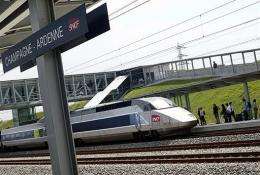
March 20, 2009 by Mira Oberman A French high-speed TGV train is pictured at the eastern French railway station of Bezannes

Enlarge

A French high-speed TGV train is pictured at the eastern French railway station of Bezannes. The United States is ready for a truly high-speed rail system and France's national railway SNCF would be "very interested" in operating a network, a senior executive said Thursday.

The United States is ready for a truly high-speed rail system and France's national railway SNCF would be "very interested" in operating a network, a senior executive said Thursday.

"We strongly believe that in this country, in some of the corridors, the system should logically be profitable," International chairman Jean-Pierre Loubinoux said in an interview on the sidelines of a rail conference in Indiana.

While detailed market analysis still needs to be undertaken, Loubinoux said the French experience has shown that high-speed rail operates most effectively between large cities that are around 1,000 to 1,500 kilometers (600 to 930 miles) apart.

These conditions exist in the east coast, California, the midwest, Texas and Florida.

"You could have more than just a corridor. You could have a system," he told AFP.

"If the possibility (of operating a network) is open we certainly would consider it with great interest."

The has allocated eight billion dollars for high-speed rail as part of a massive economic stimulus package and a number of states are competing for the money.

The bulk of the states are expected to propose incremental improvements to their rail systems by improving existing tracks in order to increase speeds from a maximum of 79 miles per hour to 110 or 150 miles per hour (127 kilometers per hour to 177 or 241 kilometers per hour.)

Loubinoux said the nation would be better off investing in a new, dedicated system with speeds of up to 217 miles (350 kilometers) per hour.

There is "a lot of business potential to be considered," Loubinoux said, adding that the structure of the bidding process remains to be determined.

"Will it be just a build and transfer of technology, will it be maintenance and operation... commercial contracts, operating possibilities," he said.

"Definitely in some cases, especially in high-speed corridors... we could envisage participating in some operation systems."

The SNCF, which developed France's famed TGV series of high-speed trains in the 1970s, plans to submit proposals to the US railway authority, which expressed interest last fall in improving service in 11 rail corridors.

"What we can bring is our experience. It's been more than 25 years since we developed high-speed rail services."

Loubinoux is hopeful that the United States, which has long lagged in developing its passenger rail system, now has the political will to launch the massive investment needed.

"The economic and financial crisis worldwide seems to be a sort of catalyst to big, nationwide infrastructure programs," he added.

(c) 2009 AFP


print this article email this article download pdf blog this article bookmark this article     Stumble it Digg this share on Facebook retweet share on Reddit add to delicious
Rate this story - 4.7 /5 (7 votes)

Rank Filter

Move the slider to adjust rank threshold, so that you can hide some of the comments.


Display comments: newest first

  • LuckyBrandon - Mar 20, 2009
    • Rank: 1 / 5 (3)
    SCREW THAT. Why invest in some train when we can do much much better...flight for instance...
    give that 8 billion dollars to the airlines and tell them to slice their freakin rates down to 1/3 of their former cost...THAT will get transportation going again.
    Trains are as old as dirt....and i know there are places that use them on a regular basis (such as subways)...but its a waste of time to improve on an old technology like the train, that is of no real competition to any existing transportation mediums in my eyes.
  • OregonWind - Mar 20, 2009
    • Rank: not rated yet
    LuckyBrandon

    Don't agree, for short distances traveling by train (specially using fast ones) makes far more sense to me. Why spend hours in a airport to travel just 40 minutes? Trains can carry more people and families enjoy the trips much more. Once I took a train from San Diego to downtown Los Angeles (regular slow train) and I enjoyed it far more than taking the airplane. It was fun, overall faster and more comfortable. A trip from, say, LA to SF with a high-speed train would be very interesting and would be very convenient for many.
  • Sparkygravity - Mar 20, 2009
    • Rank: 5 / 5 (2)
    lucky brandon

    Have you ever been to Europe? Giving 8 billion dollars to the airlines to slash rates is a short term solution. While investing 8 billion dollars in high speed transportation infrastructure is a good idea.

    The US is a large country and our transportation system is outdated. We need long term solutions not rate cuts.
  • John_balls - Mar 20, 2009
    • Rank: 5 / 5 (2)
    I would much rather take a train from Boston to ny or vice versa at 240 miles/hr then wait in the airport all day.
  • nkalanaga - Mar 20, 2009
    • Rank: 5 / 5 (1)
    Agreed. LA to Boston by train won't match airlines, but even at 150 miles/hr a train is competetive over 300-400 miles, and probably farther, if the airport security checks get any longer.
  • georgert - Mar 20, 2009
    • Rank: 5 / 5 (2)
    I've taken the TGV to travel in France quite a few times. It's clean, fast, efficient, relatively inexpensive, and a very enjoyable social experience. I would love to see high-speed rail come to the United States. For information on high-speed rail throughout the world and its social benefits, visit http://www.o-keating.com/hsr/
  • pseudophonist - Mar 22, 2009
    • Rank: not rated yet
    Trains are damn efficient, in terms of energy per person per distance. They're also cheaper to operate and likely will be cheaper, more-reliable and safer than flying.
    'Old Technology' they may be, but the age of a technology is a poor reason to decide against it, particularly with the comparative efficiency.
  • nkalanaga - Mar 22, 2009
    • Rank: not rated yet
    Not to mention that if the engine quits, you can get out and walk! And, an electric train, such as the TGV, can be powered by multiple fuels, unlike a diesel, which requires liquid hydrocarbons.

    True, hanging the wires is expensive, but even at 3 to 4 million a mile (my estimate-20 years ago the BN estimated a million) to do the routes described would be 2.5 to 4 billion each, and the systems would last for decades. How much does a new airliner capable of carrying the same passenger load as a TGV cost? And how many planes would be needed for the service? And how much to expand airports, as many are now overcrowded, and provide parking a roads for the vehicles needed to carry passengers from the city center to the airport? I'm sure a train is a lot cheaper, overall, than a plane for the same number of passengers carried. Also, some of the cost of electrifying an existing railroad is replacing the signal systems and adjusting clearances, which wouldn't be a factor on new construction.

    As for "Old Technology", knives and hammers are about as old as one can get, but they still do the job!
  • poi - Mar 22, 2009
    • Rank: not rated yet
    As KIT always says, "Hi-tech isn't always practical."

March 20, 2009 all stories

Comments: 9

4.7 /5 (7 votes)
  • Stumble this up

  • Digg this

  • share this

  • hide
  • Related Stories


  • hide
  • Relevant PhysicsForums posts

  • Ducted fan intake
    created 20 hours ago
  • why are you an engineer?
    created Nov 15, 2009
  • Bread Board
    created Nov 14, 2009
  • Student team - building a satellite - want to join - problem:i'm a biotech student.
    created Nov 13, 2009
  • More from Physics Forums - General Engineering

Other News

USA Today tests online edition at colleges

Technology / Internet

created 35 minutes ago | popularity not rated yet | comments 0

(AP) -- Penn State, Indiana and Missouri are the first schools to participate in a USA Today initiative meant to test how students respond to electronic versions of printed newspapers.


Gartner said in a statement that semiconductor revenue is on pace to fall 11.4 percent this year

Semiconductor revenue to fall 11 percent: Gartner

Technology / Business

created 1hour ago | popularity not rated yet | comments 0

Worldwide semiconductor revenue is expected to decline by more than 11 percent in 2009 over last year, less than previously forecast, market research firm Gartner said Monday.


Comcast's NBC talks cap its decades-long rise (AP)

Comcast's NBC talks cap its decades-long rise

Technology / Telecom

created 2 hours ago | popularity not rated yet | comments 0

(AP) -- Ralph Roberts knew he was onto something big when people ran after his cable TV trucks in Tupelo, Miss., asking for a visit to their homes.


More than 1,000 people have already signed up on the Internet to receive the "niiu"

Europe's first 'personalised paper' rolls off the presses

Technology / Other

created 5 hours ago | popularity not rated yet | comments 0

Billed as Europe's first "personalised paper", "niiu", a newspaper tailored to readers' individual wishes and delivered to their door before 08:00 am, made its first appearance in Berlin on Monday.


Google SPDY

Google's SPDY will speed up downloads

Technology / Internet

created 12 hours ago | popularity 4.2 / 5 (9) | comments 4

(PhysOrg.com) -- As part of its effort to speed up the Web, Google is experimenting with SPDY, a new application layer protocol, that it hopes will speed up the conversation between browsers and Web servers ...