GOCE successfully completes early orbit phase
March 20, 2009 GOCE

Enlarge

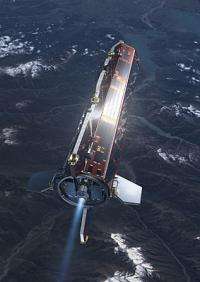
The sleek aerodynamic design of GOCE (Gravity Field and Steady-State Ocean Circulation Explorer) immediately sets it apart from most other satellites. This unique five-metre long spacecraft has none of the usual moving parts. The satellite together with its sensor, system of supporting instrumentation and control elements actually form a single composite gravity-measuring device. Credits: ESA - AOES Medialab

ESA's GOCE satellite was formally declared ready for work at 01:00 CET on 20 March. During the critical Launch and Early Orbit Phase beginning with separation from its booster on 17 March, GOCE was checked out to confirm that all of its control systems are operating normally.

The end of the Launch and Early Phase (LEOP) came overnight after was switched to Fine Pointing Mode. This means that all of its systems are working normally and the is ready for full commissioning of its scientific instruments. With the end of LEOP, normal communications between the satellite and the ground are now being provided by ESA's ESTRACK station at Kiruna, Sweden.

"Everything is working well and we have a healthy satellite. Today, we will end round-the-clock staffing in the Main Control Room and move the Flight Control Team to regular work-day operations in the Dedicated Control Room," said Flight Operations Director Pier Paolo Emanuelli speaking this morning at ESA's European Space Operations Centre (ESOC), Darmstadt, Germany.

Satellite-to-satellite tracking in operation

FLV player

March 16, 2009 MP3 audio recording of the GOCE Flight Operations Director initiating the 'GO/NO-GO' roll call in the Main Control Room at ESOC, the European Space Operations Center. The roll call confirms that all supporting teams at ESOC are ready for GOCE launch. Credit: ESA

A major aim of this week's LEOP work was to bring the Satellite-to-Satellite Tracking Instrument (SSTI) - a highly accurate GPS () receiver - into full operation. Emanuelli confirmed that it is working normally.

"Switching on the SSTI was especially important, as this meant the satellite could start performing its own autonomous orbit determinations. SSTI identifies GOCE's position very accurately, and we need this functioning before we can bring the satellite into its final drag-free operations mode," he said.

First science data sets already received

In addition to providing realtime for flight control, SSTI is one of GOCE's two payload instruments and it is a very accurate scientific tool for recording and reconstructing the satellite's actual orbit. The first SSTI data have already been successfully received at the Payload Data Ground Segment at ESA's Earth Observation Centre (ESRIN), Frascati, Italy.

FLV player

Although the GOCE (Gravity Field and Steady-State Ocean Circulation Explorer) gradiometer is highly accurate, it is not possible to map the complete gravity field at all spatial scales with the same quality. To overcome this limitation the position of the GOCE satellite is tracked by GPS relative to GPS satellites at an altitude of 20 000 km - this procedure is known as satellite-to-satellite tracking. The gradiometer is used to measure small scales of the gravity field whilst GPS is used to obtain large-scale data. Credits: ESA - AOES Medialab

"Receiving initial science data from SSTI so soon has been an excellent first step and, now that the SSTI is operating, we are already proceeding with commissioning of the scientific payload," said GOCE Mission Manager Rune Floberghagen, who worked in ESOC's Main Control Room alongside the Mission Control Team during LEOP to monitor progress.

"GOCE is operating very well, and we are already looking forward to commissioning our other main instrument, the Electrostatic Gravity Gradiometer, starting in mid-April. It's going to be a very busy but tremendously exciting time as we begin science operations," said Floberghagen.

In the coming weeks, the mission is expected to achieve a number of crucial milestones, including switching on the electric ion propulsion, switching into Drag-Free Attitude Control mode and lowering the orbit to the planned altitude of about 260 km.

Source: European Space Agency


print this article email this article download pdf blog this article bookmark this article     Stumble it Digg this share on Facebook retweet share on Reddit add to delicious
Rate this story - not rated yet


March 20, 2009 all stories

Comments: 0

not rated yet
  • Stumble this up

  • Digg this

  • share this

  • hide
  • Related Stories

  • GOCE satellite: Critical operations ongoing
    created Mar 19, 2009 | popularity not rated yet | comments 0
  • GIOVE-B spacecraft in good health
    created Apr 30, 2008 | popularity not rated yet | comments 0
  • Launch of GOCE Satellite delayed
    created Sep 08, 2008 | popularity not rated yet | comments 0
  • First Galileo signals transmitted by GIOVE-A
    created Jan 13, 2006 | popularity not rated yet | comments 0
  • Artemis provides communications for Jules Verne ATV
    created Mar 14, 2008 | popularity not rated yet | comments 0


  • hide
  • Relevant PhysicsForums posts

  • The shape of our solar system's orbits.
    created Nov 07, 2009
  • Above or Below the Line of Nodes
    created Nov 07, 2009
  • Supernova vs. Nova?
    created Nov 07, 2009
  • Supernova's Gamma Rays and Comets
    created Nov 06, 2009
  • More from Physics Forums - General Astronomy

Other News

Making Climate Forecasts More Useful to Farmers

Making Climate Forecasts More Useful to Farmers

Space & Earth / Environment

created 1hour ago | popularity not rated yet | comments 0

(PhysOrg.com) -- Climate forecasts are becoming more useful to farmers and ranchers, thanks to research by Agricultural Research Service (ARS) scientists and their cooperators.


L-R: Chiwetel Ejiofor, Amanda Peet and John Cusack at the premiere of "2012"

NASA on crusade to debunk 2012 apocalypse myths

Space & Earth / Space Exploration

created 3 hours ago | popularity not rated yet | comments 0

The world is not coming to an end on December 21, 2012, the US space agency insisted Monday in a rare campaign to dispel widespread rumors fueled by the Internet and a new Hollywood movie.


NASA satellites make a movie and get rainfall, wind info on Ida

NASA satellites make a movie and get rainfall, wind info on Ida (w/ Video)

Space & Earth / Earth Sciences

created 3 hours ago | popularity not rated yet | comments 0

NASA satellites are amazing examples of technology. The TRMM satellite peers into tropical cyclones and can tell how much rain is falling per hour and where. QuikScat uses microwave technology to measure Ida's ...


Antarctica glacier retreat creates new carbon dioxide store

Antarctica glacier retreat creates new carbon dioxide store

Space & Earth / Earth Sciences

created 8 hours ago | popularity 4.3 / 5 (3) | comments 0

Large blooms of tiny marine plants called phytoplankton are flourishing in areas of open water left exposed by the recent and rapid melting of ice shelves and glaciers around the Antarctic Peninsula. This ...


NASA's TRMM Satellite sees most of Ida's heaviest rain stayed off coasts

NASA's TRMM Satellite sees most of Ida's heaviest rain stayed off coasts

Space & Earth / Earth Sciences

created 4 hours ago | popularity not rated yet | comments 0

NASA and the Japanese Space Agency's Tropical Rainfall Measuring Mission (TRMM) satellite flew over Ida and captured her rainfall when she passed by Nicaragua, Honduras and Belize this weekend. TRMM data revealed ...