Carbon Nanotube Artificial Muscles for Extreme Temperatures
March 20, 2009 Carbon Nanotube Artificial Muscles for Extreme Temperatures

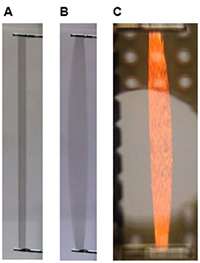
A. An artificial muscle strip with no voltage applied. B. The above artificial muscle strip with 5 kV applied. C. An artificial muscle strip actuated at 1500 K using 5 kV applied voltage.

(PhysOrg.com) -- Researchers at the UT Dallas Alan G. MacDiarmid NanoTech Institute have demonstrated a fundamentally new type of artificial muscle, which can operate at extreme temperatures where no other artificial muscle can be used -- from below the temperature of liquid nitrogen (-196° C) to above the melting point of iron (1538° C).

The discovery is reported in the March 20 issue of Science under the title “Giant Stroke, Superelastic Aerogel Muscles.”

Once actuated (or put into motion) in a certain direction, these new can elongate 10 times more than natural muscles and at rates 1,000 times higher than a natural muscle. In another direction, when densified, they can generate thirty times the force of a natural muscle having the same cross-sectional area. While natural muscles can contract at about 20 percent per second, the new artificial muscles can contract at about 30,000 percent per second.

These artificial muscles are carbon nanotube aerogel sheets made by a novel solid-state process developed at UT Dallas. Sometimes called frozen smoke, aerogel is a low-density solid-state material derived from a gel in which the liquid component of the gel has been replaced with gas. are comprised mostly of air. The starting material is an array of vertically aligned carbon nanotubes manufactured under a chemical heat process. Because of the special arrangement of these nanotube arrays, which are called forests because they look like a bamboo forest, the carbon nanotubes can be pulled into sheets at speeds of up two meters per second. The sheets have such low density that an ounce would cover an acre.

When scientists apply a voltage to the carbon nanotube aerogel sheets, the nanotubes repulse, or push away from one another, which in effect works the muscle. These transparent sheets have strange properties that are important for muscle operation. While having about the density of air, in one direction, they have higher specific strength (strength/density) than a steel plate. When stretched in another direction, they provide rubber-like stretchability, but by a mechanism quite different than for ordinary rubber. Because of their nanoscale and microscale structure, they amplify a percent stretch in the nanotube orientation direction to a percent 15 times larger than the percent they contract laterally.

“Our discovery of methods for producing these carbon nanotube sheets, their strange properties, and their corresponding remarkable performance as artificial muscles is just the beginning of a story, which will likely be taken in new directions by researchers around the world,” said Dr. Ray H. Baughman, one of the article’s authors, who is the Robert A. Welch Professor of Chemistry and director of the NanoTech Institute. “My guess is that this story will have a happy ending in terms of new products that benefit humankind.”

The ability to either permanently or reversibly tune a nanotube sheet density by flexing it, and the ability to change the shape of the sheet will likely provide the earliest applications of this technology. Due to their extremely light weight and variable density, carbon nanotube aerogels may become highly desired for use in artificial muscles and solar cells. The conductive properties of these nanotube aerogels, along with their ability to drastically expand their surface area, can improve solar cells by making them more efficient at collecting and storing energy.

In addition, because no other artificial muscle can actuate at such extreme low and high temperatures, applications for these muscles might develop for use in space exploration, where a hostile environment prohibits use of any other actuating material.

Provided by University of Texas at Dallas


print this article email this article download pdf blog this article bookmark this article     Stumble it Digg this share on Facebook retweet share on Reddit add to delicious
Rate this story - 4.8 /5 (18 votes)

Rank Filter

Move the slider to adjust rank threshold, so that you can hide some of the comments.


Display comments: newest first

  • earls - Mar 20, 2009
    • Rank: not rated yet
    Nanotube exoskeleton suits, ahoy!
  • SineQuaNon - Mar 21, 2009
    • Rank: not rated yet
    An ideal orbital-elevator material as well perhaps?
  • jaggspb - Mar 21, 2009
    • Rank: not rated yet
    another step in the rise of the Terminator
  • zygbot - Mar 21, 2009
    • Rank: not rated yet
    Humanoid robots equipped with carbon nanotube muscles will display considerable, possibly superhuman, strength and highly developed reflexes. It's even plausible that a humanoid robot will be developed to compete against humans in athletic competitions. Thoughts?
  • poi - Mar 22, 2009
    • Rank: not rated yet
    Humanoid robots equipped with carbon nanotube muscles will display considerable, possibly superhuman, strength and highly developed reflexes. It's even plausible that a humanoid robot will be developed to compete against humans in athletic competitions. Thoughts?

    well, they have to make them longer first as in lengths in human scale, unless you want robots in the nanoscale. Sticking them together to make them longer presents an issue as to the limit the adhesive will introduce into the structure that may compromise the very advantages of the material.
  • abadaba - Mar 25, 2009
    • Rank: not rated yet
    making them longer doesn't seem to be an issue since they easily stretch and are already above the nanoscale as evidenced by the non-nano scale pictures of it in action. Even losing some efficiency, it would still provide a robot with far beyond human capability to the point where i feel "superhuman" would be a huge understatement. And @ jagspb, that's the first thing i thought..lol

March 20, 2009 all stories

Comments: 6

4.8 /5 (18 votes)
  • Stumble this up

  • Digg this

  • share this

  • hide
  • Related Stories

  • Artificial muscles based on conducting polymer and carbon nanotubes
    created Jan 05, 2005 | popularity not rated yet | comments 0
  • New Properties Discovered for Nanotube Sheets
    created Apr 25, 2008 | popularity not rated yet | comments 0
  • Breakthrough for carbon nanotube materials
    created Sep 29, 2008 | popularity not rated yet | comments 0
  • Penn Physicists Develop a Carbon Nanotube Aeroegel Optimizing Strength, Shape and Conductivity
    created May 16, 2007 | popularity not rated yet | comments 0
  • Researchers produce strong, transparent carbon nanotube sheets
    created Aug 18, 2005 | popularity not rated yet | comments 0


  • hide
  • Relevant PhysicsForums posts

  • Polymer Properties Question
    created 1hour ago
  • Fatigue Properties of Chinese steel
    created Nov 04, 2009
  • Finding Hardness values
    created Nov 04, 2009
  • Fluid flow, pressure drop simulation in Comsol
    created Nov 04, 2009
  • More from Physics Forums - Materials & Chemical Engineering

Other News

Findings show nanomedicine promising for treating spinal cord injuries

Findings show nanomedicine promising for treating spinal cord injuries

Nanotechnology / Bio & Medicine

created 10 hours ago | popularity 4.5 / 5 (4) | comments 0

(PhysOrg.com) -- Researchers at Purdue University have discovered a new approach for repairing damaged nerve fibers in spinal cord injuries using nano-spheres that could be injected into the blood shortly ...


New Digital 'Electronics' Concept May Continue Moore's Law

New Digital 'Electronics' Concept May Continue Moore's Law

Nanotechnology / Nanophysics

created Nov 05, 2009 | popularity 4.6 / 5 (53) | comments 9

(PhysOrg.com) -- Computers of the future could be operating not on electrons, but on tiny waves traveling through an electron "fluid," if a new proposal is successful. The new circuit design, recently introduced ...


Nanoparticles for gene therapy improve

Nanoparticles for gene therapy improve

Nanotechnology / Bio & Medicine

created Nov 06, 2009 | popularity 5 / 5 (4) | comments 3

(PhysOrg.com) -- About five years ago, Professor Janet Sawicki at the Lankenau Institute in Pennsylvania read an article about nanoparticles developed by MIT's Robert Langer for gene therapy, the insertion ...


Breakthrough in industrial-scale nanotube processing

Breakthrough in industrial-scale nanotube processing

Nanotechnology / Nanomaterials

created Nov 02, 2009 | popularity 4.9 / 5 (20) | comments 3

(PhysOrg.com) -- Rice University scientists today unveiled a method for the industrial-scale processing of pure carbon-nanotube fibers that could lead to revolutionary advances in materials science, power ...


Scientists witness nature's complexity unfold in self-assembling quasicrystals

Scientists witness nature's complexity unfold in self-assembling quasicrystals

Nanotechnology / Nanomaterials

created Oct 31, 2009 | popularity 4.9 / 5 (17) | comments 3

(PhysOrg.com) -- Just a few decades ago, scientists believed that all ordered matter consists of self-repeating building blocks -- atoms, ions or molecules. In this view, the ordinary solids of everyday life ...