Flight of the bumble (and honey) bee
March 20, 2009 Bee

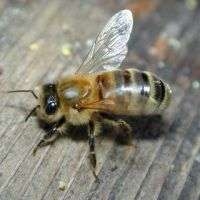
Insects such as honeybees and bumble bees are predictable in the way they move among flowers, typically moving directly from one flower to an adjacent cluster of flowers in the same row of plants. The bees' flight paths have a direct affect on their ability to hunt for pollen and generate "gene flow", fertilization and seed production that results when pollen moves from one plant to another. The study of gene flow has experienced more attention in part due to the recent introduction of genetically modified organisms (GMOs) into the environment.

Scientists, plant breeders, and growers seek to understand flight patterns of , bumble bees, and other insect "pollinators" as a way to increase production and healthy produce. Although several studies have focused on pollen movement among cucurbits, the plant family that includes cucumbers, gourds, melons, or pumpkins, little research has looked at pollinator flight patterns and, until recently, none has determined in watermelon plantings.

New research published in the February 2009 issue of HortScience by research scientists S. Alan Walters of Southern Illinois University and Jonathan R. Schultheis of North Carolina State University studied down and across rows in watermelon [Citrullus lanatus (Thunb.)] by tracking pollen flow. The direction of honeybees was tracked under field conditions during 2001 and 2002 at the Southern Illinois University Horticultural Research Center in Carbondale.

According to Walters, the study indicated that the evaluation of pollen flow showed a definite pattern of bee movement and gene migration in watermelon. "Although we detected pollinator movement that was strongly directional in both directions (east and west) down the row from the central block of donor plants, results also indicate that significant movement also occurred across rows in both directions (north and south) from the donor plot", he remarked.

Because watermelon vines grow in multiple directions, including across rows, bees can easily move across rows if the next closest flower is in that direction instead of down the row. Most pollen is deposited on the nearest neighboring flower from where pollen was collected.

Walters summarized the study stating, "Although significant amounts of linear pollinator movements occur down rows of watermelon plants, pollinator movements (in watermelon) are not as simple as just maintaining a linear direction straight down the row, but are related to the short flight distances that most likely occur to the closest neighboring flower from the one that was previously visited."

More information: The complete study and abstract are available on the ASHS HortScience electronic journal web site: http://hortsci.ashspublications.org/cgi/content/abstract/44/1/49

Source: American Society for Horticultural Science


print this article email this article download pdf blog this article bookmark this article     Stumble it Digg this share on Facebook retweet share on Reddit add to delicious
Rate this story - 5 /5 (2 votes)


March 20, 2009 all stories

Comments: 0

5 /5 (2 votes)
  • Stumble this up

  • Digg this

  • share this

  • hide
  • Related Stories

  • Flowers shape themselves to guide their pollinators to the pollen
    created Apr 03, 2007 | popularity not rated yet | comments 0
  • Bees can mediate the escape of genetically engineered material over several kilometres
    created Sep 22, 2008 | popularity not rated yet | comments 0
  • How to share a bat
    created Aug 22, 2007 | popularity not rated yet | comments 0
  • Wild bees make honey bees better pollinators
    created Aug 29, 2006 | popularity not rated yet | comments 0
  • New research provides better understanding of the birds and the bees
    created Dec 18, 2007 | popularity not rated yet | comments 0


  • hide
  • Relevant PhysicsForums posts

Other News

Scientists successfully reprogram blood cells

Biology / Cell & Microbiology

created 6 hours ago | popularity 5 / 5 (2) | comments 0

Researchers have transplanted genetically modified hematopoietic stem cells into mice so that their developing red blood cells produce a critical lysosomal enzyme -preventing or reducing organ and central nervous system damage ...


Iowa State University researcher discovers key to vital DNA, protein interaction

Researchers discover key to vital DNA, protein interaction

Biology / Other

created 2 hours ago | popularity not rated yet | comments 0

(PhysOrg.com) -- A researcher at Iowa State University has discovered how a group of proteins from plant pathogenic bacteria interact with DNA in the plant cell, opening up the possibility for what the scientist ...


Study shows that some malignant tumors can be shut down after all

Biology / Cell & Microbiology

created 10 hours ago | popularity 5 / 5 (3) | comments 1

Oncologists have had their hands tied because more than half of all human cancers have mutations that disable a protein called p53. As a critical anti-cancer watchdog, p53 masterminds several cancer-fighting operations within ...


New discovery allows scientists for the first time to experimentally annotate genomes

New discovery allows scientists for the first time to experimentally annotate genomes

Biology / Biotechnology

created 5 hours ago | popularity 5 / 5 (3) | comments 0

Over the last 20 years, the sequencing of the human genome, along with related organisms, has represented one of the largest scientific endeavors in the history of mankind. The information collected from genome ...


Wasp

Well-traveled wasps provide hope for vanishing species

Biology / Plants & Animals

created 6 hours ago | popularity not rated yet | comments 0

They may only be 1.5mm in size, but the tiny wasps that pollinate fig trees can travel over 160km in less than 48 hours, according to research from scientists at the University of Leeds. The fig wasps are transporting ...