First automated carbohydrate 'assembly line' opens door to new field of medicine
Scientists from Germany today reported a major advance toward opening the doors of a carbohydrate-based medicine chest for the 21st Century. Much more than just potatoes and pasta, these carbohydrates may form the basis of revolutionary new vaccines and drugs to battle malaria, HIV, and a bevy of other diseases.
Speaking at the 237th National Meeting of the American Chemical Society, Peter H. Seeberger, Ph.D., described development of an automated carbohydrate synthesizer, a device that builds these intricate molecules in a few hours — rather than the months or years required with existing technology.
"Our automated synthesizer is now the fastest method to make complex carbohydrates," says Seeberger, principal investigator for the research. "There are currently no competitive methods available. Today, if people working in biology run into a problem related to carbohydrates, they usually drop it because there are no tools available. They can't buy anything from a catalogue. It becomes a royal pain in the neck."
Scientists trying to synthesize DNA and protein-based molecules experienced a similar pain-in-the neck decades ago, until the invention of automated DNA and protein synthesizers. These devices helped kick start a revolution in genetics and proteomics. The carbohydrate synthesizer may do the same thing for the emerging fields of glycochemistry and glycobiology — named for carbohydrate sugar chains known as "glycans."
In 2001, Seeberger and colleagues reported the design of a prototype synthesizer. Revealed for the first time at the ACS National Meeting, the latest version is now fully automated, much faster, and can be operated by a non-expert, says Seeberger. Developed at the Swiss Federal Institute of Technology in Zurich, the instrument produces significant quantities of carbohydrate molecules that were nearly inaccessible until now.
Carbohydrates are tough molecules to build because of their complicated, branched structure. So instead of trying to build carbohydrates from scratch, scientists today use molecules isolated from nature, a painstaking process that could take months.
"We make things chemically that people used to isolate," explains Seeberger. "The automated synthesizer puts single sugars, the building blocks of carbohydrates, together like beads on a string."
Carbohydrates play crucial roles in the immune system, especially in the body's defenses against disease-causing viruses and bacteria. Most of these microbes have unique carbohydrate markers on their surfaces. The immune system recognizes these carbohydrates as foreign material, and creates antibodies that launch an immune response to battle the infection.
"Vaccines 'educate' the immune system to recognize a specific molecule on the surface of infectious organisms," explains Seeberger. "The synthesizer allows us to make not one but many carbohydrate structures from a particular organism and test those to see if they protect against the microbe. Synthetic carbohydrates that show promising protective qualities then may become the basis for new vaccines.
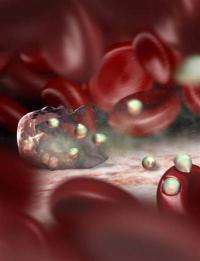
In a recent finding, the team discovered a carbohydrate on the surface of the malaria parasite P. falciparum that enables the parasite to infect human red blood cells, thus solving a long-standing mystery about how infection happens.
Seeberger's group used the carbohydrate synthesizer to develop a malaria vaccine. Clinical trials for the vaccine are scheduled for 2010 in Mozambique and Tanzania. Its unique "anti-disease" mechanism makes it the only vaccine of its kind, he says.
"To my knowledge, ours is the first attempt at an anti-disease vaccine. It doesn't actually kill the malarial parasite; it blocks its toxic action. You create antibodies against the sugar structure, and these antibodies block the carbohydrate toxin from leading to inflammation and anemia, the hallmarks of malarial infection," says Seeberger.
He explained that they will pair the carbohydrate vaccine with a traditional, protein-based one to create a "conjugate vaccine," which is best suited to immunize the most vulnerable group of potential malaria victims — children under the age of two.
The malaria vaccine is only one of almost a dozen vaccines from Seeberger's lab headed for clinical trials. Carbohydrate-based vaccines could target some of today's most serious infectious diseases, including antibiotic-resistant infections and HIV.
Seeberger is commercializing the carbohydrate synthesizer through his start-up company, Ancora Pharmaceuticals, based in Medford, Mass. Looking ahead, Seeberger discussed the other major obstacle facing carbohydrate research.
"In the area of glycobiology, there are two technological hurdles right now. One is to get access to molecules, which we have now addressed. The second one is sequencing. If you look at the human genome project, or genomics and proteomics, sequencing and synthesis were always the key issues," says Seeberger.
Seeberger saw firsthand the profound effect that automated DNA synthesizers had on genetics and biotechnology. His doctoral advisor, Marvin H. Caruthers, Ph.D., of the University of Colorado, helped develop the first model in 1980.
"We hope that we have the same effect on carbohydrate research," says Seeberger.
Source: American Chemical Society (news : web)


