Clinical trial backs use of special yogurt to fight stomach ulcer bacteria
March 22, 2009
Clinical trial backs use of special yogurt to fight stomach ulcer bacteria

Enlarge

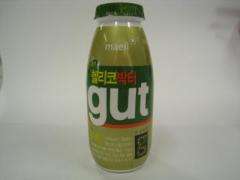
A new type of yogurt fights the bacteria that cause stomach ulcers. Manufacturers sell it in Japan under the name "Dr. Piro" and in Korea as "Gut." Credit: PharmaFood International Co., Ltd.

Results of the first human clinical studies confirm that a new yogurt fights the bacteria that cause gastritis and stomach ulcers with what researchers describe as almost vaccine-like effects, scientists in Japan will report today at the 237th National Meeting of the American Chemical Society.

Researchers have long known that , a fermented milk product containing live , is a healthy source of calcium, protein, and other nutrients. Some brands of yogurt are now made with "probiotics" — certain types of bacteria — intended to improve health. The new yogurt represents a unique approach to fighting , which affect 25 million people in the United States alone, and is part of a growing "functional food" market that now generates $60 billion in sales annually.

"With this new yogurt, people can now enjoy the taste of yogurt while preventing or eliminating the bacteria that cause stomach ulcers," says study coordinator Hajime Hatta, Ph.D., a chemist at Kyoto Women's University in Kyoto, Japan.

The new yogurt is already on store shelves in Japan, Korea, and Taiwan. The study opens the door to possible arrival of the product in the U.S., the researchers suggest.

A type of bacteria called Helicobacter pylori (H. pylori) or over-use of aspirin and or other nonsteroidal antiinflammatory drugs, causes most stomach ulcers. H. pylori ulcers can be effectively treated and eliminated with antibiotics and acid suppressants. However, that simple regimen is unavailable to millions of poverty-stricken people in developing countries who are infected with H. pylori. New research also links childhood H. pylori infection to malnutrition, growth impairment and other health problems. As a result, scientists have been seeking more economical and convenient ways of dealing with these bacteria.

In the new study, Hatta and colleagues point out that H. pylori seems to rely on a protein called urease to attach to and infect the stomach lining. In an effort thwart that protein, or antigen, Hatta turned to classic vaccine-making technology. They injected chickens with urease and allowed the chickens' immune systems to produce an antibody to the protein. The researchers then harvested the antibody, called IgY-urease, from chicken eggs. Hatta and colleagues theorized that yogurt containing the antibody may help prevent the bacteria from adhering to the stomach lining.

To test their theory, the scientists recruited 42 people who tested positive for H. pylori. The volunteers consumed two cups daily of either plain yogurt or yogurt containing the antibody for four weeks. Levels of urea, a byproduct of urease, decreased significantly in the antibody group when compared with the control group, indicating reduced bacterial activity, the researchers say.

"The results indicate that the suppression of H. pylori infection in humans could be achieved by drinking yogurt fortified with urease antibody," Hatta states. The antibody was eventually destroyed by stomach acid, but not before having its beneficial effect.

Although the yogurt appears less effective than antibiotics for reducing levels of H. pylori, it is a lot easier to take than medicine and can be eaten daily as part of regular dietary routine, Hatta says. The antibody does not affect the yogurt's overall taste and does not cause any apparent adverse side effects, he notes.

But anti-ulcer yogurt is not for everyone, Hatta cautions. He notes that people who are allergic to milk or eggs should avoid the product. Although the yogurt contains egg yolk, which tends to have lower allergen levels than egg white, an allergy risk still exists, he adds.

Source: American Chemical Society (news : web)


Rank 5 /5 (8 votes)
Related Stories
Relevant PhysicsForums posts

More news stories

Overeating may double risk of memory loss

New research suggests that consuming between 2,100 and 6,000 calories per day may double the risk of memory loss, or mild cognitive impairment (MCI), among people age 70 and older. The study was released today and will be ...

Medicine & Health / Neuroscience

created 35 minutes ago | popularity not rated yet | comments 0 | with audio podcast

Injured boomers beware: Know when to see doctor

(AP) -- It happened to nurse Jane Byron years after an in-line skating fall, business owner Haralee Weintraub while doing "men's" push-ups, and avid cyclist Gene Wilberg while lifting a heavy box.

Medicine & Health / Health

created 5 hours ago | popularity 5 / 5 (1) | comments 0

Starve a virus, feed a cure? Findings show how some cells protect themselves against HIV

A protein that protects some of our immune cells from the most common and virulent form of HIV works by starving the virus of the molecular building blocks that it needs to replicate, according to research published online ...

Medicine & Health / Research

created 4 hours ago | popularity 5 / 5 (1) | comments 0 | with audio podcast

FDA-approved drug rapidly clears amyloid from the brain, reverses Alzheimer's symptoms in mice

Neuroscientists at Case Western Reserve University School of Medicine have made a dramatic breakthrough in their efforts to find a cure for Alzheimer's disease. The researchers' findings, published in the journal Science, show t ...

Medicine & Health / Neuroscience

created Feb 09, 2012 | popularity 4.9 / 5 (57) | comments 15 | with audio podcast

Green tea found to reduce disability in the elderly

(Medical Xpress) -- A lot of research has been done over the past several years looking into the health benefits of green tea. As a result, scientists have found that regular consumption of the beverage leads ...

Medicine & Health / Health

created Feb 07, 2012 | popularity 4.4 / 5 (15) | comments 10 | with audio podcast report


Google might launch Drive for cloud storage soon

(PhysOrg.com) -- Google's next big move, according to the Wall Street Journal, is a cloud storage service called Drive. Hardly first to the plate, Google is simply catching up to introducing its cloud reposi ...

Scientists discover molecular secrets of 2,000-year-old Chinese herbal remedy

For roughly two thousand years, Chinese herbalists have treated Malaria using a root extract, commonly known as Chang Shan, from a type of hydrangea that grows in Tibet and Nepal. More recent studies suggest that halofuginone, ...

New method to examine batteries -- MRI from the inside

There is an ever-increasing need for advanced batteries for portable electronics, such as phones, cameras, and music players, but also to power electric vehicles and to facilitate the distribution and storage of energy derived ...

Lab study raises questions over nano-particle impact

Tests involving chickens have raised questions about the impact on health from engineered nano-particles, the ultra-fine grains commonly used in drugs and processed foods, scientists said on Sunday.

A mitosis mystery solved: How chromosomes align perfectly in a dividing cell

Although the process of mitotic cell division has been studied intensely for more than 50 years, Whitehead Institute researchers have only now solved the mystery of how cells correctly align their chromosomes during symmetric ...

Researchers find extensive RNA editing in human transcriptome

In a new study published online in Nature Biotechnology, researchers from BGI, the world's largest genomics organization, reported the evidence of extensive RNA editing in a human cell line by analysis of RNA-seq data, demons ...