NASA weighs repair of jammed pin in third spacewalk
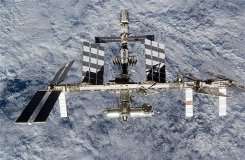
Discovery astronauts prepared for a third and final spacewalk Monday, with a busy to-do list that may include unsticking a jammed restraint pin used to clamp a toolbox to the outside of the International Space Station.
Astronauts Steve Swenson and Joseph Acaba inadvertently inserted the pin upside-down during a space walk Saturday, causing a jam that prevents the tool container from swinging away from the space station, NASA officials said.
"The engineers are trying to troubleshoot it," hoping to figure out a way to free the pin, NASA spokesman Bill Jeffs said on Sunday.
The astronauts "possibly are going back and looking at it tomorrow," he said, adding that engineers were still drawing up a schedule for Monday's space walk, the third and final one of the 13-day mission.
Astronauts Acaba and Richard Arnold were to spend the night in the space station's airlock in anticipation of Monday's walk in space, NASA said.
Ahead of that spacewalk, on Sunday Discovery began to maneuver the shuttle and space station to increase drag, a move designed to alter the vessels' trajectory and so avoid a piece of debris that is also floating in space.
"The debris is estimated to be about four inches in diameter, part of a spent Chinese satellite upper stage," NASA's website read.
NASA engineers were worried the debris would have passed close to Discovery around two hours into Monday's space walk.
Saturday's spacewalk followed the successful unfurling of huge solar wings on Friday that will allow the orbiting laboratory to power up to its full capacity for the first time.
The autonomous craft will supply the station's Kibo laboratory with water, food and scientific materials, and could also resupply the rest of the station if needed.
On Saturday, the astronauts prepared a worksite to facilitate battery replacement on the external Port 6 truss for a later shuttle mission in June.
They also photographed the radiator panels extending from the Port 1 and Starboard 1 trusses and reconfigured connectors on the Zenith 1 truss that powers the ISS's gyroscopes, NASA said.
Inside the ISS, a new system that purifies urine and wastewater for drinking and other purposes was put through a "dry spinning" test run Saturday. ISS commander Mike Fincke on Sunday replaced a filter assembly and put it through a proper urine test.
"We didn't accomplish everything that we wanted to accomplish ... but we just know that we did accomplish all of the critical path items that were scheduled for this EVA (Extra Vehicular Activity)," NASA's lead space station flight director Kwatsi Alibaruho told reporters at the Houston Space Center.
It was Swanson's fourth spacewalk, Acaba's first and the 122nd spacewalk in support of ISS assembly and maintenance, NASA said.
With Friday's addition, the ISS now has four solar panels, two per wing, containing 32,800 cells that convert sunlight into electricity.
They will boost the outpost's full power generation from 90 to 120 kilowatts, providing the power the space station needs to carry out scientific experiments aboard Kibo and the European Columbus laboratory.
The additions also allow the doubling the space station's crew from three to six, beginning in May.
Discovery's latest mission, which blasted off last Sunday from Florida with a crew of seven astronauts, is one of the last major efforts in a decade-long push by 16 countries to build the 100-billion-dollar outpost in space.
NASA has scheduled nine shuttle flights through 2010 to finish building the space station. Upcoming shuttle flights also include the last mission to service the orbiting Hubble telescope in May.
Discovery is due to land back on Earth on March 28 at 1742 GMT, two days after a Russian Soyuz mission takes off for the ISS carrying a crew of three, including US billionaire businessman Charles Simonyi, who has shelled out 35 million dollars for his second trip as a space tourist.
On Discovery, crew member Koichi Wakata became the first Japanese astronaut to join the ISS for a long stay. He is scheduled to remain on the orbiting station until June.
The Discovery mission, delayed five times, is the first by a US space shuttle in 2009.
(c) 2009 AFP


