American space tourist buys return ticket to orbit
March 23, 2009 By MARCIA DUNN , AP Aerospace Writer
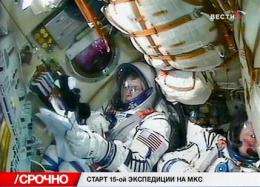
A Saturday, April 7, 2007 file photo taken from a broadcast on Russian RTR Russian Television Channel, Space tourist U.S. billionaire Charles Simonyi, left, is seen aboard the space craft before the launch of the Soyuz TMA-10 from the Baikonur cosmodrome in Kazakhstan. Simoni will become the world's first two-time space tourist when he leaves Earth behind Thursday, March 26, 2009 and heads back to the space station. (AP Photo/RTR-Russian Television Channe, Filel)
(AP) -- Recession or no, billionaire Charles Simonyi couldn't pass up another shot at space, even if it meant shelling out $35 million more.
Besides, it may one of the last times the Russian government allows tourists to hitch a ride to the international space station.
"It's now or never," said Simonyi, who has now spent $60 million for a couple of space vacations. The first was $25 million.
A computer genius who helped build Microsoft, Simonyi (sih-MOHN'-ee) will become the world's first two-time space tourist when he leaves Earth behind Thursday. He'll be accompanied by two professional astronauts - a Russian and American - who will be going up for a six-month stint at the space station.
His own trip will last under two weeks, and it will be his last.
"I'm not getting any younger," the 60-year-old told The Associated Press in a recent telephone interview. He'll be one of the older men to fly in space, though nowhere near John Glenn's record at age 77.
Besides, he's promised his new wife, Lisa Persdotter, a 28-year-old Swedish socialite, that this will be his final spaceflight. He told her about his plans when they got engaged and "she was very supportive, but, BUT to a limit, mainly. Just once," Simonyi said with a chuckle. He's quick to point out this is his first marriage, and he's taking one of their engagement rings with him into orbit.
The Hungarian-born Simonyi, who lives in suburban Seattle, is among six rich people who have bought tickets to space through Virginia-based Space Adventures.
NASA, the major stakeholder in the space station, may not love the idea of hosting tourists - "spaceflight participants" as it calls them. But the initial concerns back in 2001 have eased over the years with the addition of guidelines.
Space station program manager Mike Suffredini has spoken to Simonyi, just as he has with everyone going up, to make sure the visitor understands his limitations at the orbiting complex.
"It really has to do with their safety," as well as the safety of the others and the space station itself, Suffredini said. "They're extremely restricted" in what they can do on the American side.
All this may soon be moot: Russian space officials have indicated that after this year, there will be no more seats available to tourists. That's because the space station crew is about to double in size to six - hopefully by the end of May - and professional fliers will fill all the slots.
After he returned from his two-week space station trip in April 2007, Simonyi said Russian cosmonauts told him how different and rewarding it was to go back up a second time. With doors closing on future tourist flights, Simonyi did not want to miss out.
Because the training for his first flight was so recent, Simonyi got the abridged version, three months at cosmonaut headquarters in Star City, Russia, versus six to eight months before. He will return to Earth on April 7 in a Soyuz capsule.
"I look at it as a continuation of the first flight," Simonyi said. "The reasons are the same. It's to support space research, it's to popularize civilian space flight and communicate the excitement of sciences and engineering to our kids."
Simonyi's own interest in space was kindled in childhood. He represented Hungary as a junior cosmonaut, when he was 13, and won a trip to Moscow to meet one of the first Soviet spacemen. His interest in computer programming eventually led him to the United States; he's been a U.S. citizen for 27 years.
Simonyi - who has a doctorate in computer science and is a licensed pilot - led the development of Microsoft Word and Excel. He left Microsoft in 2002 and founded Intentional Software Corp. as well as the Charles Simonyi Fund for Arts and Sciences.
He's offered to do medical and radiation experiments while he's up there, and will use Windows on Earth software to photograph Earth. The view and the feeling of weightlessness are drawing him back as well.
"It's a super-wide screen, and the Earth is fantastic blue," he said.
His wife of four months will be at the launching site in Kazakhstan, along with about a dozen other family and friends. Microsoft Corp. co-founder Bill Gates, who was an usher at Simonyi's wedding, can't make it.
It's ironic, Simonyi said, that he left Hungary in 1966 as a teenager, frustrated by Soviet secrecy, and now Russia is allowing him to fulfill his dream - again.
"Who would have thought? The irony of this is amazing," he said.
---
On the Net:
Simonyi: http://www.charlesinspace.com/
Charles Simonyi Fund for Arts and Sciences: http://www.simonyifund.org/
NASA: http://www.nasa.gov/mission-pages/station/main/index.html
©2009 The Associated Press. All rights reserved. This material may not be published, broadcast, rewritten or redistributed.
-
US space tourist shrugs off 10 mln dollar price hike
Mar 05, 2009 |
not rated yet |
0
-
Russia raises space tourist tab to $21m
Nov 09, 2006 |
not rated yet |
0
-
Space Station Crew Landing Moved to Saturday
Apr 19, 2007 |
not rated yet |
0
-
New crew assumes space station duties
Apr 18, 2007 |
not rated yet |
0
-
ISS gets ready for new computer system
Mar 19, 2007 |
not rated yet |
0
-
Engineers build first sub-10-nm carbon nanotube transistor
Feb 01, 2012 |
4.9 / 5 (32) |
30
-
Something old, something new: Evolution and the structural divergence of duplicate genes
Jan 31, 2012 |
4.6 / 5 (7) |
1
-
The hidden nanoworld of ice crystals: Revealing the dynamic behavior of quasi-liquid layers
Jan 30, 2012 |
5 / 5 (4) |
1
-
Stock market network reveals investor clustering
Jan 27, 2012 |
3.9 / 5 (23) |
8
-
Of microchemistry and molecules: Electronic microfluidic device synthesizes biocompatible probes
Jan 26, 2012 |
5 / 5 (2) |
0
-
Never ending outer space.....
16 hours ago
-
Neutron Star fragments?
18 hours ago
-
stationary or not?
22 hours ago
-
Scale of the Universe
Feb 10, 2012
-
Titan's lack of impact craters
Feb 09, 2012
-
Real pictures of black hole eating a star?
Feb 08, 2012
- More from Physics Forums - General Astronomy
More news stories
Salvage workers begin pumping fuel from Italian shipwreck
Salvage workers Sunday began pumping fuel from the shipwrecked Italian cruise liner Costa Concordia, a day ahead of schedule, officials said.
1 hour ago |
not rated yet |
0
Latin America mining boom clashes with conservation
Latin America is experiencing a mining boom as prices rise fuelled by a hike in global demand, but the region is also being hit by a wave of violent protests, strikes and rallies by environmentalists.
9 hours ago |
5 / 5 (1) |
1
Political leaders play key role in how worried Americans are by climate change: study
More than extreme weather events and the work of scientists, it is national political leaders who influence how much Americans worry about the threat of climate change, new research finds.
Feb 06, 2012 |
5 / 5 (6) |
73
NASA budget will axe Mars deal with Europe: scientists
US President Barack Obama's budget proposal to be submitted next week for 2013 will cut NASA's budget by 20 percent and eliminate a major partnership with Europe on Mars exploration, scientists said Thursday.
Space & Earth / Space Exploration
Feb 10, 2012 |
5 / 5 (3) |
55
Humans may have helped the decline of African rainforests 3000 years ago
(PhysOrg.com) -- Large areas of rainforests in Central Africa mysteriously disappeared over three thousand years ago, to be replaced by savannas. The prevailing theory has been that the cause was a change ...
Lab study raises questions over nano-particle impact
Tests involving chickens have raised questions about the impact on health from engineered nano-particles, the ultra-fine grains commonly used in drugs and processed foods, scientists said on Sunday.
Iran blocks email, restricts net access: reports
Iran has further restricted access to the Internet and blocked popular email services for the past few days, in a move a top lawmaker said could "cost the regime dearly," media reports said on Sunday.
Scientists discover molecular secrets of 2,000-year-old Chinese herbal remedy
For roughly two thousand years, Chinese herbalists have treated Malaria using a root extract, commonly known as Chang Shan, from a type of hydrangea that grows in Tibet and Nepal. More recent studies suggest that halofuginone, ...
New method to examine batteries -- MRI from the inside
There is an ever-increasing need for advanced batteries for portable electronics, such as phones, cameras, and music players, but also to power electric vehicles and to facilitate the distribution and storage of energy derived ...
A mitosis mystery solved: How chromosomes align perfectly in a dividing cell
Although the process of mitotic cell division has been studied intensely for more than 50 years, Whitehead Institute researchers have only now solved the mystery of how cells correctly align their chromosomes during symmetric ...
Starve a virus, feed a cure? Findings show how some cells protect themselves against HIV
A protein that protects some of our immune cells from the most common and virulent form of HIV works by starving the virus of the molecular building blocks that it needs to replicate, according to research published online ...