Lethal air pollution booms in emerging nations
March 23, 2009 The WHO estimates that two million people die every year as a result of air pollution

Enlarge

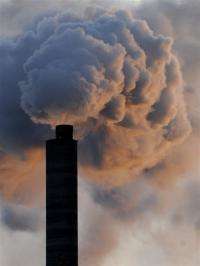
Heavy smoke billows from a factory in Pietarsaari, Finland. International experts are warning that potentially lethal air pollution has boomed in fast-growing big cities in Asia and South America in recent decades.

International experts are warning that potentially lethal air pollution has boomed in fast-growing big cities in Asia and South America in recent decades.

While Europe has managed to drastically cut some, but not all, of the most noxious pollutants over the past 20 years, experienced the opposite trend with their fast economic growth, scientists at the UN's meteorological agency said.

Their comments came ahead of World Meteorological Day on Monday, which this year has the theme "The Air We Breathe".

The World Health Organization estimates that about two million people die prematurely every year as a result of , while many more suffer from breathing ailments, heart disease, lung infections and even cancer.

Fine particles or from coal or wood fires and unfiltered diesel engines are rated as one of the most lethal forms or air pollution caused by industry, transport, household heating, cooking and ageing coal or oil-fired power stations.

In 2005, the WHO estimated that deaths rates in cities with higher were 15 to 20 percent above those found in cleaner cities.

"Particulate matter is of great concern in cities," said Liisa Jalkanen, research chief at the World Meteorological Organisation.

"In Asia many cities such as Karachi, New Delhi, Kathmandu, Dacca, Shanghai, Beijing, and Mumbai they exceed all the limits."

"Also several cities in South America such as Lima, Santiago, Bogota. The worst city in Africa is Cairo," she told journalists.

Half of the world?s population now live in urban areas, and the proportion is expected to grow to two-thirds by 2030, according to the United Nations.

The WMO says more resources are needed for a global air monitoring network it runs with national offices.

Len Barrie, director of WMO research, said restrictions set up in Europe after concern about emerged in the 1980s have cut concentrations of another pollutant, sulphur dioxide, there "by a factor of 20".

"In other areas where economic growth has leapt forward, such as Asia, China, India, the opposite is true," he added. In North America levels were largely kept in check.

But Barrie told AFP that such pollution in China appeared to be reaching its peak.

"There?s a real awakening in China on the economic benefits of reducing air pollution," he added.

Attempts are being made to bring developing and emerging nations, as well as the United States, into a new global warming pact in Copenhagen in December.

While such curbs on carbon emissions can have a substantial impact on overall air pollution, they may not tackle it completely.

Levels of another harmful pollutant, nitrogen dioxide, from vehicle traffic have not decreased in Europe by as much as the WMO expected, while the impact of weather patterns on pollution is also a concern.

(c) 2009 AFP


print this article email this article download pdf blog this article bookmark this article     Stumble it Digg this share on Facebook retweet share on Reddit add to delicious
Rate this story - 4 /5 (7 votes)

Rank Filter

Move the slider to adjust rank threshold, so that you can hide some of the comments.


Display comments: newest first

  • DozerIAm - Mar 23, 2009
    • Rank: not rated yet
    Doesn't make much sense for developed countries to spend trillions of dollars on preventing that last little bit of pollution from leaving our smokestacks and tailpipes while the rest of the world belches out the worst pollutions imaginable on a scale that absolutely dwarfs ours.

    And while yes I acknowledge that every little bit helps, in a global economy an expense applied to only some of the players is a crippling handicap.

    I would think the sensible thing would be to acknowledge the 80/20 rule, accept that we are already past the 80% mark, and focus on helping the developing countries build clean energy sources rather than dirty ones. The net result globally will be less pollution.


  • wawadave - Mar 23, 2009
    • Rank: 1 / 5 (1)
    The earth as we know it is doing the funcky chicken.
    Even if we stopped all pollution right now we have passed we have passed the point of no return.
  • GrayMouser - Mar 24, 2009
    • Rank: not rated yet
    Who will sell them carbon credits?

March 23, 2009 all stories

Comments: 3

4 /5 (7 votes)
  • Stumble this up

  • Digg this

  • share this

  • hide
  • Related Stories

  • Bad air pervades in half of Chinese cities
    created Oct 24, 2006 | popularity not rated yet | comments 0
  • Study says Chinese air quality standards not yet met
    created May 13, 2008 | popularity not rated yet | comments 0
  • Longer life linked with air pollution cuts
    created Mar 16, 2006 | popularity not rated yet | comments 0
  • Mexico City air pollution is studied
    created Mar 03, 2006 | popularity not rated yet | comments 0
  • Study: Cleaner air adds 5 months to US life span
    created Jan 21, 2009 | popularity not rated yet | comments 0


  • hide
  • Relevant PhysicsForums posts

  • cycles
    created 17 hours ago
  • The Origin of the term 'fossil' fuels
    created Nov 05, 2009
  • co2
    created Nov 03, 2009
  • Early Earths Sulfidic Ocean Conditions
    created Oct 30, 2009
  • More from Physics Forums - Earth

Other News

Deep creep means milder, more frequent earthquakes along Southern California's San Jacinto fault

Deep creep means milder, more frequent earthquakes along Southern California's San Jacinto fault

Space & Earth / Earth Sciences

created 16 hours ago | popularity 4.5 / 5 (4) | comments 0

With an average of four mini-earthquakes per day, Southern California's San Jacinto fault constantly adjusts to make it a less likely candidate for a major earthquake than its quiet neighbor to the east, the ...


Success in 'space elevator' competition (AP)

Success in 'space elevator' competition (Update 3)

Space & Earth / Space Exploration

created Nov 05, 2009 | popularity 4.3 / 5 (33) | comments 50

(AP) -- A robot powered by a ground-based laser beam climbed a long cable dangling from a helicopter on Wednesday to qualify for prize money in a $2 million competition to test the potential reality of the ...


In a Galaxy Far, Far Away...

In a Galaxy Far, Far Away...

Space & Earth / Astronomy

created Nov 06, 2009 | popularity 4.8 / 5 (5) | comments 17

(PhysOrg.com) -- Astronomers have published the discovery of the farthest known object in the cosmos: a star that exploded when the universe was only 630 million years old -- only 4.6% of its current age. ...


'Dropouts' pinpoint earliest galaxies

'Dropouts' pinpoint earliest galaxies

Space & Earth / Astronomy

created Nov 06, 2009 | popularity 4.2 / 5 (10) | comments 13

Astronomers, conducting the broadest survey to date of galaxies from about 800 million years after the Big Bang, have found 22 early galaxies and confirmed the age of one by its characteristic hydrogen signature ...


Space hotel taking bookings for 2012 opening

Space hotel taking bookings for 2012 opening

Space & Earth / Space Exploration

created Nov 05, 2009 | popularity 4.4 / 5 (21) | comments 11

(PhysOrg.com) -- The first orbiting space hotel is on track to open for its first customers in 2012, but hurry, as bookings are filling fast.