What is 'Real'? How Our Brain Differentiates Between Reality and Fantasy
March 23, 2009 By Lisa Zyga
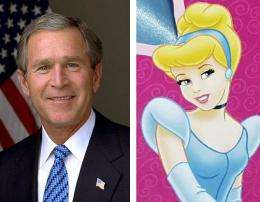
What criteria does the brain use for distinguishing between real people such as George W. Bush and fictional characters such as Cinderella? Recent research suggests that personal relevance may be a key factor, although there are exceptions.
(PhysOrg.com) -- Most people can easily tell the difference between reality and fantasy. We know that characters in novels and movies are fictitious, and we also understand that historical figures - even if we’ve never met them personally - were real people. As obvious as this distinction may seem, however, scientists know very little about the specific brain mechanisms that are responsible for our ability to distinguish between real and fictional events.
Recently, research has identified two areas of the brain that are more strongly activated when people see real characters than when they see fictional characters. These brain regions - in the anterior medial prefrontal and posterior cingulated cortices (amPFC and PCC) - are known to be involved during autobiographical memory retrieval and self-referential thinking. Based on this finding, scientists have hypothesized that our brains may distinguish between reality and fantasy because real things tend to have a higher degree of personal relevance than fictional things do.
A new study tests this hypothesis that personal relevance is the critical factor in differentiating between reality and fantasy by using functional magnetic resonance imaging (fMRI) to compare the brain’s response when processing real and fictional characters. Anna Abraham of the Max Planck Institute for Human Brain and Cognitive Sciences in Leipzig, Germany, and the University of Giessen in Giessen, Germany, and D. Yves von Cramon of the Max Planck Institute for Human Brain and Cognitive Sciences and the Max Planck Institute for Neurological Research in Cologne, Germany, have published their results in a recent issue of PLoS ONE.
“Perhaps the greatest significance of the study is that it has enabled us to get a step closer to understanding what ‘realness’ captures,” Abraham told PhysOrg.com. “The categorical distinction between reality and fiction that we employ in daily life appears to be too simplistic and non-representative of our phenomenological experience. The term ‘real’ in itself does not have much explanatory power, as it means only that something objectively exists.”
The researchers’ experiments helped them investigate what “realness” is, as the brain defines it. Two weeks prior to the experiments, 19 volunteers were asked to submit names of their close friends and family, and also read through a list of famous people and fictional characters to confirm that they were familiar with them. During the experiments, the participants viewed names of individuals who were either friends/family (high personal relevance), famous people (medium personal relevance) or fictional characters (low personal relevance). The participants also answered questions, such as whether it was possible for someone to talk with one of the people/characters (interactions between real people and fictional characters were considered impossible).
As the researchers had predicted, the results showed that when participants answered questions about their friends and family (high personal relevance), stronger activation occurred in the amPFC and PCC regions, as compared with questions about famous people (medium activation) and fictional characters (low activation). As the scientists explained, our conceptual knowledge of real people is more extensive than our knowledge of famous people, and much more extensive than our knowledge of fictional characters. But this finding also raises further questions.
“I experience my mother and George Bush as being ‘more real’ than Cinderella, but why do I experience George Bush as being ‘less real’ than my mother?” Abraham said. “After all, both people objectively exist. Is it because I’ve never interacted with him? Is it because I know less about him? Would he have been more relevant for me if he waged war on my home country? These are all open questions that can only be answered when we define what constitutes ‘realness.’ And we have shown in this study that one factor that affects how real I perceive someone to be is modulated by how personally relevant the person is for me.”
The researchers further explained that personal relevance is not unequivocally related to what is real, since some individuals may experience personal relevance in certain fictional realms, such as in chronic computer gaming or religion. For instance, for a chronic gamer, a World of Warcraft character could yield greater activation in the amPFC and PCC than a real person of low personal relevance would. Abraham added that, although the current research doesn’t provide insight on a connection between fictional violence and real violence, future related research may help understand if a connection exists.
“A great deal more work needs to be done before we attempt to assess such complex connections,” she said. “For a start, one needs to define what exactly is meant by fictional violence - is it limited to violence experienced while playing computer games or does it extend to watching violent movies and/or even to one's own fantasies about carrying out violent acts? Of utmost importance when exploring such ideas is to aim for specificity (avoiding undue generalizations).”
In addition to helping understand how the brain differentiates between reality and fantasy, this study could help researchers understand the brain’s default network, to which the amPFC and PCC belong. The default network is a group of brain regions that are generally more engaged during passive periods, such as when at rest or when performing undemanding tasks. During these periods, the brain tends to multitask, such as by reflecting on past events, planning future events, or thinking self-consciously.
This study shows that brain regions (the amPFC and PCC) in the default network are automatically engaged when an individual views a person’s name - even when the individual is not thinking specifically about their own personal relevance to the person. In other words, personal relevance is not relevant to this task, but it may be explained by the anticipatory nature of the brain. The default network may play a role in automatically evoking various associations with a stimulus in order to quickly react, if needed. This finding may help researchers further understand how the brain’s default network works.
“Our immediate plans are to verify our findings by exploring the modulation of personal relevance within fictional and real domains,” said Abraham. “An example of a within-fictional domain investigation, as stated in the paper, would be studying chronic gamers versus beginner gamers on group-relevant versus group-irrelevant information. An example of a within-reality domain investigation would be studying groups with different vocations/interests - for instance, political journalists would be expected to find information concerning politicians far more relevant than that of celebrities, whereas the situation would be expected to be vice versa for paparazzi journalists. There are several avenues to be explored. Once the findings have been verified across a variety of situations, we will be in a better position to dig deeper to uncover how our brains encode and store such categorical information in the first place, how malleable the reality-fiction distinction is, and so on.”
More information: Anna Abraham and D. Yves von Cramon. “Reality = Relevance? Insights from Spontaneous Modulations of the Brain’s Default Network when Telling Apart Reality from Fiction.” PLoS ONE, March 2009, Volume 4, Issue 3, e4741.
• Join PhysOrg.com on Facebook!
• Follow PhysOrg.com on Twitter!
Copyright 2009 PhysOrg.com.
All rights reserved. This material may not be published, broadcast, rewritten or redistributed in whole or part without the express written permission of PhysOrg.com.
-
Young children learn to tell fact from fiction
Dec 04, 2006 |
not rated yet |
0
-
Scientists identify the neural circuitry of first impressions
Mar 08, 2009 |
not rated yet |
0
-
This is your brain on violent media
Dec 06, 2007 |
not rated yet |
0
-
Tots separate fact, fiction early
Nov 17, 2006 |
not rated yet |
0
-
Altered brain activity in schizophrenia may cause exaggerated focus on self
Jan 20, 2009 |
not rated yet |
0
-
Engineers build first sub-10-nm carbon nanotube transistor
Feb 01, 2012 |
4.9 / 5 (30) |
30
-
Something old, something new: Evolution and the structural divergence of duplicate genes
Jan 31, 2012 |
4.6 / 5 (7) |
1
-
The hidden nanoworld of ice crystals: Revealing the dynamic behavior of quasi-liquid layers
Jan 30, 2012 |
5 / 5 (3) |
1
-
Stock market network reveals investor clustering
Jan 27, 2012 |
3.9 / 5 (23) |
8
-
Of microchemistry and molecules: Electronic microfluidic device synthesizes biocompatible probes
Jan 26, 2012 |
5 / 5 (1) |
0
-
Is Everyday Technology Killing Us?
Feb 08, 2012
-
Exercise and weight loss
Feb 08, 2012
-
Why do we have head aches? Our brains can't feel anything.
Feb 07, 2012
-
"The end of diseases" by David Agus, interview from Daily Show with Jon Stewart
Feb 04, 2012
-
Oncolytic adenovirus
Feb 04, 2012
-
Nutrition label stuffs and diets
Feb 02, 2012
- More from Physics Forums - Medical Sciences
More news stories
FDA-approved drug rapidly clears amyloid from the brain, reverses Alzheimer's symptoms in mice
Neuroscientists at Case Western Reserve University School of Medicine have made a dramatic breakthrough in their efforts to find a cure for Alzheimer's disease. The researchers' findings, published in the journal Science, show t ...
Medicine & Health / Neuroscience
9 hours ago |
4.9 / 5 (31) |
11
|
Anyone can learn to be more inventive, cognitive researcher says
There will always be a wild and unpredictable quality to creativity and invention, says Anthony McCaffrey, a cognitive psychology researcher at the University of Massachusetts Amherst, because an "Aha moment" is rare and ...
Medicine & Health / Psychology & Psychiatry
5 hours ago |
4.7 / 5 (3) |
0
|
Cell biologists describes mechanism by which some people may be more susceptible to colon cancer
An international research team led by cell biologists at the University of California, Riverside has uncovered a new insight into colon cancer, the third leading cause of cancer-related deaths in the United ...
6 hours ago |
5 / 5 (1) |
0
|
Researchers weigh in on ethics of H5N1 research
(Medical Xpress) -- In a commentary on the biosecurity controversy surrounding publication of bird flu research details, a bioethicist and a vaccine expert at Johns Hopkins reaffirm that "all scientists have an affirmativ ...
8 hours ago |
not rated yet |
0
|
To perform with less effort, practice beyond perfection
Whether you are an athlete, a musician or a stroke patient learning to walk again, practice can make perfect, but more practice may make you more efficient, according to a surprising new University of Colorado Boulder study.
Medicine & Health / Neuroscience
8 hours ago |
4.4 / 5 (7) |
3
|
'Dark plasmons' transmit energy
Microscopic channels of gold nanoparticles have the ability to transmit electromagnetic energy that starts as light and propagates via "dark plasmons," according to researchers at Rice University.
Hydrogen from acidic water: Researchers develop potential low cost alternative to platinum for splitting water
A technique for creating a new molecule that structurally and chemically replicates the active part of the widely used industrial catalyst molybdenite has been developed by researchers with the Lawrence Berkeley ...
Ultraviolet protection molecule in plants yields its secrets
Lying around in the sun all day is hazardous not just for humans but also for plants, which have no means of escape. Ultraviolet (UV) radiation from the sun can damage proteins and DNA inside cells, leading ...
Flexible paper robots
(PhysOrg.com) -- These inexpensive robots can stretch, bend and twist under control, and lift objects up to 120 times their own weight. Being soft, they can apply gentle and even pressure, and adapt to varied ...
New method makes culture of complex tissue possible in any lab
Scientists at the University of California, San Diego have developed a new method for making scaffolds for culturing tissue in three-dimensional arrangements that mimic those in the body. This advance, published online in ...
Deadly bird parasite evolves at exceptionally fast rate
A new study of a devastating bird disease that spread from poultry to house finches in the mid-1990s reveals that the bacteria responsible for the disease evolves at an exceptionally fast rate. What's more, ...
Mar 23, 2009
Rank: 5 / 5 (3)
Mar 23, 2009
Rank: 5 / 5 (2)
Mar 23, 2009
Rank: 5 / 5 (2)
Mar 23, 2009
Rank: 5 / 5 (2)
Mar 23, 2009
Rank: 3.3 / 5 (3)
Mar 23, 2009
Rank: 5 / 5 (2)
Mar 23, 2009
Rank: 5 / 5 (2)
The researchers claim not to know how "malleable the reality-fiction distinction is" assuming human brains or other senses are somehow capable of sensing this distinction. It appears to be a very poorly constructed formulation of a research premise.
Mar 23, 2009
Rank: 4 / 5 (1)
Mar 23, 2009
Rank: 4 / 5 (1)
Mar 24, 2009
Rank: 3 / 5 (6)
Mar 24, 2009
Rank: 4 / 5 (4)
Bad behavior isn't limited (or even biased) to one side of the political spectrum.
Mar 24, 2009
Rank: 4.3 / 5 (3)
For example, every person would rate differently the president, the boss, the spouse, the children, a historical figure, a teen idol. Hell, I developed a bond with certain special functions I'm working with. It's all about the level of importance and involvement you have with someone/something. It might be completely fictional, but if it's very important for you, then, it is real!
Mar 24, 2009
Rank: 4.5 / 5 (2)
Talk about getting off on math.
Sorry man, too easy to let get by.
Mar 25, 2009
Rank: 5 / 5 (6)
Mar 25, 2009
Rank: 5 / 5 (1)
Well, if it helps, I'm a woman :)
Mar 25, 2009
Rank: 5 / 5 (2)
Mar 25, 2009
Rank: 5 / 5 (1)
Perception does not make reality...
Mar 27, 2009
Rank: 2.5 / 5 (2)
Mar 30, 2009
Rank: 4.5 / 5 (2)
30 years ago I had a most profound conversion experience which rocked my world and gave me the intuitive assurance that I was experiencing myself and the world at a deeper and more authentic level. I chose to believe that I was thereby a Christian and strove to learn all I could of the Bible and things Holy and Spiritual. Compared to where I was at before then this was an improvement and allowed me to gain a solid personal psychological foundation.
It was only after deciding to try and explain my Christian life in terms that would be understandable to people really interested in science that I began to look at what researchers and clinicians over the last 150 years have been discovering about the workings of brain, mind, consciousness, emotion, and behaviour. Simply put, a lot has been discovered and far more is being investigated, "as we speak". Now I am not a Christian, but I am sympathetic toward those who choose to "believe", up to a point anyway.
Modern mystic says:
Maybe so, but perception is what we MAKE OF reality, and we know nothing else. The incredible paradox is that we only experience what our brains can construct ABOUT the world. Yes the great and potentially infinite IT is really there. But we don't know it unless our brains are modelling it.
So the $100K question is: what controls the apparent 'solidity', the "knowledge" that something/someone is "real", as opposed to just a story? Well it helps to understand that there must be areas in the brain which mediate this kind of belief. I don't think that psycho-babble helps, but these guys are making a start. The question is really important.
Mar 30, 2009
Rank: not rated yet
These concepts lend additional weight to the notion of six degrees of separation as social hierarchy develops or evolves. I trust it is as natural for the collective conscience to engage indirect coincidence as it is to legislate.
Mar 30, 2009
Rank: 5 / 5 (1)
The best you can say is there are emergent patterns out of aggregate individual decisions/actions. It's important to make this distinction.
Does society influence individual consciousness? Certainly, but again this is not reflective of what many people might envision when hearing/using a term like "collective consciousness/conscience".
An interesting side note here is that while reality always reinforces our conscious minds towards the truth, society may push us into a more realistic world view, or completely off the pier into a sea of insanity. This is why one must always be careful of, and call into question precepts of any society one finds oneself in. It is also why societies which allow and encourage such are vastly more successful than ones who don't...there's a semi self correction mechanism in place if allowed to function.
Mar 30, 2009
Rank: not rated yet
You're rather religious but don't give any creedence to collective consciousness.
We should talk more.
Apr 01, 2009
Rank: not rated yet
Apr 11, 2009
Rank: not rated yet