After the collapse: Scientists observe the largest exploding star yet seen
March 23, 2009 After the collapse: Scientists observe the largest exploding star yet seen

Enlarge

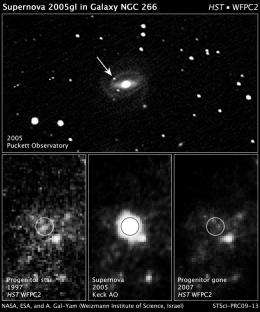
Archival photographs from NASA's Hubble Space Telescope have been used to uncover the progenitor star to a supernova that exploded in 2005. To the surprise of astronomers, the progenitor is a rare class of ultra-bright star that, according to theory, shouldn't explode so early in its evolution. [Top Center] This is a 2005 ground-based photograph of the supernova as seen in host galaxy NGC 266, located in the constellation Pisces. Credit: Puckett Observatory [Bottom Left] This is a 1997 Hubble archival visible-light image of the region of the galaxy where the supernova exploded. The white circle marks a star that Hubble measured to have an absolute magnitude of -10.3. This corresponds to the brightness of 1 million suns (at the galaxy's distance of 215 million light-years). Credit: NASA, ESA, and A. Gal-Yam (Weizmann Institute of Science, Israel) [Bottom Center] This is a near-infrared-light photo of the supernova explosion taken on Nov. 11, 2005, with the Keck telescope, using adaptive optics. The blast is centered on the position of the progenitor. Credit: NASA, ESA, and A. Gal-Yam (Weizmann Institute of Science, Israel), D. Leonard (San Diego State University), and D. Fox (Penn State University) [Bottom Right] This is a visible-light Hubble follow-up image taken on September 26, 2007. Note that a bright source near the site of the supernova can be seen in all three panels, but the progenitor star is gone. The Hubble pictures from both epochs were taken with the Wide Field Planetary Camera 2. Credit: NASA, ESA, and A. Gal-Yam (Weizmann Institute of Science, Israel)

Scientists from the Weizmann Institute of Science and San Diego State University managed to observe a super-sized supernova explosion from start to finish, including the black hole ending.

In the first observation if its kind, scientists at the Weizmann Institute of Science and San Diego State University were able to watch what happens when a star the size of 50 suns explodes. As they continued to track the spectacular event, they found that most of the star's mass collapsed in on itself, resulting in a large black hole.

While exploding - supernovae - have been viewed with everything from the naked eye to high-tech research satellites, no one had directly observed what happens when a really huge star blows up. Dr. Avishay Gal-Yam of the Weizmann Institute's Faculty of Physics and Prof. Douglas Leonard of San Diego State University recently located and calculated the mass of a gigantic star on the verge of exploding, following through with observations of the blast and its aftermath. Their findings have lent support to the reigning theory that stars ranging from tens to hundreds of times the mass of our sun all end up as .

A star's end is predetermined from birth by its size and by the 'power plant' that keeps it shining during its lifetime. Stars, among them our sun, are fueled by hydrogen nuclei fusing together into helium in the intense heat and pressure of their inner cores. A helium nucleus is a bit lighter than the sum of the masses of the four hydrogen nuclei that went into making it and, from Einstein's (E=MC2), we know that the missing mass is released as energy.

When stars like our sun finish off their hydrogen fuel, they burn out relatively quietly in a puff of expansion. But a star that's eight or more times larger than the sun makes a much more dramatic exit. Nuclear fusion continues after the hydrogen is exhausted, producing heavier elements in the star's different layers. When this process progresses to the point that the core of the star has turned to iron, another phenomenon takes over: In the enormous heat and pressure in the star's center, the iron nuclei break apart into their component protons and neutrons. At some point, this causes the core and the layer above it to collapse inward, firing the rest of the star's material rapidly out into space in a supernova flash.

A supernova releases more energy in a few days than our sun will release over its entire lifetime, and the explosion is so bright that one occurring hundreds of light years away can be seen from Earth even in the daytime. While a supernova's outer layers are lighting up the universe with dazzling fireworks, the star's core collapses further and further inward. The gravity created in this collapse becomes so strong that the protons and electrons are squeezed together to form neutrons, and the star's core is reduced from a sphere 10,000 kilometers around to one with a circumference of a mere 10 kilometers. Just a crate-full of this star's material weighs as much as our entire Earth. But when the exploding star is 20 times the mass of our sun or more, say the scientists, its gravitational pull becomes so powerful that even light waves are held in place. Such a star - a black hole - is invisible for all intents and purposes.

Until now, none of the supernovae stars that scientists had managed to measure had exceeded a mass of 20 suns. Gal-Yam and Leonard were looking at a specific region in space using the Keck Telescope on Mauna Kea in Hawaii and the Hubble Space Telescope. Identifying the about-to-explode star, they calculated its mass to be equal to 50-100 suns. Continued observation revealed that only a small part of the star's mass was flung off in the explosion. Most of the material, says Gal-Yam, was drawn into the collapsing core as its gravitational pull mounted. Indeed, in subsequent telescope images of that section of the sky, the star seems to have disappeared. In other words, the star has now become a black hole - so dense that light can't escape.

Source: Weizmann Institute of Science (news : web)


print this article email this article download pdf blog this article bookmark this article     Stumble it Digg this share on Facebook retweet share on Reddit add to delicious
Rate this story - 4.4 /5 (22 votes)

Rank Filter

Move the slider to adjust rank threshold, so that you can hide some of the comments.


Display comments: newest first

  • magpies - Mar 23, 2009
    • Rank: 2.3 / 5 (3)
    Wouldnt it take along time for us to view a stars complete explosion? Or did they just happen to get this star they picked in exactly the right possition?
  • physpuppy - Mar 23, 2009
    • Rank: 3.5 / 5 (4)
    The collapse is very fast. They just happened to be looking in the right place at the right time.


    http://chandra.ha...-33.html

  • yyz - Mar 23, 2009
    • Rank: 5 / 5 (4)
    a version of the paper is available at: http://hubblesite.../pdf.pdf .It seems this was a Type IIn supernova and that most of its' ejecta was swallowed by the putative Black Hole.IF this was indeed the result of a LBV gone supernova, theorists need to head back to the books. It seems that SN 1987A and Eta Carina were (or are) LBVs, like P Cygni. Maybe we haven't figured out the complete pathways that massive stars take to their supernova stage, but this supernova may be telling us something important about supernovas in general.
  • yyz - Mar 24, 2009
    • Rank: 4 / 5 (1)
    An important possibility was provided by a poster at the Universe Today site (3-22-09)regarding the possibility of a Pair-instability supernova.This SN (2005gl) looks to be massive enough for this to be a real possibility (see my link above for SN 2005gl for a look at the light curve & progenitor mass estimate) A good primer on Pair-instability Supernova (with reference to the candidate 2006gy) can be found here: http://en.wikiped...upernova
  • earls - Mar 25, 2009
    • Rank: 5 / 5 (1)
    SWING... And a miss.

    "Pair instability supernovae can only happen in stars with a mass range from around 130 to 250 solar masses"

    "blows the star completely apart without leaving a black hole remnant behind"

    "The doomed star, estimated at about 100 times our sun's mass" and from the article, paper, and your comment you know a "black hole" was formed.

    This article:

    http://www.space....oon.html

    or even the one on Universe Today:

    http://www.univer...re-27627

    are a much better description of this bizarre supernova.

    Some have proposed that a binary system collided... You'd think if two stars were merging or colliding, there would be "warning flashes" of radiation as the orbit decayed. Instead, this seems to be a "random" explosion.

    I'm also confused by something a commenter pointed out: "the doomed star, about 100 times our sun's mass [...] only a small part of the star's mass was flung off in the explosion. Most of the material, says Gal-Yam, was drawn into the collapsing core that has probably become a black hole estimated to be at least 10 to 15 solar masses."

    ...what? Does this mean that the "black hole" is 10-15 solar masses with a 85-90 solar mass accretion disk surrounding it?
  • yyz - Mar 25, 2009
    • Rank: not rated yet
    I think the 'take away' part of this story is: Are Luminous Blue Variables (LBVs) immediate precursors of some types of supernovae? Could their known violent eruptive episodes actually lead to a detonation? Must concur with earls, not massive enough to consider Pair-instability mechanism, but who knows what (or if) a remnant of any kind is present?

March 23, 2009 all stories

Comments: 6

4.4 /5 (22 votes)
  • Stumble this up

  • Digg this

  • share this

  • hide
  • Related Stories

  • Brightest supernova in a decade captured by Hubble
    created Sep 03, 2004 | popularity not rated yet | comments 0
  • Heaviest stellar black hole discovered in nearby galaxy
    created Oct 17, 2007 | popularity not rated yet | comments 0
  • Chandra sees brightest supernova ever
    created May 07, 2007 | popularity not rated yet | comments 0
  • Scientist says neutron stars, not black holes, at center of galaxies
    created Dec 01, 2005 | popularity not rated yet | comments 0
  • The Oddball Hosts of Gamma-ray Bursts
    created Oct 22, 2008 | popularity not rated yet | comments 0


  • hide
  • Relevant PhysicsForums posts

  • The shape of our solar system's orbits.
    created 9 hours ago
  • Above or Below the Line of Nodes
    created 13 hours ago
  • Supernova vs. Nova?
    created 20 hours ago
  • Supernova's Gamma Rays and Comets
    created Nov 06, 2009
  • Our Moon
    created Nov 06, 2009
  • Question about a Carl Zeiss lens
    created Nov 05, 2009
  • More from Physics Forums - General Astronomy

Other News

Seattle team wins $900,000 in Space Elevator Games (AP)

Seattle team wins $900,000 in Space Elevator Games

Space & Earth / Space Exploration

created 22 hours ago | popularity 5 / 5 (8) | comments 4

(AP) -- A Seattle team has collected a $900,000 prize in a NASA-backed competition to develop the concept of an elevator to space - an idea spurred by science fiction novels.


Russian rocket to launch from French Guiana in 2010

Space & Earth / Space Exploration

created 22 hours ago | popularity 5 / 5 (3) | comments 0

A Russian rocket will next year for the first time blast off from a European launch pad in South America, officials said Saturday, as the first rockets headed for the site on board a ship.


Success in 'space elevator' competition (AP)

Success in 'space elevator' competition (Update 3)

Space & Earth / Space Exploration

created Nov 05, 2009 | popularity 4.3 / 5 (33) | comments 50

(AP) -- A robot powered by a ground-based laser beam climbed a long cable dangling from a helicopter on Wednesday to qualify for prize money in a $2 million competition to test the potential reality of the ...


Space hotel taking bookings for 2012 opening

Space hotel taking bookings for 2012 opening

Space & Earth / Space Exploration

created Nov 05, 2009 | popularity 4.3 / 5 (19) | comments 11

(PhysOrg.com) -- The first orbiting space hotel is on track to open for its first customers in 2012, but hurry, as bookings are filling fast.


'Dropouts' pinpoint earliest galaxies

'Dropouts' pinpoint earliest galaxies

Space & Earth / Astronomy

created Nov 06, 2009 | popularity 4.1 / 5 (9) | comments 11

Astronomers, conducting the broadest survey to date of galaxies from about 800 million years after the Big Bang, have found 22 early galaxies and confirmed the age of one by its characteristic hydrogen signature ...