Brain wave patterns can predict blunders, new study finds
March 23, 2009 Brain wave patterns can predict blunders, new study finds

Enlarge

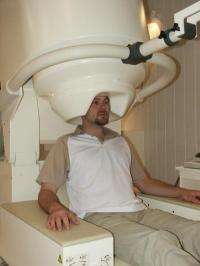
Neuroscientist Ole Jensen models the Donders Institute's MEG machine. With the help of the machine, Jensen, Ali Mazaheri (now at UC Davis) and colleagues found that a distinct alpha-wave pattern occurred in the brains of people taking an attention-demanding test. Credit: Donders Institute

From spilling a cup of coffee to failing to notice a stop sign, everyone makes an occasional error due to lack of attention. Now a team led by a researcher at the University of California, Davis, in collaboration with the Donders Institute in the Netherlands, has found a distinct electric signature in the brain which predicts that such an error is about to be made.

The discovery could prove useful in a variety of applications, from developing monitoring devices that alert air traffic control operators that their attention is flagging, to devising new strategies to help children cope with (). The work will be posted online on March 23 by the journal Human Brain Mapping as part of a special issue highlighting innovations in electromagnetic brain imaging that will be published in May.

How the brain responds to mistakes has been the subject of numerous studies, said Ali Mazaheri, a research fellow at the UC Davis Center for Mind and Brain. "But what I was looking for was the state the brain is in before a mistake is made," he said, "because that's what can tell us what produces the error."

Working with colleagues at the Donders Institute for Brain, Cognition and Behavior at Radboud University, where he was a Ph.D student at the time, Mazaheri recruited 14 students into his study. While they took an attention-demanding test, Mazaheri recorded their brain activity using MEG — magnetoencephalography — a non-invasive brain-wave recording technique similar to, but more sensitive than (EEG), the technique commonly used in hospitals to detect seizures.

The test, known as the "sustained attention response task," was developed in the 1990s to evaluate brain damage, ADHD and other neurological disorders. As participants sit at a computer for an hour, a random number from 1 to 9 flashes onto the screen every two seconds. The object is to tap a button as soon as any number except 5 appears.

The test is so monotonous, Mazaheri said, that even when a 5 showed up, his subjects spontaneously hit the button an average of 40 percent of the time.

By analyzing the recorded MEG data, the research team found that about a second before these errors were committed, brain waves in two regions were stronger than when the subjects correctly refrained from hitting the button. In the back of the head (the occipital region), alpha wave activity was about 25 percent stronger, and in the middle region, the sensorimotor cortex, there was a corresponding increase in the brain's mu wave activity.

"The alpha and mu rhythms are what happen when the brain runs on idle," Mazaheri explained. "Say you're sitting in a room and you close your eyes. That causes a huge alpha rhythm to rev up in the back of your head. But the second you open your eyes, it drops dramatically, because now you're looking at things and your neurons have visual input to process."

The team also found that errors triggered immediate changes in wave activity in the front region of the brain, which appeared to drive down alpha activity in the rear region, "It looks as if the brain is saying, 'Pay attention!' and then reducing the likelihood of another mistake," Mazaheri said.

It shouldn't take too many years to incorporate these findings into practical applications, Mazaheri said. For example, a wireless EEG could be deployed at an air traffic controller's station to trigger an alert when it senses that alpha activity is beginning to regularly exceed a certain level.

It could also provide new therapies for children with ADHD, he said. "Instead of watching behavior — which is an imprecise measure of attention — we can monitor these alpha waves, which tell us that attention is waning. And that can help us design therapies as well as evaluate the efficacy of various treatments, whether it's training or drugs."

Source: University of California - Davis


print this article email this article download pdf blog this article bookmark this article     Stumble it Digg this share on Facebook retweet share on Reddit add to delicious
Rate this story - 4.3 /5 (9 votes)

Rank Filter

Move the slider to adjust rank threshold, so that you can hide some of the comments.


Display comments: newest first

  • Icester - Mar 23, 2009
    • Rank: 5 / 5 (1)
    Where is the electric shock that should accompany the lack of attention signal?
  • Mercury_01 - Mar 23, 2009
    • Rank: 5 / 5 (1)
    I could use something like this, but if I have to wear that hat in the car, Im probably going to cause an accident.
  • ryuuguu - Mar 24, 2009
    • Rank: 5 / 5 (1)
    I want this for attention training. More than just ADHD kids need attetion training, this could be very generally usefull.

March 23, 2009 all stories

Comments: 3

4.3 /5 (9 votes)
  • Stumble this up

  • Digg this

  • share this

  • hide
  • Related Stories

  • Boys have biological reason to be troublesome
    created Sep 25, 2007 | popularity not rated yet | comments 0
  • Study: Meditators 'surprisingly' alert
    created Jul 06, 2007 | popularity not rated yet | comments 0
  • Paying attention sets off symphony of cell synchronization
    created Dec 20, 2006 | popularity not rated yet | comments 0
  • Researchers discover new mechanism for attentional control in the human brain
    created Dec 15, 2008 | popularity not rated yet | comments 0
  • Looking for something? Surprising number of neurons help find it
    created Jul 18, 2007 | popularity not rated yet | comments 0


  • hide
  • Relevant PhysicsForums posts

  • Improving the brain through chemistry
    created 9 hours ago
  • Sleep / REM Sleep and homeostasis
    created Nov 07, 2009
  • The Biceps Reflex
    created Nov 05, 2009
  • Consequenses of striking a Vein and an artery?
    created Nov 05, 2009
  • More from Physics Forums - Medical Sciences

Other News

House passes health care bill on close vote (AP)

Landmark health bill passes House on close vote

Medicine & Health / Health

created 3 hours ago | popularity 3 / 5 (4) | comments 0

(AP) -- The Democratic-controlled House has narrowly passed landmark health care reform legislation, handing President Barack Obama a hard won victory on his signature domestic priority.


Decision day for health care in the House (AP)

Decision day for health care in the House

Medicine & Health / Health

created 22 hours ago | popularity 1 / 5 (1) | comments 0

(AP) -- President Barack Obama is trying to close the deal in the House on his health care overhaul, facing a make-or-break vote that's certain to be seen as a test of his presidency.


Island village hit by suspected swine flu (AP)

Island village hit by suspected swine flu

Medicine & Health / Diseases

created 23 hours ago | popularity 5 / 5 (1) | comments 1

(AP) -- Suspected swine flu is sweeping a traditional Eskimo whaling village on a remote Alaska island - prompting an urgent medical mission to deliver help.


Turn On, Tune In, Develop?

Turn On, Tune In, Develop? Researchers Examine How Brain Benefits From Musical Training

Medicine & Health / Neuroscience

created Nov 06, 2009 | popularity 5 / 5 (10) | comments 4

For most people music is an enjoyable, although momentary, form of entertainment. But for those who seriously practiced a musical instrument when they were young, perhaps when they played in a school orchestra ...


Children who often drink full-fat milk weigh less

Medicine & Health / Health

created Nov 03, 2009 | popularity 5 / 5 (4) | comments 5

Eight-year-old children who drink full-fat milk every day have a lower BMI than those who seldom drink milk. This is not the case for children who often drink medium-fat or low-fat milk. This is one conclusion of a thesis ...