'Ice that burns' may yield clean, sustainable bridge to global energy future
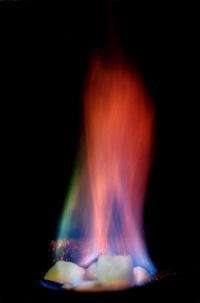
In the future, natural gas derived from chunks of ice that workers collect from beneath the ocean floor and beneath the arctic permafrost may fuel cars, heat homes, and power factories. Government researchers are reporting that these so-called "gas hydrates," a frozen form of natural gas that bursts into flames at the touch of a match, show increasing promise as an abundant, untapped source of clean, sustainable energy. The icy chunks could supplement traditional energy sources that are in short supply and which produce large amounts of carbon dioxide linked to global warming, the scientists say.
"These gas hydrates could serve as a bridge to our energy future until cleaner fuel sources, such as hydrogen and solar energy, are more fully realized," says study co-leader Tim Collett, Ph.D., a research geologist with the U.S. Geological Survey (USGS) in Denver, Colo. Gas hydrates, known as "ice that burns," hold special promise for helping to combat global warming by leaving a smaller carbon dioxide footprint than other fossil fuels, Collett and colleagues note.
They will present research on gas hydrates today at the American Chemical Society's 237th National Meeting. It is among two dozen papers on the topic scheduled for a two-day symposium, "Gas Hydrates and Clathrates," March 23-24, held at the Hilton Salt Lake City.
Last November, a team of USGS researchers that included Collett announced a giant step toward that bridge to the future. In a landmark study, the USGS scientists estimated that 85.4 trillion cubic feet of natural gas could potentially be extracted from gas hydrates in Alaska's North Slope region, enough to heat more than 100 million average homes for more than a decade.
"It's definitely a vast storehouse of energy," Collett says. "But it is still unknown how much of this volume can actually be produced on an industrial scale." That volume, he says, depends on the ability of scientists to extract useful methane, the main ingredient in natural gas, from gas hydrate formations in an efficient and cost-effective manner. Scientists worldwide are now doing research on gas hydrates in order to understand how this strange material forms and how it might be used to supplement coal, oil, and traditional natural gas.
Although scientists have known about gas hydrates for decades, they've only recently begun to try to use them as an alternative energy source. Gas hydrates, also known as "clathrates," form when methane gas from the decomposition of organic material comes into contact with water at low temperatures and high pressures. Those cold, high-pressure conditions exist deep below the oceans and underground on land in certain parts of the world, including the ocean floor and permafrost areas of the Arctic.
Today, researchers are finding tremendous stores of gas hydrates throughout the world, including United States, India, and Japan. In addition to Alaska, the United States has vast gas hydrate deposits in the Gulf of Mexico and off its eastern coast. Interest in and support of hydrate research is now growing worldwide. Japan and India currently have among the largest, most well-funded hydrate research programs in the world.
"Once we have learned better how to find the most promising gas hydrate deposits, we will need to know how to produce it in a safe and commercially-viable way," says study co-author Ray Boswell, Ph.D. He manages the National Methane Hydrate R&D Program of the U.S. Department of Energy's National Energy Technology Laboratory in Morgantown, W. Va. "Chemistry will be a big part of understanding just how the hydrates will respond to various production methods."
One of the more promising techniques for extracting methane from hydrates involves simply depressurizing the deposits, Boswell says. Another method involves exchanging the methane molecules in the "clathrate" structure with carbon dioxide. Workers can, in theory, collect the gas using the same drilling technology used for conventional oil and gas drilling.
Under the Methane Hydrate Research and Development Act of 2000, the U.S. government has already spent several million dollars, in collaboration with universities and private companies, to investigate gas hydrates as an alternative energy source. Scientists are particularly optimistic about the vast stores of gas hydrates located in Alaska and in the Gulf of Mexico. Research is also accelerating under the U.S. Department of Energy and USGS to better understand gas hydrate's role in the natural environment and in climate change.
"Gas hydrates are totally doable," Collett says. "But when and where we will see them depends on need, motivation, and our supply of other energy resources. In the next five to ten years, the research potential of gas hydrates will be more fully realized."
Source: American Chemical Society (news : web)


