Researchers find tiny genetic change keeps nicotine from binding to muscle cells
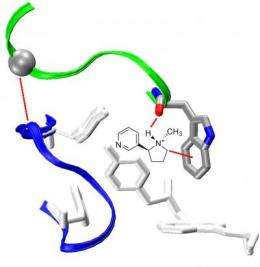
A tiny genetic mutation is the key to understanding why nicotine--which binds to brain receptors with such addictive potency--is virtually powerless in muscle cells that are studded with the same type of receptor. That's according to California Institute of Technology (Caltech) researchers, who report their findings in the March 26 issue of the journal Nature.
By all rights, nicotine ought to paralyze or even kill us, explains Dennis Dougherty, the George Grant Hoag Professor of Chemistry at Caltech and one of the leaders of the research team. After all, the receptor it binds to in the brain's neurons--a type of acetylcholine receptor, which also binds the neurotransmitter acetylcholine--is found in large numbers in muscle cells. Were nicotine to bind with those cells, it would cause muscles to contract with such force that the response would likely prove lethal.
Obviously, considering the data on smoking, that is not what happens. The question has long been: Why not?
"It's a chemical mystery," Dougherty admits. "We knew something subtle had to be going on here, but we didn't know exactly what."
That subtlety, it turns out, lies in the slight tweaking of the structure of the acetylcholine receptor in muscle cells versus its structure in brain cells.
The shape of the acetylcholine receptor, and the way the chemicals that bind with it contort themselves to fit into that receptor, is determined by a number of different weak chemical interactions. Perhaps most important is an interaction that Dougherty calls "underappreciated"--the cation-π interaction, in which a positively charged ion and an electron-rich π system come together.
Back in the late 1990s, Dougherty and colleagues had shown that the cation-π interaction is indeed a key part of acetylcholine's ability to bind to the acetylcholine receptors in muscles. "We assumed that nicotine's charge would cause it to do the same thing, to have the same sort of strong interaction that acetylcholine has," says Dougherty. "But we found that it didn't."
This would explain why smoking doesn't paralyze us; if the nicotine can't get into the muscle's acetylcholine receptors, it can't cause the muscles to contract.
But how, then, does nicotine work its addictive magic on the brain?
It took another decade for the scientists to be able to peek at what happens in brain cells' acetylcholine receptors when nicotine arrives on the scene. Turns out that in brain cells, unlike in muscle cells, nicotine makes the exact same kind of strong cation-π interaction that acetylcholine makes in both brain and muscle cells.
"In addition," Dougherty notes, "we found that nicotine makes a strong hydrogen bond in the brain's acetylcholine receptors. This same hydrogen bond, in the receptors in muscle cells, is weak."
The cause of this difference in binding potency, says Dougherty, is a single point mutation that occurs in the receptor near the key tryptophan amino acid that makes the cation-π interaction. "This one mutation means that, in the brain, nicotine can cozy up to this one particular tryptophan much more closely than it can in muscle cells," he explains. "And that is what allows the nicotine to make the strong cation-π interaction."
Dougherty says the best way to visualize this change is to think of the receptor as a box with one open side. "In muscle cells, this box is slightly distorted, so that the nicotine can't get to the tryptophan," he says. "But in the brain, the box is subtly reshaped. That's the thing: It's the shape, not the composition, of the box that changes. This allows the nicotine to make strong interactions, to become very potent. In other words, it's what allows nicotine to be addictive in the brain."
"Several projects in our labs are converging on the molecular and cellular mechanisms of the changes that occur when the brain is repeatedly exposed to nicotine," adds study coauthor Henry Lester, the Bren Professor of Biology at Caltech. "We think that the important events begin with the rather tight and selective interaction between nicotine and certain receptors in the brain. This Nature paper teaches us how this interaction occurs, at an unprecedented level of resolution."
Dougherty notes that these findings might one day lead to better drugs to combat nicotine addiction and other neurological disorders. "The receptor we describe in this paper is an important drug target," he says. "It might help pharmaceutical companies develop a better drug than nicotine to do the good things nicotine does--enhance cognition, increase attention--without being addictive and toxic."
More information: "Nicotine binding to brain receptors requires a strong cation-π interaction," Nature.
Source: California Institute of Technology (news : web)


