Researchers Identify Early Brain Marker for Familial Form of Depression
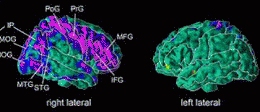
(PhysOrg.com) -- Findings from one of the largest-ever imaging studies of depression indicate that a structural difference in the brain - a thinning of the right hemisphere - appears to be linked to a higher risk for depression, according to new research at Columbia University Medical Center and the New York State Psychiatric Institute.
The research was led by Myrna Weissman, Ph.D., professor of epidemiology in psychiatry, Columbia University College of Physicians and Surgeons, and director of the Division of Epidemiology at the New York State Psychiatric Institute, and co-senior author of the study, and Bradley Peterson, M.D., director of Child & Adolescent Psychiatry and director of MRI Research in the Department of Psychiatry at Columbia University Medical Center and the New York State Psychiatric Institute, and first author of the study.
Published in the upcoming early online edition of the Proceedings of the National Academy of Sciences (PNAS), the researchers found that people at high risk of developing depression had a 28 percent thinning of the right cortex, the brain's outermost surface, compared to people with no known risk.
The drastic reduction surprised researchers, which they say is on par with the loss of brain matter typically observed in persons with Alzheimer's disease and schizophrenia. "The difference was so great that at first we almost didn't believe it. But we checked and re-checked all of our data, and we looked for all possible alternative explanations, and still the difference was there," said Dr. Peterson.
Dr. Peterson says the thinner cortex may increase the risk of developing depression by disrupting a person's ability to pay attention to, and interpret, social and emotional cues from other people. Additional tests measured each person's level of inattention to and memory for such cues. The less brain material a person had in the right cortex, the worse they performed on the attention and memory tests.
The study compared the thickness of the cortex by imaging the brains of 131 subjects, aged 6 to 54 years-old, with and without a family history of depression. Structural differences were observed in the biological offspring of depressed subjects but were not found in the biological offspring of those who were not depressed.
One of the goals of the study was to determine whether structural abnormalities in the brain predispose people to depression or are a cause of the illness. Dr. Peterson said, "Because previous biological studies only focused on a relatively small number of individuals who already suffered from depression, their findings were unable to tease out whether those differences represented the causes of depressive illness, or a consequence."
The study found that thinning on the right side of brain did not correlate with actual depression, only an increased risk for the illness. It was subjects who exhibited an additional reduction in brain matter on the left side, who went on to develop depression or anxiety.
"Our findings suggest rather strongly that if you have thinning in the right hemisphere of the brain, you may be predisposed to depression and may also have some cognitive and inattention issues. The more thinning you have, the greater the cognitive problems. If you have additional thinning in the same region of the left hemisphere, that seems to tip you over from having a vulnerability to developing symptoms of an overt illness," said Dr. Peterson.
Imaging Done on Participants of One of Longest Multi-Generational Studies of Depression
Participants were pulled from "Children at High and Low Risk of Depression," an earlier study, which was begun 27 years ago by Dr. Weissman. While at Yale, Dr. Weissman began the trial to examine the familial risk for depression. She identified people with moderate to severe depression, as well as people with no mental illness, and followed these families for more than 25 years. Dr. Weissman found that depression was transmitted across the generations in the high risk families and at the 20 year follow-up invited Dr. Peterson to collaborate on imaging the participants. The study now includes grandparents, their children and grandchildren.
Future Clinical Implications of the Findings
Commenting on the potential clinical implications of the findings, Dr. Peterson said, "If the mechanism-or pathway to illness-indeed runs from the thinning of the cortex to these cognitive problems that affect a person's attention and their ability to interpret social and emotional cues - it would suggest that there may be potential treatments or novel uses of already existing treatments for intervention. For example, either behavioral therapies that aim to improve attention and memory and/or stimulant medications currently used for attention-deficit/hyperactivity disorder (ADHD), may surface as possible treatments for people who have familial depression and this pattern of cortical thinning, in a highly personalized form of medical decision-making and treatment, for it may be that treating their inattention could improve their processing of social information. This conjecture is entirely speculative at this point, but it is a logical hypothesis to test based on the findings from this study."
Next Steps
Using function magnetic resonance imaging (fMRI) with 152 subjects, aged 12 to 20, with and without a family history of depression, Dr. Peterson and Dr. Weissman plan to learn more about the pattern of thinning by observing the circuits of functional activation during attentional tasks to look at how these groups differ.
Rescanning of the subjects in the future is also expected to allow researchers to determine if the reduction in brain matter relates to neurons rather than other supporting cells in the brain, know as glia. In addition, specific behavioral and cognitive testing can help to identify more definitively the causal pathways that lead from thinning of the cortex to depression.
Drs. Peterson, Weissman, and their colleagues also plan to study the DNA of these subjects to determine if there is a particular gene that contributes to having an elevated risk for depression. The researchers can then investigate whether individuals with this depression risk gene have more thinning in the cortex.
Background
A highly familial illness, depression is a leading cause of disability worldwide for persons 15 to 44 years of age, and is associated with increased mortality resulting from cardiovascular disease, poor personal care and suicide. Early onset of depression, which occurs before young adulthood, tends to be familial and is usually characterized as being more chronic and having greater severity.
Until now, there have been no studies of brain structure in depression which have focused on cortical thickness.
Source: Columbia University Medical Center (news : web)


