Research links evolution of fins and limbs with that of gills
March 23, 2009 Research links evolution of fins and limbs with that of gills

Enlarge

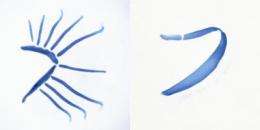
The shark arch gill skeleton (left) shows primitive gill rays that are found only in sharks and other cartilaginous fishes. The gills of other fishes (right) are also arched but lack gill rays. This primitive feature of sharks allowed the researchers to link the developmental genetic program for fins and limbs to the more primitive one for gill rays. Credit: Image by J. Andrew Gillis, University of Chicago

The genetic toolkit that animals use to build fins and limbs is the same genetic toolkit that controls the development of part of the gill skeleton in sharks, according to research to be published in Proceedings of the National Academy of Sciences on March 23, 2009, by Andrew Gillis and Neil Shubin of the University of Chicago, and Randall Dahn of Mount Desert Island Biological Laboratory.

"In fact, the skeleton of any appendage off the body of an animal is probably patterned by the developmental genetic program that we have traced back to formation of in sharks," said Andrew Gillis, lead author of the paper and a graduate student in the Department of Organismal Biology and Anatomy at the University of Chicago. "We have pushed back the of the developmental genetic program that patterns and limbs."

This new finding is consistent with an old theory, often discounted in science textbooks, that fins and (later) limbs evolved from the gills of an extinct vertebrate, Gillis added. "A dearth of fossils prevents us from definitely concluding that fins evolved from gills. Nevertheless, this research shows that the of gills, fins and limbs is the same."

The research builds on the breakthrough discovery of the fossil Tiktaalik, a "fish with legs," by Neil Shubin and his colleagues in 2006. "This is another example of how evolution uses common developmental programs to pattern different anatomical structures," said Shubin, who is the senior author on the PNAS paper and Professor and Associate Dean of Organismal and at the University of Chicago. "In this case, shared developmental mechanisms pattern the skeletons of vertebrate gill arches and paired fins."

The research also showed for the first time that the gill arch skeleton of embryonic skates (a living relative of sharks that has gill rays) responds to treatment with the vitamin A in the same way a limb or fin skeleton does: by making a mirror image duplicate of the structure as the embryo develops. According to the researchers, the genetic circuitry that patterns (arms, legs and fins) has a deep evolutionary origin that actually predates the origin of paired appendages themselves.

"These findings suggest that when paired appendages appeared, the mechanism used to pattern the skeleton was co-opted from the gills," Gillis said. "Perhaps we should think of shark gills as another type of vertebrate appendage—one that's patterned in essentially the same way as fins and limbs."

The deep structural, functional, and regulatory similarities between paired appendages and developing gill rays, as well as the antiquity of gills relative to paired appendages, suggest that the signaling network that is induced by retinoic acid had a patterning function in gills before the origin of vertebrate appendages, the research concludes. And this function has been retained in the gill rays of living cartilaginous fishes.

Source: University of Chicago Medical Center


print this article email this article download pdf blog this article bookmark this article     Stumble it Digg this share on Facebook retweet share on Reddit add to delicious
Rate this story - 5 /5 (1 vote)


March 23, 2009 all stories

Comments: 0

5 /5 (1 vote)
  • Stumble this up

  • Digg this

  • share this

  • hide
  • Related Stories

  • What do a shark fin and a human leg have in common?
    created Jul 31, 2006 | popularity not rated yet | comments 0
  • Scientists discover evolutionary origin of fins, limbs
    created Jul 27, 2006 | popularity not rated yet | comments 0
  • New genetic data overturn long-held theory of limb development
    created May 23, 2007 | popularity not rated yet | comments 0
  • Coelacanth fossil sheds light on fin-to-limb evolution
    created Aug 01, 2007 | popularity not rated yet | comments 0
  • Primordial fish had rudimentary fingers
    created Sep 22, 2008 | popularity not rated yet | comments 0


  • hide
  • Relevant PhysicsForums posts

  • What is transpulmonary pressure?
    created Nov 24, 2009
  • Is there a gay gene?
    created Nov 23, 2009
  • Super quick question about Starling forces?
    created Nov 22, 2009
  • Questions about diffusion
    created Nov 22, 2009
  • More from Physics Forums - Biology

Other News

Redback spiders were first spotted in Japan in 1995

Venomous Aussie redback spiders invading Japan

Biology / Ecology

created 3 hours ago | popularity not rated yet | comments 0

Australia's venomous redback spiders are on the march in Japan, where they are believed to have arrived years ago as stowaways on cargo ships, a wildlife expert warned Wednesday.


Study explores violent world of raptors

Biology / Plants & Animals

created 3 hours ago | popularity not rated yet | comments 0

A journey that started with a box of bird feet carried three Montana State University graduate students into the gruesome world of raptors and led to their findings being published in a prominent journal.


Asian carp may have breached barrier protecting Lake Michigan

Biology / Ecology

created 11 hours ago | popularity 5 / 5 (4) | comments 0

Two feared species of Asian carp have zoomed beyond the $9 million electric barriers built to keep them out of Lake Michigan. Now, the only thing left between the carp and the Great Lakes is a lock and dam in southern Chicago.


Got a pain? -- Have a cup of Brazilian mint

Biology / Plants & Animals

created 13 hours ago | popularity 4.6 / 5 (7) | comments 0

For thousands of years it has been prescribed by traditional healers in Brazil to treat a range of ailments from headaches and stomach pain to fever and flu.


Opposites attract: Monkeys choose mating partners with different genes

Biology / Evolution

created 13 hours ago | popularity 5 / 5 (1) | comments 0

The world's largest species of monkey 'chooses' mates with genes that are different from their own to guarantee healthy and strong offspring, according to a new research study.