National Science and Technology Council releases strategy for digital scientific data
March 23, 2009
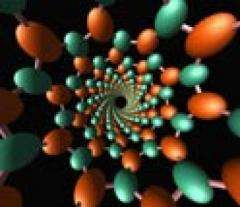
This photo shows a view down the middle of a boron nitride nanotube. Credit: Vin Crespi, Pennsylvania State Physics. Distributed under the Creative Commons license http://creativecommons.org/licenses/by-sa/2.0/.
The National Science and Technology Council (NSTC) released a report describing a strategy to promote preservation and access to digital scientific data. The report, Harnessing the Power of Digital Data for Science and Society, was produced by the NSTC's Committee on Science under the auspices of the Office of Science and Technology Policy (OSTP) in the Executive Office of the President.
The open and timely publication of digital scientific data called for in the report will advance President Obama's plan to democratize data by publishing government information online in forms that the public can readily find and use. OSTP, which is implementing the President's agenda on transparency and open government, in collaboration with the CIO Council, is working to create a central, online repository--data.gov--where the public can download such information in open, structured formats. The report provides a strategy to ensure that digital scientific data produced by and for the Federal government and made available via data.gov and agency websites can be reliably preserved for maximum access in catalyzing progress in science and society.
Digital imaging, sensors, analytical instrumentation and other technologies are becoming increasingly central to all areas of science. Increases in computing power drive advances in modeling and simulation that extend the reach of science. Improvements in networking increase access to information, instrumentation, and colleagues around the globe. Digital data are the common thread linking these powerful trends in science.
"Science and engineering research and education are increasingly digital," said Arden L. Bement, Jr., director of the National Science Foundation and co-chair of the Committee on Science. "New observation systems are prime examples, expanding the scales for conducting observations from the sub-atomic to the cosmic; from a billionth of a degree to millions of degrees; and from sub- picoseconds to light years. A broad framework for promoting continuing access and interoperability for scientific data is key to progress in this digital age."
The report lays out a strategic vision for "a digital scientific data universe in which data creation, collection, documentation, analysis, preservation, and dissemination can be appropriately, reliably, and readily managed, thereby enhancing the return on our nation's research and development investment by ensuring that digital data realize their full potential as catalysts for progress in our global information society."
The report includes three key recommendations to pursue this vision. The first is to create an interagency subcommittee under NSTC that will focus on goals that are best addressed through continuing broad cooperation and coordination across agencies. The second key element of the strategic framework is for departments and agencies to lay the foundations for agency digital scientific data policy and make the policy publicly available. In laying these foundations, agencies should consider all components of a comprehensive policy to address the full data management life cycle. The third key element is for all agencies to promote a data management planning process for projects that generate scientific data for preservation.
More information: The report represents the combined effort of representatives from 22 federal agencies working together under the Interagency Working Group on Digital Data. The report may be found at http://www.nitrd.g … g_Power.aspx .
-
International science community to establish global virtual library for scientific data
Oct 23, 2008 |
not rated yet |
0
-
Digital preservation: Alliance set to tackle science's new frontier
Nov 26, 2007 |
not rated yet |
0
-
Blue ribbon task force: Economic plans needed to preserve digital data
Dec 16, 2008 |
not rated yet |
0
-
San Diego Supercomputer Center director offers tips on data preservation in the information age
Dec 11, 2008 |
not rated yet |
0
-
New authentication code urged for digital data
Jun 03, 2005 |
not rated yet |
0
-
Engineers build first sub-10-nm carbon nanotube transistor
Feb 01, 2012 |
4.9 / 5 (32) |
30
-
Something old, something new: Evolution and the structural divergence of duplicate genes
Jan 31, 2012 |
4.6 / 5 (7) |
1
-
The hidden nanoworld of ice crystals: Revealing the dynamic behavior of quasi-liquid layers
Jan 30, 2012 |
5 / 5 (4) |
1
-
Stock market network reveals investor clustering
Jan 27, 2012 |
3.9 / 5 (23) |
8
-
Of microchemistry and molecules: Electronic microfluidic device synthesizes biocompatible probes
Jan 26, 2012 |
5 / 5 (2) |
0
-
Need help reading 3-D
19 hours ago
-
A way to send and receive wireless data
Feb 11, 2012
-
Calling function with no input argument
Feb 10, 2012
-
Force free body diagram problem on gym equipment
Feb 10, 2012
-
Empirical data regarding shower heads and water
Feb 10, 2012
-
feed hold button on CNC lathe
Feb 09, 2012
- More from Physics Forums - General Engineering
More news stories
Iran blocks email, restricts net access: reports
Iran has further restricted access to the Internet and blocked popular email services for the past few days, in a move a top lawmaker said could "cost the regime dearly," media reports said on Sunday.
31 minutes ago |
5 / 5 (1) |
2
Google might launch Drive for cloud storage soon
(PhysOrg.com) -- Google's next big move, according to the Wall Street Journal, is a cloud storage service called Drive. Hardly first to the plate, Google is simply catching up to introducing its cloud reposi ...
Love a click away in Indonesia's Twitter Republic
He was a geeky kid from Yogyakarta, she a glamorous city girl in Jakarta. In a country with one of the world's most vibrant social networking scenes they fell in love on Twitter.
8 hours ago |
4 / 5 (1) |
0
Walney offshore wind farm is world's biggest (for now)
(PhysOrg.com) -- The Walney wind farm on the Irish Sea--characterized by high tides, waves and windy weather--officially opened this week. The farm is treated in the press as a very big deal as the Walney ...
Navy to begin tests on electromagnetic railgun prototype launcher
The Office of Naval Research (ONR)'s Electromagnetic (EM) Railgun program will take an important step forward in the coming weeks when the first industry railgun prototype launcher is tested at a facility ...
Feb 06, 2012 |
4.7 / 5 (16) |
93
|
Scientists discover molecular secrets of 2,000-year-old Chinese herbal remedy
For roughly two thousand years, Chinese herbalists have treated Malaria using a root extract, commonly known as Chang Shan, from a type of hydrangea that grows in Tibet and Nepal. More recent studies suggest that halofuginone, ...
New method to examine batteries -- MRI from the inside
There is an ever-increasing need for advanced batteries for portable electronics, such as phones, cameras, and music players, but also to power electric vehicles and to facilitate the distribution and storage of energy derived ...
A mitosis mystery solved: How chromosomes align perfectly in a dividing cell
Although the process of mitotic cell division has been studied intensely for more than 50 years, Whitehead Institute researchers have only now solved the mystery of how cells correctly align their chromosomes during symmetric ...
Starve a virus, feed a cure? Findings show how some cells protect themselves against HIV
A protein that protects some of our immune cells from the most common and virulent form of HIV works by starving the virus of the molecular building blocks that it needs to replicate, according to research published online ...
Researchers find extensive RNA editing in human transcriptome
In a new study published online in Nature Biotechnology, researchers from BGI, the world's largest genomics organization, reported the evidence of extensive RNA editing in a human cell line by analysis of RNA-seq data, demons ...
The proteins ensuring genome protection
Researchers from the University of Geneva (UNIGE), Switzerland, have discovered the crucial role of two proteins in developing a cell 'anti-enzyme shield'. This protection system, which operates at the level of molecular ...