Molecular fingerprints point the way to earlier cancer diagnosis and more targeted treatment
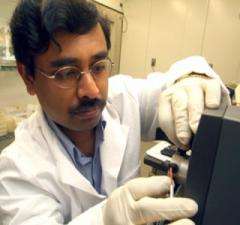
Metabolites are molecular fingerprints of what your cells are up to and Dr. Arun Sreekumar wants to know the impression made by cancer.
You've likely heard about metabolites; your physician probably screens for some known ones such as triglycerides or cholesterol at your annual physical. Scientists suspect we have about 3,000 metabolites that come from our food or are synthesized from different compounds in our bodies.
Dr. Sreekumar, a cancer researcher at the Medical College of Georgia Cancer Center, wants those screens of the blood or urine to also detect early signs of cancers such as leukemia, bladder, kidney and breast when the chance for cure is best.
He's already begun to identify metabolites that indicate not only the presence of prostate cancer, but its aggressiveness, a tool that could help tailor optimal treatment. The search began in men at risk: those with elevated prostate specific antigen, or PSA, levels. A PSA test along with a digital rectal exam is today's standard for prostate screening so physicians typically do both in men age 50 and older. But PSA levels are actually better at helping determine if prostate cancer has returned, Dr. Sreekumar says.
Elevated levels of PSA, a protein, are not always predictive of cancer, which means a lot of men get unnecessary biopsies. PSA measurements also can't distinguish between tumors that have a good outcome versus those with a poor one.
"The physician does not really have the tools in hand to really say that this tumor will spread to other organs or not." says the Georgia Cancer Coalition Distinguished Cancer Scholar. "We want to find clinical markers that supplement PSA."
Aggressiveness is a major factor in prostate cancer treatment. In fact some men with slow growing disease likely won't even need treatment. So he wants to provide a complement of biomarkers that accurately diagnose and categorize the disease then help monitor success of treatment. These early studies indicate a urine test may one day be possible to do just that.
He and colleagues at the University of Michigan reported in the Feb. 12 issue of Nature what appears to be one of the first metabolites implicated in cancer invasion. They looked at 1,126 metabolites in 262 samples taken from men with high PSA levels. They consistently found elevated levels of the amino acid sarcosine in the prostate tissues of men with cancer; levels were highest in what appeared to be the most aggressive tumors.
Sarcosine, a modified form of the amino acid glycine, was a known entity but its function was unclear. Scientists thought it might be a dumping ground for excess methyl groups needed to enable chemical changes of genes, proteins and other body components that can affect what and how much they do.
This process called methylation can be a good thing - like when it's helping an embryo develop - but when it goes badly, it can cause disease such as cancer. While sarcosine's dumping role seemed to protect from cancer, the Michigan scientists found its action actually helps induce tumors. In fact, when they added it to prostate cancer cells, the cells became more aggressive. Exactly how that process works is still under study but the findings were pretty consistent.
"When we looked at patients with metastatic disease, sarcosine levels were sky high compared to patients with localized tumors," says Dr. Sreekumar. "It's enabling invasion."
Because cancer and people are both very heterogenous, measures need to be taken in larger population samples, he says. Also, they found a small group of patients with negative biopsies and high sarcosine levels. "We don't know how many of them have missed cancer," says Dr. Sreekumar who joined the MCG faculty in February.
These are among the reasons he believes in strength in numbers. "In the real world of biomarkers, you want 100 percent sensitivity. If the patient has cancer, you want to pick it up. We need to have a kind of multiplex test where you can test for say10 different entities and have a greater confidence that what you are stating about the tumor is true. Our goal is to develop such a panel and research on sarcosine is a first step toward achieving this."
In his new position at MCG, he's looking to expand the number of metabolites known to be predictive of prostate and other cancers. In prostate cancer, he's beginning with follow up on other metabolites identified in the Michigan study in which researchers identified a total of six metabolites, including sarcosine, linked to increased tumor progression. A total of 89 metabolites were different in metastatic prostate cancer compared to localized disease.
He's excited about what metabolites will one day tell cancer physicians and patients but adds that they are just a piece of what our bodies can tell us about a potential cancer growing inside. Scientists also need to continue to look at genes expressed by tumors and the proteins expressed by those genes to get the bigger picture. "It's basically a systems approach you need to take," he says.
The young scientist has worked with all those pieces in his relatively short career. He started his postdoctoral fellowship at the University of Michigan in1999, when the ability to look at gene expression was new. With his mentor, Dr. Arul M. Chinnaiyan, director of Michigan Center for Translational Pathology, Pathology Research Informatics and Cancer Bioinformatics at Michigan, he helped develop the next step: the ability to look at expression of hundreds of proteins at a time, instead of a handful, an important advance in light of the fact that there are about 1 million proteins. Recently they were among the first to venture into the world of metabolites, which are made by proteins.
"Previous technology was looking at a cell from a narrow perspective and cells never act in isolation, proteins never act in isolation, they always form complexes, act in pathways," Dr. Sreekumar says.
His inspiration to follow those pathways is a fellow Ph.D. student who died too young and quickly of an aggressive leukemia and the fact that cancer is a leading cause of death worldwide.
Source: Medical College of Georgia


