Portuguese wave-power snake dead in the water
March 24, 2009 by Anne Le Coz
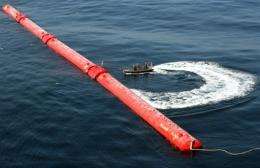
An off-shore electricity generator based on wave power off of Portugal?s coast

Enlarge

An off-shore electricity generator based on wave power off of Portugal?s coast. Opened in September as a world "first" in producing electricity from waves, a pioneering installation here is dead in the water having functioned for only a few weeks in a stormy process of research and development

Opened in September as a world "first" in producing electricity from waves, a pioneering installation here is dead in the water having functioned for only a few weeks in a stormy process of research and development.

First it had to be taken out of service and dismantled because of technical problems. And now one of the main investors in the project, which had a start-up cost of nine million euros (12.3 million dollars), has gone bankrupt.

The structure, five kilometres (three miles) out to sea off Povoa do Varzim in northern , was put into service officially in September by Economy Minister Manual Pinho after three years of development.

"The first project in the world for the commercial exploitation of ." With these words the minister launched the so-called "wave park." A frigate of the Portuguese navy stood by to honour the event.

The installation has modest generating capacity however, being capable of producing 2.25 megawatts or the output equivalent to that of one wind turbine.

It comprises three units built like articulated sea snakes which lie semi-submerged and undulate with the movement of the waves to generate current.

The three serpent-like units were taken ashore several times for so-called "checks" but since November they have been lying immobile in the northern port of Leixoes.

"There was a recurrent problem with the movements of the hydraulic screws in the three machines, and this is why they have been removed from deep water," Rui Barros, who is one of those in charge of the Agucadoura wave park told AFP.

But, on inspection, "we saw that the problem was serious, generalised, and not incidental."

The main partner in the park is Energias de Portugal. A senior executive in the group, Jorge Cruz Morais, said: "The machines had a hard winter in maritime conditions, and they have been brought ashore for repairs. Do not forget that this is a project."

However, several sources involved in the scheme said that beyond the technical failings, the very existence of the installation is now threatened by the bankruptcy of Australian investment group Babcock & Brown.

The Australian firm owns 35 percent of a consortium called Ondas de Portugal, which was created to develop the system. EDP owns 45 percent of the entity and Portuguese electrical engineering group Efacec owns 20 percent.

An unnamed source in the Australian company, quoted by the website of the Portuguese weekly magazine Expresso, said: "It is not a profitable project. It will become so by growing in size. But the current phase is compromised unless a new partner can be found."

Meanwhile, British company Pelamis Wave Power, the partner for technology in the project, announced in February that it had signed a contract with EON-UK, a subsidiary of EON, the leading energy group in Germany, to develop a similar project in Scotland using a new generation of power converters.

Cruz Morais said that EDP was also considering using this new version or "two or three other technologies" which exist.

EDP was still ready to invest in wave power despite "perfectly normal setbacks in a process of research," he said.

(c) 2009 AFP

4.4 /5 (14 votes)  

Filter


Move the slider to adjust rank threshold, so that you can hide some of the comments.


Display comments: newest first

zevkirsh
Mar 24, 2009

Rank: 2.3 / 5 (4)
yea, making energy from something located inside a moving and highly abrasive medium: a salt water ocean, is not smart. all large energy harvesting facilities require massive maintanence, even mines, and oil rigs. why should renewables be any different. ...stick to land based energy factories.
Mayday
Mar 24, 2009

Rank: 3.2 / 5 (5)
Why not build underwater watermills to harvest the energy of sea currents(no pun intended)or deep rivers? The flow is regular and predictable, plus the mills would be out of sight. They could be made to turn slow enough to minimize the danger to aquatic life.
DGBEACH
Mar 24, 2009

Rank: 1.8 / 5 (5)
Why not build underwater watermills to harvest the energy of sea currents(no pun intended)or deep rivers? The flow is regular and predictable, plus the mills would be out of sight. They could be made to turn slow enough to minimize the danger to aquatic life.

THAT would only make sense! But then again, there are those here that will be more concerned with changing those undersea currents, and perhaps disturbing the odd crab or lobster, then with actually doing something to reduce our CO2 emissions!
david_42
Mar 24, 2009

Rank: 4.5 / 5 (4)
Mayday - there have been many ocean turbine projects dating back to the lift-translators from the 1970s. None of them have gotten very far, but people keep trying.
Velanarris
Mar 24, 2009

Rank: 2.4 / 5 (5)
THAT would only make sense! But then again, there are those here that will be more concerned with changing those undersea currents, and perhaps disturbing the odd crab or lobster, then with actually doing something to reduce our CO2 emissions!
Which has a greater affect on climate, altering the flow of ocean currents or adding 0.000028% CO2 over the course of 200 years?
Soylent
Mar 25, 2009

Rank: 4.3 / 5 (3)
Which has a greater affect on climate, altering the flow of ocean currents or adding 0.000028% CO2 over the course of 200 years?


Adding to the CO2 concentration by a few hundred ppm over the next 50-100 years.

RayCherry
Mar 25, 2009

Rank: 5 / 5 (2)
Anything in the water is less easy to maintain, even more so if it is on the bed of the ocean. However, the ocean has more energy than any other source we know. We are just beginning, and money will be spent, (and appear to be lost), discovering the right solution.

If we have only decades left before the ocean currents change, and the climate changes increase the energy requirements of domestic and public climate control systems, then we must all 'waste' some money now ... 'buying time from the future'.
Velanarris
Mar 25, 2009

Rank: 2.6 / 5 (5)
Which has a greater affect on climate, altering the flow of ocean currents or adding 0.000028% CO2 over the course of 200 years?

Adding to the CO2 concentration by a few hundred ppm over the next 50-100 years.

I rarely say this to you soylent, but you're wrong. Impeding an ocean current stops the transport of warm water, and in turn wind, to cold areas.

Also, we're not going to be adding several hundred ppm to the current CO2 count. Humans are only listed as being culpable for 50% of the increase. So over several hundred years we've produced a questionable 50 ppm. Now that we're utilizing many other more efficient sources of energy as well as a few cleaner ones (sporadically), I doubt we'll be able to match that increase even with the current population.
Roach
Apr 17, 2009

Rank: not rated yet
Um, mayday, you migh want to check you numbers, if a low flow like a river or ocean current could drive a generator, then why would the Hoover Dam have been needed? I don't think the minimal mechanical energy of an underwater flow is enough to drive very much, for a large energy demand you've need a "windmill" bigger than the river.

As to the ocean having more energy than many other sources yes, but at 1.37 billion cubic kilometers the volume versus energy isn't very appealing.
Rank 4.4 /5 (14 votes)
Relevant PhysicsForums posts
  • Need help reading 3-D
    created14 hours ago
  • A way to send and receive wireless data
    created20 hours ago
  • Tabletop Cold Fusion Reactor
    created22 hours ago
  • Calling function with no input argument
    createdFeb 10, 2012
  • Force free body diagram problem on gym equipment
    createdFeb 10, 2012
  • Empirical data regarding shower heads and water
    createdFeb 10, 2012
  • More from Physics Forums - General Engineering

More news stories

Google might launch Drive for cloud storage soon

(PhysOrg.com) -- Google's next big move, according to the Wall Street Journal, is a cloud storage service called Drive. Hardly first to the plate, Google is simply catching up to introducing its cloud reposi ...

Technology / Internet

created 3 hours ago | popularity 4.5 / 5 (2) | comments 2 | with audio podcast report

Walney offshore wind farm is world's biggest (for now)

(PhysOrg.com) -- The Walney wind farm on the Irish Sea--characterized by high tides, waves and windy weather--officially opened this week. The farm is treated in the press as a very big deal as the Walney ...

Technology / Energy & Green Tech

created 23 hours ago | popularity 4 / 5 (11) | comments 34 | with audio podcast weblog

Love a click away in Indonesia's Twitter Republic

He was a geeky kid from Yogyakarta, she a glamorous city girl in Jakarta. In a country with one of the world's most vibrant social networking scenes they fell in love on Twitter.

Technology / Internet

created 4 hours ago | popularity not rated yet | comments 0

GPS court ruling leaves US phone tracking unclear

A US Supreme Court decision requiring a warrant to place a GPS device on the car of a criminal suspect leaves unresolved the bigger issue of police tracking using mobile phones, legal experts say.

Technology / Telecom

created 23 hours ago | popularity 4 / 5 (2) | comments 0

Europeans protest controversial Internet pact

Tens of thousands of people marched in protests in more than a dozen European cities Saturday against a controversial anti-online piracy pact that critics say could curtail Internet freedom.

Technology / Internet

created 19 hours ago | popularity 4.6 / 5 (9) | comments 0


Latin America mining boom clashes with conservation

Latin America is experiencing a mining boom as prices rise fuelled by a hike in global demand, but the region is also being hit by a wave of violent protests, strikes and rallies by environmentalists.

Europe stakes billion-dollar bet on new rocket

A pencil-slim rocket is scheduled to lift into space from South America on Monday, carrying a billion-dollar bet that Europe can grab a juicy slice of the market to place satellites in low orbit.

Study finds that anti-diabetic medication can prevent the long-term effects of maternal obesity

In a study to be presented today at the Society for Maternal-Fetal Medicine's annual meeting, The Pregnancy Meeting, in Dallas, Texas, researchers will report findings that show that short therapy with the anti-diabetic medication ...

Netflix settlement trims 14 pct off 4Q earnings

(AP) -- Netflix pressed the rewind button on its fourth-quarter earnings after settling allegations that the video subscription service violated a consumer-privacy law.

Navy to begin tests on electromagnetic railgun prototype launcher

The Office of Naval Research (ONR)'s Electromagnetic (EM) Railgun program will take an important step forward in the coming weeks when the first industry railgun prototype launcher is tested at a facility ...

Explained: Sigma

It's a question that arises with virtually every major new finding in science or medicine: What makes a result reliable enough to be taken seriously? The answer has to do with statistical significance -- but ...