Glass you can build with: Metallic glass that's stronger and lasts longer
March 24, 2009 Glass you can build with

Enlarge

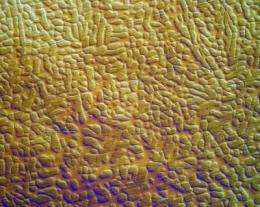
The two-phase structure of DH3, a metallic glass alloy of five different metals. When the space between the dendritic branches are properly spaced, they can stop cracks before they propagate. Credit: William Johnson, Caltech; Robert Ritchie, Berkeley Lab

(PhysOrg.com) -- The normal structure of metals is crystalline. Glass, on the other hand, is amorphous. But it's possible to make amorphous forms of metal, metallic glasses, which can be remarkably strong, having many properties equal to or better than their crystalline metal cousins. The catch is that bulk metallic glasses are highly susceptible to fatigue, a severe problem for their use as structural materials.

Now researchers at the U.S. Department of Energy's Lawrence Berkeley National Laboratory and the University of California at Berkeley, working with colleagues at the California Institute of Technology, have solved the fundamental problem of poor in bulk metallic glasses. The results are alloys that are not only stronger than high-strength steel and aluminum alloys but more resistant to fatigue as well.

Bulk metallic glasses

For a decade or so it has been possible to make metallic glasses in bulk - just like regular crystalline metals - by using a number of tricks: rapidly cooling the liquid metal, for example, and mixing together several elements with different crystalline structures - "which because they don't know how to crystallize, delays the crystallization and allows you to create an amorphous structure," as Robert Ritchie of Berkeley Lab's Materials Sciences Division explains.

The excitement that greeted the ability to make metallic glasses in bulk has not been followed up by widespread technological use, however. These alloys were first employed for lightweight, springy gold clubs, but to date there have been few, if any, important structural applications - in the aerospace industry, for example, as was initially hoped.

"One reason for this is that properties associated with cracking or fracture - such as or fatigue resistance - in these bulk metallic glass have often been quite poor," says Maximilien Launey, a postdoctoral research fellow working with Ritchie at Berkeley Lab.
Glass you can build with
Enlarge

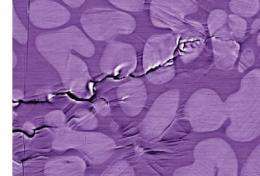
Cracks propagate through metallic glass by following shear bands, which in this micrograph look like wrinkles in cloth. The featureless blobs in the picture are a second, crystalline phase of the metal, but if these barriers are not properly spaced to halt crack propagation, the metal can fail disastrously. Credit: William Johnson, Caltech; Robert Ritchie, Berkeley Lab

"Without good toughness, these alloys have found few applications structurally," says Ritchie, who is also a professor in UC Berkeley's Department of Materials Science and Engineering. "Moreover, their fatigue resistance is also quite poor, with fatigue limits sometimes as low as one tenth or so that of most crystalline metallic alloys."

Since fatigue is the most widespread mechanism of degradation in metallic structures, low fatigue resistance has impeded the adoption of metallic glasses as structural materials.

"While it has been often thought the fatigue limit was the cyclic stress needed to initiate a crack in a material, there are always small cracks present," Ritchie says. "The fatigue limit is actually the cyclic stress needed to get such a small crack propagating."
In crystalline materials there are many barriers to crack propagation, including grain boundaries, inclusions, and other microstructural obstacles. Says Ritchie, "The fatigue limit is the stress needed to get cracks past such barriers." But metallic glasses have no crystalline structure, so no such barriers exist.

"If a crack is present, there's nothing to stop it from propagating," says Ritchie. "In metallic glasses, dominant shear bands can form and extend throughout the material; under tensile stress, this can lead to premature catastrophic failures at very small strains -- a particular problem in metallic glasses."

Stopping runaway cracks

Ritchie and Launey worked with colleagues Douglas Hofmann and William Johnson at Caltech to find a solution. Johnson's group at Cal Tech had developed a metallic glass alloy named DH3, made from five elements - roughly a third zirconium, a third titanium, and the remainder niobium, copper, and beryllium. In bulk samples of DH3 the researchers induced a second phase of the metal, which took the form of narrow pathways of permeating the metallic glass in dendritic (treelike) patterns; its growth was carefully controlled by processing a partially molten liquid-solid mixture.

The resulting dendritic phase acts as a local arrest point to any crack that begins to propagate in the glass.

"The process of blocking these shear bands is important not just for fatigue but for toughness as well," Launey says. "The approach of using a second phase has been tried before, but hasn't always been very successful. What this study shows is that it is their separation that is critical; the spacing of these arrest points has to be small enough to arrest any crack before it becomes large enough to cause catastrophic failure."

The goal is to match the mechanical and microstructural scales of the material: the microstructural scale is the space of the dendritic branches, while the mechanical scale is the length of a crack that breaks the material.

"So it is important that any shear band or crack is arrested before it makes it that far," Ritchie says. "We do that by having a finer distribution of these second phases" - with dimensions determined by a simple formula - "and as a result we got far superior fatigue resistance."

So good, in fact, that toughness, ductility, and fatigue resistance - all intimately related properties - of the DH3 alloy improved to the point that the bulk metallic glass was not only stronger than many structural metal alloys but had a fatigue limit more than 30 percent higher than ultra-high-strength steel and aluminum-lithium alloys.

"The important point here is that these design strategies can be universally applied to any other metallic glass systems," Launey says. "As a result, we feel the fatigue problem in metallic glasses can be solved."

More information: "Solution to the problem of the poor cyclic fatigue resistance of bulk metallic glasses," by Maximilien E. Launey, Douglas C. Hofmann, William L. Johnson, and Robert O. Ritchie, appears in the , and is available online to subscribers in the PNAS Early Edition, 16 March 2009, at http://www.pnas.org/content/early/2009/03/13/0900740106.abstract

Source: Lawrence Berkeley National Laboratory (news : web)


print this article email this article download pdf blog this article bookmark this article     Stumble it Digg this share on Facebook retweet share on Reddit add to delicious
Rate this story - 4.7 /5 (27 votes)

Rank Filter

Move the slider to adjust rank threshold, so that you can hide some of the comments.


Display comments: newest first

  • gopher65 - Mar 24, 2009
    • Rank: 3 / 5 (2)
    Now that is just awesome. Good work!
  • RFC - Mar 24, 2009
    • Rank: 3 / 5 (4)
    Transparent aluminum?

    (Oh, come on... someone had to say it.)
  • gopher65 - Mar 24, 2009
    • Rank: 3 / 5 (2)
    Posting this for the thousandth time: Transparent Aluminum was invented nearly 4 years ago, and is currently being used as for windows in armoured military vehicles in place of bulletproof glass:). It's amazing how many people missed that incredible invention.
  • jimbo92107 - Mar 25, 2009
    • Rank: 4 / 5 (1)
    Why is this so difficult? Why not simply expose a liquid sample to a shaped resonator vibrating at a frequency that is deliberately de-tuned from the natural harmonics of the expected solid crystal?

    I do it all the time when I tune my guitar! ;-)
  • RFC - Mar 25, 2009
    • Rank: 4 / 5 (1)
    So you've taken a joke too seriously a thousand times?
  • DozerIAm - Mar 25, 2009
    • Rank: 5 / 5 (1)
    Transparent aluminum?


    (Oh, come on... someone had to say it.)


    Damn you (and others) beat me to it!
  • latersville - Mar 25, 2009
    • Rank: 4 / 5 (1)
    Forget transparent aluminum, I want a "lightweight, springy gold club." BTW, what exactly is that?
  • gopher65 - Mar 25, 2009
    • Rank: 3.7 / 5 (3)
    So you've taken a joke too seriously a thousand times?

    It was only a joke when it hadn't been invented yet. It was even kind of funny. Now it's just like, "uh... don't you read the news?"

    It's like someone making a joke about how one day we might harness the power of lightning. 150 years ago it would have been funny, now it's just out of date.
  • Rawley - Mar 27, 2009
    • Rank: 5 / 5 (2)

    Jimbo:
    Why is this so difficult? Why not simply expose a liquid sample to a shaped resonator vibrating at a frequency that is deliberately de-tuned from the natural harmonics of the expected solid crystal?


    Making the amorphous metal isn't really the hard part anymore. It was getting a way to prevent cracks from destroying the material imediately, like a crack in normal silicate glass, it spreads unhindered through the material once it starts.
    The problem was getting the bulk of the metal to form a glass phase while allowing for some crystalline grains to be present while not making the whole bulk crystallize.
  • adave - Mar 29, 2009
    • Rank: 5 / 5 (1)
    A way to prevent fatigue failure or cracking of steel, that has been around for thousands of years is to make a composite of iron and steel that combines the extreme properties of both systems. A file can chip or shatter like a piece of glass. Mechanical damascus steel solved the problem. Wootz steel is the alloy form of damascus. Decades ago I made low alloy amorphous steel in bulk. The response has been like owning a dvd in the time of vcr's! The low alloy part is a system of iron and iron carbide. Amorphous composites of wire, sheet, scroll, lattice and tube microstructures provide unique solutions to mechanical and chemical stress failure.
  • Sparkygravity - Apr 04, 2009
    • Rank: not rated yet
    Not all glass is transparent. I guess I don't understand what other benefits glass has in structural engineering other than transparency. So what are the other benefits?

March 24, 2009 all stories

Comments: 11

4.7 /5 (27 votes)
  • Stumble this up

  • Digg this

  • share this

  • hide
  • Related Stories

  • Scientists create titanium-based structural metallic-glass composites
    created Dec 19, 2008 | popularity not rated yet | comments 0
  • New Method for Creating Tough Metallic Glass Composites
    created Feb 28, 2008 | popularity not rated yet | comments 0
  • Los Alamos pressure process makes pure zirconium glass
    created Jul 15, 2004 | popularity not rated yet | comments 0
  • Compression of metallic glasses sheds light on phase transitions
    created Oct 12, 2007 | popularity not rated yet | comments 0
  • Mystery of metallic glass is cracked
    created Jan 26, 2006 | popularity not rated yet | comments 0


  • hide
  • Relevant PhysicsForums posts

Other News

First Neutrino Events Observed at T2K Near Detector

First Neutrino Events Observed at T2K Near Detector

Physics / General Physics

created 16 hours ago | popularity 4.8 / 5 (17) | comments 0

(PhysOrg.com) -- Physicists from the Japanese-led multi-national T2K neutrino collaboration announced today that over the weekend they detected the first events generated by their newly built neutrino beam ...


Researchers develop virtual streams to help restore real ones

Physics / General Physics

created 12 hours ago | popularity not rated yet | comments 0

Researchers at the University of Minnesota have developed a unique new computer model called the Virtual StreamLab, designed to help restore real streams to a healthier state. The Virtual StreamLab, which demonstrates the ...


Scientists react as they stand in front of a screen at CERN

First atoms reported smashed in Large Hadron Collider (Update)

Physics / General Physics

created Nov 23, 2009 | popularity 4.7 / 5 (27) | comments 21

Two circulating beams on Monday produced the first particle collisions in the world's biggest atom smasher, the Large Hadron Collider (LHC), three days after its restart, scientists announced.


In the Brain, Seven Is A Magic Number

In the Brain, Seven Is A Magic Number

Physics / General Physics

created Nov 23, 2009 | popularity 4.4 / 5 (29) | comments 8

Having a tough time recalling a phone number someone spoke a few minutes ago or forgetting items from a mental grocery list is not a sign of mental decline; in fact, it's natural.


Restored machine to explore mysteries of Big Bang (AP)

Restored machine to explore mysteries of Big Bang

Physics / General Physics

created Nov 21, 2009 | popularity 4.6 / 5 (18) | comments 26

(AP) -- Scientists are preparing the world's largest atom smasher to explore the depths of matter after successfully restarting the $10 billion machine following more than a year of repairs.