New test may predict spread of breast cancer (w/Video)
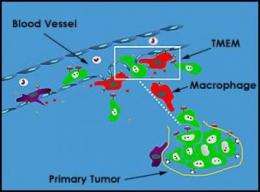
Scientists at Albert Einstein College of Medicine of Yeshiva University have previously shown that the co-mingling of three cell types can predict whether localized breast cancer will spread throughout the body. Now, a collaborative study led by investigators at NewYork-Presbyterian Hospital/Weill Cornell Medical Center, has produced a test for metastasis that could help doctors precisely identify which patients should receive aggressive therapy. This might spare many women at low risk for metastatic disease from undergoing unnecessary and potentially dangerous treatment. The findings were published today in the online version of Clinical Cancer Research.
“This is the first marker that could reliably predict metastatic outcome in a case-controlled study,” says study co-author John S. Condeelis, Ph.D., professor and co-chair of anatomy and structural biology and co-director of the Gruss Lipper Biophotonics Center at Einstein. “It could dramatically change the way we approach the care of women with breast cancer.”
The test, which most pathology labs could carry out, was developed by scientists at NewYork-Presbyterian/Weill Cornell based on the intravital imaging observations of researchers from Einstein.
Breast cancer is the most common cancer among women in the United States. Last year, approximately 182,000 women were diagnosed with breast cancer and more than 40,000 died from the disease.
Tumors in breast cancer patients are graded for degree of differentiation and staged for the extent of disease. Surgery is the first line of defense for most patients with breast cancer. For patients with higher grade tumors, additional treatment with chemotherapy or radiation is typically recommended to decrease the risk that the disease will spread. However, studies show that only 40 percent of these patients actually do develop metastatic disease. “What this means is that most of these patients are unnecessarily exposed to chemotherapy or radiation, which can have significant side effects or even worsen the disease,” says Dr. Condeelis.
Recently, Dr. Condeelis found that breast cancer spreads only when a specific trio of cells are present together in the same microanatomic site: an endothelial cell (a type of cell that lines the blood vessels), a perivascular macrophage (a type of immune cell found near blood vessels), and a tumor cell that produces Mena. The protein Mena was shown to enhance a cancer cell’s invasiveness in a collaborative study from Dr. Condeelis and Frank Gertler at the Koch Institute for Integrative Cancer Research at MIT published in Developmental Cell in December. A site with these three cells constitutes what is called a tumor microenvironment of metastasis, or TMEM.
The NewYork-Presbyterian/Weill Cornell investigators, aided by the Einstein and MIT scientists, then developed a tissue test to detect the presence and density of TMEMs. The test consists of a triple immunostain containing antibodies to the three cell types. A high number of TMEMs in a tissue sample means that the tumor is likely to metastasize or has already done so. In the current study, the immunostain was tested on breast tissue biopsy samples taken from 30 patients with advanced metastatic breast cancer and 30 patients with localized breast cancer, all of whom had been followed for at least five years. The resulting immunostains were evaluated by two pathologists who were not aware of the patients’ clinical outcomes.
Their analysis confirmed that TMEM density was significantly higher in patients who had developed metastatic breast cancer than in those who had localized disease. For every ten-unit increase in TMEM density, the risk for metastatic disease doubled. The density of any of three TMEM components alone was not sufficient to predict clinical outcome.
The study also showed that the ability of the TMEM density test to predict metastatic disease was independent of other currently used predictors, including lymph node metastasis, tumor size, presence of lymphovascular invasion, and tumor grade.
While the new test promises to reduce overtreatment of breast cancer, it could reduce undertreatment as well. “There are some patients with Grade 1 breast cancer who ultimately develop metastatic disease,” says Dr. Condeelis. “By measuring TMEM counts, we could identify those people and treat them appropriately.”
The researchers are currently working on a blood test for predicting metastatic breast cancer. In theory, such a test could predict the risk of metastatic disease even before a tumor forms. “It could be part of a routine checkup, especially for women with a strong family history of the disease,” says Dr. Condeelis. Before such a blood test could be developed for commercial use, researchers will need to conduct a population study.
The paper, “TMEM in Human Breast Carcinoma: A Potential Prognostic Marker Linked to Hematogenous Dissemination,” was published March 24th, 2009 in the online version of Clinical Cancer Research.
In addition to Dr. Condeelis, the co-authors of the paper include: Brian D. Robinson, Gabriel L. Sica, Yi-Fang Liu, Joan G. Jones of NewYork-Presbyterian Hospital/Weill Cornell Medical Center; Frank B. Gertler of Massachusetts Institute of Technology; and Thomas E. Rohan, professor of epidemiology and population health at Einstein.
Source: Albert Einstein College of Medicine


