Deep-sea rocks point to early oxygen on Earth

March 24, 2009
Pictured is a micrograph of siderite crystals with the red showing hematite inside. The dark blue is magnatite and pyrite. Credit: Hiroshi Ohmoto/Yumiko Watanabe
Red jasper cored from layers 3.46 billion years old suggests that not only did the oceans contain abundant oxygen then, but that the atmosphere was as oxygen rich as it is today, according to geologists.
This jasper or hematite-rich chert formed in ways similar to the way this rock forms around hydrothermal vents in the deep oceans today.
"Many people have assumed that the hematite in ancient rocks formed by the oxidation of siderite in the modern atmosphere," said Hiroshi Ohmoto, professor of geochemistry, Penn State. "That is why we wanted to drill deeper, below the water table and recover unweathered rocks."
The researchers drilled diagonally into the base of a hill in the Pilbara Craton in northwest Western Australia to obtain samples of jasper that could not have been exposed to the atmosphere or water. These jaspers could be dated to 3.46 billion years ago.
"Everyone agrees that this jasper is 3.46 billion years old," said Ohmoto. "If hematite were formed by the oxidation of siderite at any time, the hematite would be found on the outside of the siderite, but it is found inside," he reported in a recent issue of Nature Geoscience.
The next step was to determine if the hematite formed near the water's surface or in the depths. Iron compounds exposed to ultra violet light can form ferric hydroxide, which can sink to the bottom as tiny particles and then converted to hematite at temperatures of at least 140 degrees Fahrenheit.
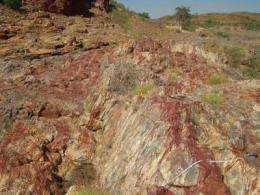
This is the location of the core drilling in the Pilbara Craton, West Australia. Credit: Hiroshi Ohmoto/Yumiko Watanabe
"There are a number of cases around the world where hematite is formed in this way," says Ohmoto. "So just because there is hematite, there is not necessarily oxygen in the water or the atmosphere."The key to determining if ultra violet light or oxygen formed the hematite is the crystalline structure of the hematite itself. If the precursors of hematite were formed at the surface, the crystalline structure of the rock would have formed from small particles aggregating producing large crystals with lots of empty spaces between. Using transmission electron microscopy, the researchers did not find that crystalline structure.
"We found that the hematite from this core was made of a single crystal and therefore was not hematite made by ultra violet radiation," said Ohmoto.
This could only happen if the deep ocean contained oxygen and the iron rich fluids came into contact at high temperatures. Ohmoto and his team believe that this specific layer of hematite formed when a plume of heated water, like those found today at hydrothermal vents, converted the iron compounds into hematite using oxygen dissolved in the deep ocean water.
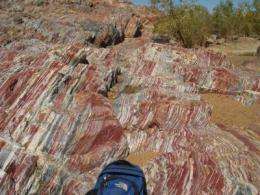
This is a banded rock formation in Pilbara Craton, West Australia. Credit: Hiroshi Ohmoto/Yumiko Watanabe
"This explains why this hematite is only found in areas with active submarine volcanism," said Ohmoto. "It also means that there was oxygen in the atmosphere 3.46 billion years ago, because the only mechanism for oxygen to exist in the deep oceans is for there to be oxygen in the atmosphere."In fact, the researchers suggest that to have sufficient oxygen at depth, there had to be as much oxygen in the atmosphere 3.46 billion years ago as there is in today's atmosphere. To have this amount of oxygen, the Earth must have had oxygen producing organisms like cyanobacteria actively producing it, placing these organisms much earlier in Earth's history than previously thought.
"Usually, we look at the remnant of what we think is biological activity to understand the Earth's biology," said Ohmoto. "Our approach is unique because we look at the mineral ferric oxide to decipher biological activity."
Ohmoto suggests that this approach eliminates the problems trying to decide if carbon residues found in sediments were biologically created or simply chemical artifacts.
-
Sulfur signature changes thoughts on atmospheric oxygen
Aug 23, 2006 |
not rated yet |
0
-
New Evidence About the Rise of Oxygen
Oct 25, 2005 |
not rated yet |
0
-
A new process for making much-sought iron nanospheres
Feb 19, 2007 |
not rated yet |
0
-
Rock: Electrons run through it
Mar 06, 2008 |
not rated yet |
0
-
Climate change and the rise of atmospheric oxygen
Mar 23, 2006 |
not rated yet |
0
-
Engineers build first sub-10-nm carbon nanotube transistor
Feb 01, 2012 |
4.9 / 5 (33) |
30
-
Something old, something new: Evolution and the structural divergence of duplicate genes
Jan 31, 2012 |
4.6 / 5 (7) |
1
-
The hidden nanoworld of ice crystals: Revealing the dynamic behavior of quasi-liquid layers
Jan 30, 2012 |
5 / 5 (4) |
1
-
Stock market network reveals investor clustering
Jan 27, 2012 |
3.9 / 5 (23) |
8
-
Of microchemistry and molecules: Electronic microfluidic device synthesizes biocompatible probes
Jan 26, 2012 |
5 / 5 (2) |
0
-
Do some geologists actually act a lot like Randy Marsh?
Feb 11, 2012
-
Discrepancy between oxygen and carbon-dioxide levels
Feb 09, 2012
-
where gems are found in the world
Feb 09, 2012
-
Wind Waves in Reservoir ~ Wind run-up and Wind set-up
Feb 08, 2012
-
Balance of oxygen in the atmosphere
Feb 01, 2012
-
The case for a methanol-based economy
Jan 30, 2012
- More from Physics Forums - Earth
More news stories
Latin America mining boom clashes with conservation
Latin America is experiencing a mining boom as prices rise fuelled by a hike in global demand, but the region is also being hit by a wave of violent protests, strikes and rallies by environmentalists.
22 hours ago |
5 / 5 (1) |
1
Salvage workers begin pumping fuel from Italian shipwreck
Salvage workers Sunday began pumping fuel from the shipwrecked Italian cruise liner Costa Concordia, a day ahead of schedule, officials said.
14 hours ago |
5 / 5 (2) |
0
Political leaders play key role in how worried Americans are by climate change: study
More than extreme weather events and the work of scientists, it is national political leaders who influence how much Americans worry about the threat of climate change, new research finds.
Feb 06, 2012 |
5 / 5 (8) |
76
NASA budget will axe Mars deal with Europe: scientists
US President Barack Obama's budget proposal to be submitted next week for 2013 will cut NASA's budget by 20 percent and eliminate a major partnership with Europe on Mars exploration, scientists said Thursday.
Space & Earth / Space Exploration
Feb 10, 2012 |
5 / 5 (4) |
58
Humans may have helped the decline of African rainforests 3000 years ago
(PhysOrg.com) -- Large areas of rainforests in Central Africa mysteriously disappeared over three thousand years ago, to be replaced by savannas. The prevailing theory has been that the cause was a change ...
Japan's Fukushima reactor may be reheating: operator
Temperature readings at one of the crippled Fukushima nuclear reactors have risen above Japan's stringent new safety standard but there was no immediate danger, its operator said Sunday.
Integrated pest management recommendations for the southern pine beetle
The southern pine beetle, Dendroctonus frontalis Zimmermann, is a chronic insect pest within pine forests in the southeastern United States. Under favorable environmental and host conditions, it is an agg ...
Botox developer rues missing out on billions
Botox developer Alan Scott says he rues the day he handed over rights to the best-selling wrinkle-smoothing drug to a US company for just $4.5 million, saying he might have become a billionaire.
Cognitive impairment in older adults often unrecognized in the primary care setting
A new study published in the Journal of the American Geriatrics Society reveals that brief cognitive screenings combined with offering further evaluation increased new diagnoses of cognitive impairment in older veterans two to ...
AT&T customers surprised by 'unlimited data' limit
(AP) -- Mike Trang likes to use his iPhone 4 as a GPS device, helping him get around in his job. Now and then, his younger cousins get ahold of it, and play some YouTube videos and games.
Australian women reject 'I love u' texts
Australian women may have embraced the digital era, but they prefer a face-to-face declaration of affection to an "I love u" text and find men addicted to their mobile phones a major turnoff.


Mar 24, 2009
Rank: 1 / 5 (1)
But it may raise the question as to whether cyanobacteria and or similar organisms are the dominant source of oxygen in the atmosphere or in fact are the source.
More research might produce the need for a rethink in this area.
This suggests a virtually stable oxygen content over an extremely long period, whereas a biological source implies a build up over a protracted period of time.
Definitely worth watching future progress in this area.