EU travellers to get cheaper mobile messages
March 24, 2009 European travellers will pay less to send text messages and access the internet via mobile phone

Enlarge

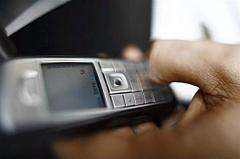
A person uses a mobile phone in Paris. European travellers will pay less to send text messages and access the internet via mobile phone networks, under a compromise deal thrashed out by EU negotiators Tuesday, a spokesman said.

European travellers will pay less to send text messages and access the internet via mobile phone networks, under a compromise deal thrashed out by EU negotiators Tuesday, a spokesman said.

The scheme -- which must yet be approved by the full and the 27 member states -- continues efforts to cap "roaming" charges -- the cost of using mobile phones while travelling in another EU nation.

EU nations and Euro MPs also agreed to new cuts in calls seeking to lower gradually to a ceiling of 35 cents (47 US cents) a minute for "roaming calls" from 2011, the parliamentary spokesman said.

The new plans broaden the net for the regulated prices by including texting for the first time.

The negotiators from the European Parliament and 27 member states called for a maximum price of 11 cents for text messages sent while abroad in the European Union, much lower than the current EU average of 29 cents which is almost 10 times the cost of sending an SMS at home.

In some countries the price of sending a "roaming" is as high as 80 cents.

For those surfing the internet on their , the plan is to impose a ceiling of 80 cents per megabyte downloaded from 2010, dropping to 50 cents a year later.

The agreement to cut "roaming" charges for mobile telephone calls continues a process begun in 2007 amid concerns that holidaymakers and others were being ripped off while abroad.

The current maximum cost for such a call is 45 cents a minute.

This should to drop to 43 cents in July, the EU negotiators said, two months earlier than planned.

The EU negotiators decided to continue lowering the maximum tariff to 39 cents next summer and 35 cents in the summer of 2011.

Also from this summer, mobile will have to charge by the second, rather than topping up to the nearest minute.

They will however be allowed to charge for 30 seconds for any very short call.

The deal thrashed out behind closed doors in Strasbourg will be put up for full parliamentary approval next month.

Parliament's chief negotiator, Romanian liberal Adina-Ioana Valean, welcomed the deal, expressing the hope that it would pass smoothly through the legislative hurdles, "in order to benefit European consumers from this summer."

(c) 2009 AFP


print this article email this article download pdf blog this article bookmark this article     Stumble it Digg this share on Facebook retweet share on Reddit add to delicious
Rate this story - not rated yet


March 24, 2009 all stories

Comments: 0

not rated yet
  • Stumble this up

  • Digg this

  • share this

  • hide
  • Related Stories


  • hide
  • Relevant PhysicsForums posts

  • Achromat lens - magnifying LCD
    created 4 hours ago
  • Control System
    created Nov 24, 2009
  • Base Isolation Systems in Skyscrapers?
    created Nov 23, 2009
  • Need to interview a Computer Hardware Engineer for school project
    created Nov 23, 2009
  • More from Physics Forums - General Engineering

Other News

Time Inc., Conde Nast and Hearst are preparing to launch an online newsstand described as an "iTunes for magazines"

Magazine publishers creating 'iTunes for magazines': reports

Technology / Internet

created 5 hours ago | popularity not rated yet | comments 0

US magazine publishers Time Inc., Conde Nast and Hearst are preparing to launch an online newsstand described as an "iTunes for magazines," according to published reports.


Should I buy a PC or Mac?

Technology / Software

created 3 hours ago | popularity 5 / 5 (1) | comments 2

Q. Our 6-year-old PC computer is dying a slow death and we are considering moving to a new iMac but have a few concerns. First, of all, we have several Word documents on our disk drive now that we want to keep and add to ...


Design chosen for British 1,000 mph car

Design chosen for British 1,000 mph car (w/ Video)

Technology / Engineering

created 15 hours ago | popularity 4.2 / 5 (5) | comments 5

(PhysOrg.com) -- A British team hoping to be the first to get a car to 1,000 mph (1,610 km/h) has made its final design selection. The six-tonne car, known as the Bloodhound, will be powered by a Eurofighter ...


Web sites aim to survive with hyperlocal focus

Technology / Internet

created 2 hours ago | popularity not rated yet | comments 0

Finding a financially viable way to provide local news is a challenge large metropolitan newspapers are confronting. But a Coral Gables, Fla., Web site is among a few locally with faith it can succeed.


ORNL 'deep retrofits' can cut home energy bills in half

ORNL 'deep retrofits' can cut home energy bills in half

Technology / Energy

created 7 hours ago | popularity 3 / 5 (2) | comments 0

(PhysOrg.com) -- Oak Ridge National Laboratory has announced plans to conduct a series of deep energy retrofit research projects with the potential to improve the energy efficiency in selected homes by as ...