DNA analysis uncovers the prehistory of Norwegian red deer
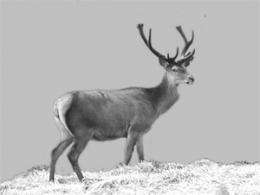
March 24, 2009
Photo:Frode Bergan
For his doctoral thesis, Hallvard Haanes discovered that Norwegian red deer are genetically different from other European red deer, due to their historical distribution. However, a century ago, red deer were imported from continental Europe to the island of Otterøya in Namsos, and these imported deer have created hybrid forms with the Norwegian red deer on the island. These hybrids have only to a modest degree become integrated with the rest of the Norwegian red deer population.
Red deer colonised Norway after the last ice age. Since then the population has been isolated from the rest of Europe, and on several occasions their numbers were reduced so dramatically that the genetic makeup became altered and genetic diversity was lost.
Analyses of the deer DNA revealed that isolation and population reduction during the eighteenth and nineteenth centuries significantly altered genetic makeup at a time when red deer were limited to just a few locations in western Norway. Genetic code was probably also lost during earlier population collapses, for example, during colonisation. "The animals that survived may be considered to have been well adapted to the Norwegian climate, but such genetic loss may in the long term reduce the ability of red deer to adapt to changes in climate and habitat", says Haanes.
In 1902 and 1904, red deer from Germany and Hungary were introduced to Otterøya, near Namsos. The doctorate shows that the genetic composition of the present-day red deer of Otterøya is a combination of Norwegian and imported forms, but that no negative consequences of this have been seen that might indicate reduced adaptability among the hybrids. Until now, hunting pressure on the hybrids has been so great that foreign genetic material has only to a limited degree been spread to the Norwegian deer population, although the hybrid population is today increasing.
The Norwegian red deer population has increased dramatically during the last century, both in number and distribution. Haanęs showed in his thesis that this increase came about at five or six locations in western Norway, which during the eighteenth and nineteenth centuries were separate entities. The current population consists of five genetically different sub-populations that have spread out from these original groups. The pattern of spread shows a relatively high degree of mixing further east as the deer followed the valleys eastward, while in the west, steep fjords and high mountain ranges created barriers for spread.
Hallvard Haanes has in addition shown that hinds are relatively sedentary and move over shorter distances than do bucks, which wander among the sub-populations to a greater degree. During the expansion of the last century, the hinds most likely moved in family units and therefore maintained the genetic integrity of the five original groups, spread over old and new regions.
The work was carried out under the auspices of the Section of Genetics, the Norwegian School of Veterinary Science, in collaboration with the Department of Health & Social Work Studies, Telemark University College, Norway. In addition, Norwegian and international hunters and veterinarians contributed samples to the project.
Cand. scient. Hallvard Haanes defended his doctoral thesis, entitled "Genetic variation and structure in Norwegian red deer", at the Norwegian School of Veterinary Science, on January 15, 2009.
Provided by Norwegian School of Veterinary Science
-
Maine weather wreaking havoc on deer
Mar 30, 2008 |
not rated yet |
0
-
Extinct giant deer relative found in U.K.
Sep 07, 2005 |
not rated yet |
0
-
Red Deer Confirms Global Warming
Jul 25, 2005 |
not rated yet |
0
-
Deer denigrate Pennsylvania forests
Apr 02, 2007 |
not rated yet |
0
-
Rhode Island deer tick effort under way
Nov 04, 2005 |
not rated yet |
0
-
Engineers build first sub-10-nm carbon nanotube transistor
Feb 01, 2012 |
4.9 / 5 (31) |
30
-
Something old, something new: Evolution and the structural divergence of duplicate genes
Jan 31, 2012 |
4.6 / 5 (7) |
1
-
The hidden nanoworld of ice crystals: Revealing the dynamic behavior of quasi-liquid layers
Jan 30, 2012 |
5 / 5 (3) |
1
-
Stock market network reveals investor clustering
Jan 27, 2012 |
3.9 / 5 (23) |
8
-
Of microchemistry and molecules: Electronic microfluidic device synthesizes biocompatible probes
Jan 26, 2012 |
5 / 5 (1) |
0
-
Factors affecting beet root cell membrane
4 hours ago
-
Stem cell question.
Feb 10, 2012
-
Protease cleavage
Feb 10, 2012
-
Pertubance in a model
Feb 10, 2012
-
Cancer drugs and Alzheimer's, Oh my!
Feb 09, 2012
-
Squishing cells
Feb 09, 2012
- More from Physics Forums - Biology
More news stories
Entire genome of extinct human decoded from fossil
(PhysOrg.com) -- In 2010, Svante Pääbo and his colleagues presented a draft version of the genome from a small fragment of a human finger bone discovered in Denisova Cave in southern Siberia. The ...
Feb 07, 2012 |
4.7 / 5 (58) |
48
|
Why are there so few fish in the Earth's oceans?
(PhysOrg.com) -- A Stony Brook University researcher has found that, contrary to popular belief, there are not plenty of fish in the sea.
Feb 08, 2012 |
4.3 / 5 (17) |
27
|
Miami battling invasion of giant African snails
No one knows how they got there. But an invasion of African giant snails has southern Florida in a panic over potential crop damage, disease and general yuckiness surrounding the slimy gastropods.
Feb 10, 2012 |
4.7 / 5 (3) |
5
Deciding to go left or right: Researchers use device to determine that lower animals can navigate too
For decades, scientists have associated binary decision making opting to go left or right with higher-ranking animals, including humans. A team of Harvard researchers, however, is rewriting that ...
Feb 09, 2012 |
4 / 5 (1) |
4
|
Study shows chimps able to understand needs of others
(PhysOrg.com) -- By setting up a unique experiment, a small team of researchers has found that chimpanzees are able to understand need in other chimps, despite their general disinclination to offer aid when ...
Injured boomers beware: Know when to see doctor
(AP) -- It happened to nurse Jane Byron years after an in-line skating fall, business owner Haralee Weintraub while doing "men's" push-ups, and avid cyclist Gene Wilberg while lifting a heavy box.
Google might launch Drive for cloud storage soon
(PhysOrg.com) -- Google's next big move, according to the Wall Street Journal, is a cloud storage service called Drive. Hardly first to the plate, Google is simply catching up to introducing its cloud reposi ...
Latin America mining boom clashes with conservation
Latin America is experiencing a mining boom as prices rise fuelled by a hike in global demand, but the region is also being hit by a wave of violent protests, strikes and rallies by environmentalists.
Love a click away in Indonesia's Twitter Republic
He was a geeky kid from Yogyakarta, she a glamorous city girl in Jakarta. In a country with one of the world's most vibrant social networking scenes they fell in love on Twitter.
Europeans protest controversial Internet pact
Tens of thousands of people marched in protests in more than a dozen European cities Saturday against a controversial anti-online piracy pact that critics say could curtail Internet freedom.
Walney offshore wind farm is world's biggest (for now)
(PhysOrg.com) -- The Walney wind farm on the Irish Sea--characterized by high tides, waves and windy weather--officially opened this week. The farm is treated in the press as a very big deal as the Walney ...