Atlantic snails are increasing dramatically in size
March 24, 2009 Atlantic snails are increasing dramatically in size, Queen's researcher discovers

Enlarge

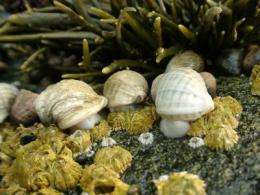
These snails are feeding on barnacles on the Maine shoreline. Credit: Jonathan A. D. Fisher

A Queen's University biologist has discovered that the shell lengths of snails in the northwest Atlantic Ocean - an important member of the Atlantic food chain - have increased by 22.6 per cent over the past century. Until now, this significant change in the marine ecosystem has gone unnoticed.

"We found a dramatic increase in size, which could affect the entire intertidal food chain," says Jonathan Fisher, Queen's Postdoctoral Fellow and the leader of the study. Growing larger shells is a major way for the to avoid predators, he explains. Previous and continuing research has also found that large snails tend to prey on mussels and barnacles and spend less time resting between feedings, compared to small snails.

The findings will appear online this week in the journal .

The team used museum collections from the Academy of Natural Sciences of Philadelphia as a base for their data. They measured the shells from 19 lots of shells gathered between 1915 and 1922, and compared them with samples from the same 19 locations today. The increase in size was striking however, the researchers are unsure exactly why the snails are growing so large, so rapidly.

"Many documented environmental changes between these time periods could affect snail survival or growth rates," Dr. Fisher suggests. "We're finding fewer predatory fish now, which would allow the snails to grow." The temperature of the water today is warmer than 100 years ago, which could also account for faster growth of the snails, he adds.

"But regardless of the factors that contributed to the size increase, the marine landscape is changing dramatically on a historic timescale. That's what is really important here," says Dr. Fisher.

Source: Queen's University


print this article email this article download pdf blog this article bookmark this article     Stumble it Digg this share on Facebook retweet share on Reddit add to delicious
Rate this story - 4.5 /5 (4 votes)


March 24, 2009 all stories

Comments: 0

4.5 /5 (4 votes)
  • Stumble this up

  • Digg this

  • share this

  • hide
  • Related Stories

  • The beetle's dilemma
    created Jun 26, 2007 | popularity not rated yet | comments 0
  • Calif. scientists battle Kiwi mud snails
    created Jun 12, 2006 | popularity not rated yet | comments 0
  • Giant snails a danger in Florida
    created Aug 10, 2005 | popularity not rated yet | comments 0
  • Well-travelled snails hitch a ride around the globe
    created Jan 30, 2006 | popularity not rated yet | comments 0
  • Glimmer of hope for Tahitian tree snails' survival
    created Jul 02, 2007 | popularity not rated yet | comments 0


  • hide
  • Relevant PhysicsForums posts

Other News

World's rarest gorilla ready for its close-up

World's rarest gorilla ready for its close-up (w/ Video)

Biology / Plants & Animals

created 55 minutes ago | popularity not rated yet | comments 1

The world's rarest -- and most camera shy -- great ape has finally been captured on professional video on a forested mountain in Cameroon, according to the Wildlife Conservation Society and Germany's NDR Naturfilm.


Toward reading your own personal 'Book of Life'

Biology / Biotechnology

created 25 minutes ago | popularity not rated yet | comments 0

What secrets about your risk for diseases are written in your own personal "Book of Life" -- the 30,000 or so genes that make you you?


Bacteria wouldn't opt for a swine flu shot

Biology / Cell & Microbiology

created 2 hours ago | popularity not rated yet | comments 1

Bacteria inhabited our planet for more than 4 billion years before humans showed up, and they'll probably outlive us by as many eons more. That suggests they may have something to teach us.


Surveying bird biodiversity from space?

Biology / Ecology

created 1hour ago | popularity not rated yet | comments 0

(PhysOrg.com) -- A fundamental rule of wildlife ecology says that diverse habitats foster greater biodiversity: The Amazon has far more species than Greenland. But how do habitat and biodiversity relate in a state like Wisconsin, ...


Marking of tissue-specific crucial in embryonic stem cells to ensure proper function

Biology / Cell & Microbiology

created 3 hours ago | popularity 5 / 5 (1) | comments 0

Tissue-specific genes, thought to be dormant or not marked for activation in embryonic stem cells, are indeed marked by transcription factors, with proper marking potentially crucial for the function of tissues derived from ...