A New Family of Molecules for Self-Assembly: The Carboranes
March 24, 2009
A new family of molecules for self-assembly: The carboranes

Enlarge

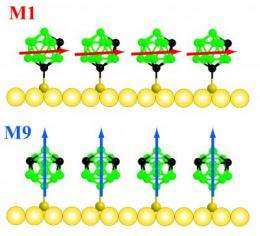
Schematic showing relative dipole orientations for the carboranethiol isomers, M1 and M9. The M1 molecule's dipole is oriented nearly parallel to the surface of the SAM, while the M9 molecule's dipole is oriented perpendicular to the surface of the SAM. The arrows point in the direction of positive charge. Credit: J. Nathan Hohman, Penn State

(PhysOrg.com) -- To be useful in real-world applications, a self-assembled monolayer (SAM) of molecules on a surface must have a stable and controllable geometry. Researchers at Penn State and the Sigma-Aldrich company have found a way to control geometry and stability by making SAMs out of different carboranethiol isomers, which are cage-like molecules. The research results will be published in the March 2009 issue of the journal ACS Nano.

"Our results allow us to control the chemical and physical properties of the SAM without changing its structure," said team leader Penn State Distinguished Professor of Chemistry and Physics Paul Weiss. "The ability to control these types of properties enables us to create SAMs that, for example, selectively capture biomolecules from complex mixtures. These carboranethiol give us exceptionally high-quality SAMs, largely because of their simplicity. This innovation opens up new capabilities in terms of patterning and control. We are trying to come up with simple and economical means to control the chemistry of a all the way from the wafer scale (several centimeters) down to the single-molecule scale (sub-nanometer)."
A new family of molecules for self-assembly: The carboranes
Enlarge

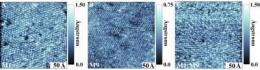
Scanning tunneling microscope images of carboranethiol SAMs (M1 (left), M9 (middle), and mixed (right)) all have the same lattice. Credit: J. Nathan Hohman, Penn State

Using two different carboranethiol isomers, the team built SAMs that have identical geometries, as well as selectable interaction strengths. They found that they could easily control the chemical properties, including chemical resistance and wettabilitity, of the new SAMs. "The beauty of self-assembled monolayers is that with a one-nanometer or two-nanometer-thick film, we completely changed the chemical, physical, and biological properties of the surface," said Weiss.

To build the new SAMs, the researchers performed separate experiments in which they attached one of two, or both, versions of a carboranethiol molecule -- either a meta-9 (M9) or a meta-1 isomer (M1) -- to gold surfaces through sulfur-gold bonds. Each of the carborane cages consists of 10 and two . The carbon atoms have an unusual hexa-coordinated structure that gives them a positive charge. As a result, the carborane cages have a dipole moment -- a measure of the separated charge of a molecule that helps determine its interaction with water and other molecules -- that is either nearly parallel to the surface of the SAM (for M1, in which sulfur is attached to a carbon atom in the carborane cage) or nearly perpendicular to the surface of the SAM (for M9, in which sulfur is attached to a boron atom in the carborane cage).

"Both the M1 and M9 molecules form the same structure on the surface of the SAM, but the M1 molecules make the SAM more stable, while the M9 molecules make the SAM more hydrophilic, or wettable," said Weiss. "Each of these properties is beneficial for different applications."

Specifically, the group determined that the M1 molecules interacted more strongly with one another than the M9 molecules interacted with each other due to dipole interactions between the M1 cages. As a result, more energy was required to remove an M1 molecule from the SAM, thus creating a more stable SAM. On the other hand, the M9 SAM, although less stable, was able to become wet more easily than the M1 SAM because the dipole was oriented toward the outside of the SAM.

"Carborane chemistry is so well-understood that there is a lot we can do to exploit these SAMs," said Weiss. "For example, we can add more chemical groups onto selected spots on SAMs to determine the supra-molecular, or overall, properties of a SAM that go beyond the properties of a single molecule."

Weiss, his lab group, and Viktor Balema, a product manager at Sigma-Aldrich Co, plan to continue their work to develop a library of carboranethiols that can be used to make novel nanostructures and nanodevices.

Provided by Pennsylvania State University (news : web)

4.3 /5 (3 votes)  

Rank 4.3 /5 (3 votes)
Related Stories
Relevant PhysicsForums posts
  • Corrosion Tests on Magnesium
    created13 hours ago
  • polyethylene copper nanocomposite
    created18 hours ago
  • Output of xrd analysis
    createdFeb 08, 2012
  • Transport phenomena problem based on problems 18.B11 and 19B.6 from Bird, stewart, lw
    createdFeb 06, 2012
  • Help with material selection - Car Piston
    createdFeb 05, 2012
  • Name of the steel alloy?!!?
    createdFeb 02, 2012
  • More from Physics Forums - Materials & Chemical Engineering

More news stories

'Dark plasmons' transmit energy

Microscopic channels of gold nanoparticles have the ability to transmit electromagnetic energy that starts as light and propagates via "dark plasmons," according to researchers at Rice University.

Nanotechnology / Nanophysics

created 8 hours ago | popularity 5 / 5 (4) | comments 0 | with audio podcast

Nanotube therapy takes aim at breast cancer stem cells

Wake Forest Baptist Medical Center researchers have again proven that injecting multiwalled carbon nanotubes (MWCNTs) into tumors and heating them with a quick, 30-second laser treatment can kill them.

Nanotechnology / Bio & Medicine

created 13 hours ago | popularity 5 / 5 (1) | comments 0 | with audio podcast

Inspired by steel, nanomanufacturing gets wear-resistant carbide tip

(PhysOrg.com) -- Scientists at the University of Pennsylvania, the University of Wisconsin-Madison and IBM Research - Zurich have fabricated an ultrasharp silicon carbide tip possessing such high strength ...

Nanotechnology / Nanophysics

created 18 hours ago | popularity 5 / 5 (3) | comments 1 | with audio podcast

New technology platform for molecule-based electronics

Researchers at the Nano-Science Center at the University of Copenhagen have developed a new nano-technology platform for the development of molecule-based electronic components using the wonder material graphene. At the same ...

Nanotechnology / Nanomaterials

created 15 hours ago | popularity 5 / 5 (2) | comments 0

Australians risking skin cancer to avoid nanoparticles

More than three in five Australians are concerned enough about the health implications of nanoparticles in sunscreens to want to know more about their impact. And while the initial scientific information released suggests ...

Nanotechnology / Bio & Medicine

created 17 hours ago | popularity 5 / 5 (1) | comments 0


FDA-approved drug rapidly clears amyloid from the brain, reverses Alzheimer's symptoms in mice

Neuroscientists at Case Western Reserve University School of Medicine have made a dramatic breakthrough in their efforts to find a cure for Alzheimer's disease. The researchers' findings, published in the journal Science, show t ...

Hydrogen from acidic water: Researchers develop potential low cost alternative to platinum for splitting water

A technique for creating a new molecule that structurally and chemically replicates the active part of the widely used industrial catalyst molybdenite has been developed by researchers with the Lawrence Berkeley ...

Ultraviolet protection molecule in plants yields its secrets

Lying around in the sun all day is hazardous not just for humans but also for plants, which have no means of escape. Ultraviolet (UV) radiation from the sun can damage proteins and DNA inside cells, leading ...

Anyone can learn to be more inventive, cognitive researcher says

There will always be a wild and unpredictable quality to creativity and invention, says Anthony McCaffrey, a cognitive psychology researcher at the University of Massachusetts Amherst, because an "Aha moment" is rare and ...

Soraa LED light may dim 50-watt halogen rivals

(PhysOrg.com) -- Soraa, a Fremont, California company founded in 2008, this week launched its first product, a light that uses LEDS (light emitting diodes). The "Soraa LED MR16 lamp" is the "perfect" replacement ...

Flexible paper robots

(PhysOrg.com) -- These inexpensive robots can stretch, bend and twist under control, and lift objects up to 120 times their own weight. Being soft, they can apply gentle and even pressure, and adapt to varied ...