Biologists discover a protein link to wound healing
Diabetes and eczema may appear to be two completely unrelated diseases. But UC San Diego biologists have uncovered what appears to be a crucial biochemical link between the two.
The scientists report in the March 26 issue of the journal Nature their discovery that a protein previously linked only to cell death, plays a critical role in the healing of wounds in laboratory mice. This protein, known as caspase 8, is deficient in humans with eczema, but produced in excess amounts by diabetics.
The researchers say their discovery may explain why many diabetics lack a normal wound response and suffer severe complications from minor cuts and scrapes, and why those with eczema exhibit a chronic inflammation of the skin that compromises its protective function.
"Not only does the loss of this protein, caspase 8, stimulate inflammation, which brings in a rush of cells designed to stop microbes from infecting the wound," said Colin Jamora, an assistant professor of biology at UCSD who headed the research team. "But it also stimulates the production of stem cells that provide the materials to help close the wound. That's important, because in the initial stages of a wound the protective barrier provided by the skin is broken and the internal body is exposed to microbes and environmental toxins."
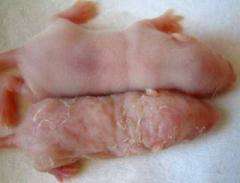
The discovery occurred by accident when Jamora, who studies the stem cell progenitors of skin cells and hair follicles, was asked by a colleague—Steve Hedrick, a professor of biology at UCSD—whether he wanted to examine a mutant mouse with unusually thick skin that had been genetically engineered in his laboratory. Hedrick's team had knocked out the gene in the epidermis necessary for the production of caspase 8.
The skin is the largest organ in the mammalian body. The average adult human, according to Jamora, has six pounds of skin that spans approximately 21 square feet. What's more, our skin is constantly being replaced because skin cells have a short lifespan and are genetically programmed to die.
Jamora said he initially suspected that the reason for the unusually thick-skinned mutant mouse was that the lack of caspase 8 in the epidermis was somehow interfering with the "death program" of the skin cells, leading to an accumulation of skin cells that should have otherwise died. As a result, the mutant mouse had an epidermal layer that was five times thicker than normal, creating infections, dehydration and other problems that led these mice to have an average lifespan of only 15 days.
"But what was actually happening was not that the skin cells were living longer, but that the lack of caspase 8 was stimulating more skin cells to divide, which was unexpected," said Jamora. "And when we looked further, we also found that there was inflammation going on in the skin of these mice. Those two things led us to suspect that the loss of caspase 8 can trigger a normal wound-healing response in the absence of any trauma to the skin."
In order to heal wounds, animals have three responses: inflammation, in which the body brings disease-fighting cells to the site of the wound; proliferation, in which stem cells are triggered to produce more skin cells to fill the wound; and remodeling, in which the skin is smoothed over to look as normal as possible.
Because caspase 8 resides in cells at the surface of the epidermis, this presented a conundrum for Jamora who knew that the stem cells responsible for the proliferation phase were deeper in the tissue and the infection-fighting cells in the blood vessels responsible for the inflammation phase were deeper still.
"The question was how does a protein in cells near the top of the skin signal the stem cells deep within the tissue as well as the cells circulating within the bloodstream to come over to the site of the wound, proliferate and do their jobs?" said Jamora. "What we discovered was that the loss of caspase 8 in the epidermis releases a protein from the cells called interleukin 1-alpha that can travel deeper into the tissue to recruit immune cells and cause the local reservoirs of stem cells in the skin to start proliferating. This protein is well known as a stimulator of an inflammatory response, but this is the first time anyone has demonstrated that caspase 8 triggers the release of this protein and how it does so."
The team of UCSD researchers that contributed to this study included members of the Jamora lab—Pedro Lee, Dai-Jen Lee, Carol Chan and Shih-Wei Chen—in collaboration with Irene Ch'en from the laboratory of Steve Hedrick.
Jamora and his colleagues are now studying laboratory mouse models of human diabetes, which produce excess amounts of caspase 8, to determine if artificially damping their production of caspase 8 will restore their ability to heal wounds.
"We are also using the caspase-8 knockout mouse as a model system to study eczema in order to identify the players that contribute to this disorder and thereby unveil new therapeutic targets to attack a disease that affects 10 to 20 percent of children worldwide," Jamora said.
"The number of cases of eczema and diabetics with complications from impaired wound healing are both rising dramatically and we hope that our current efforts to understand the regulation and function of caspase 8 in the skin will contribute to alleviating the pain and suffering of the millions of people with these diseases."
Source: University of California - San Diego


