Scientists find 56 new species in Papua New Guinea
Jumping spiders, a tiny chirping frog and an elegant striped gecko are among 56 species believed new to science discovered during a Conservation International (CI) Rapid Assessment Program (RAP) expedition to Papua New Guinea's highlands wilderness.
The discoveries were announced today following analysis of the species that were found in July and August of 2008 during a month-long exploration of Papua New Guinea's central mountains. CI scientists were joined by scientists from Papua New Guinea and the University of British Columbia (UBC) and Montclair State University to explore the region alongside members of local communities.
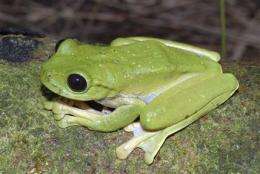
More than 600 species were documented during the expedition. Of those, a total of 50 spider species, two plants, three frogs and one gecko are believed to be new to science. The three frogs include a tiny brown frog with a sharp chirping call (Oreophryne sp.), a bright green tree frog with enormous eyes (Nyctimystes sp.), and a torrent-dwelling frog that has a loud ringing call (Litoria sp.). The gecko (Cyrtodactylus sp.) was the only specimen of its kind found in the dense rainforest.
"The vast Kaijende Uplands and nearby valleys represent one of Papua New Guinea's largest undeveloped highlands wilderness areas, and all of it is under the tenure of local clan landowners. These forests are essential to their traditional lifestyles," said CI scientist Steve Richards, who led the expedition.
Local clan communities rely on this wilderness area for hunting and collecting forest products, and the region is a critical source of clean drinking water to tens of thousands of valley people living in the Enga Southern Highlands, Sandaun and Western Provinces. Globally, this vast forested wilderness is critical in helping slow climate change by sequestering large amounts of the greenhouse gas carbon dioxide.
As part of the expedition, Montclair State University anthropologist Dr. William Thomas worked with the local Hewa clans to document the natural history and local knowledge of these resources as part of the "Forest Stewards" project, an initiative started by Dr. Thomas and CI's Dr. Bruce Beehler.
"Dr. Thomas has devoted his professional life to the study of the traditional knowledge system of the Hewa people," Beehler said. "Their intimate knowledge of and stewardship over a large tract of this vast upland wilderness has led to conservation of their wildlife and environment. Dr. Thomas's goal is to help the Hewa continue this indigenous stewardship into the next century, for the good of these people and the world at large."
The discovery of three entirely novel genera from among the spider species discovered is particularly noteworthy, said UBC scientist Wayne Maddison, Director of the new Beaty
Biodiversity Museum. "They are strikingly distinctive evolutionary lineages that had been unknown before, with a group that is already very distinctive on the evolutionary tree of jumping spiders," said Maddison. "Their key position on the evolutionary tree will help us understand how this unique group of jumping spiders has evolved."
Much of Papua New Guinea's vast wilderness remains unexplored for scientific documentation. CI's RAP program is planning three more expeditions to the country in 2009 with the first beginning in early April.
The expedition was funded by Porgera Joint Venture (PJV), principally owned by Barrick Gold Corporation. The resulting report will provide information for decision makers trying to balance development with protecting biodiversity that benefits local communities and the global ecosystem. The findings will be used to inform future conservation activities, the PJV mining operation, and development decisions by the local and national government.
"This underlines how passionate we are about our environmental responsibilities and we are pleased to be able to contribute towards the discovery of new plant and animal life but more importantly, their preservation for the future generations," said Barrick General Manager Papua New Guinea, Mark Fisher.
Source: Conservation International


