Spacetime May Have Fractal Properties on a Quantum Scale
March 25, 2009 By Lisa Zyga
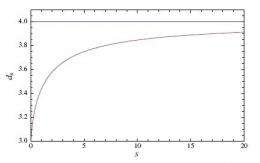
As scale decreases, the number of dimensions of k-Minkowski spacetime (red line), which is an example of a space with quantum group symmetry, decreases from four to three. In contrast, classical Minkowski spacetime (blue line) is four-dimensional on all scales. This finding suggests that quantum groups are a valid candidate for the description of a quantum spacetime, and may have connections with a theory of quantum gravity. Image credit: Dario Benedetti.
(PhysOrg.com) -- Usually, we think of spacetime as being four-dimensional, with three dimensions of space and one dimension of time. However, this Euclidean perspective is just one of many possible multi-dimensional varieties of spacetime. For instance, string theory predicts the existence of extra dimensions - six, seven, even 20 or more. As physicists often explain, it’s impossible to visualize these extra dimensions; they exist primarily to satisfy mathematical equations.
As if extra dimensions weren’t strange enough, new research has probed an even more mind-bending possibility: that spacetime has dimensions that change depending on the scale, and the dimensions could have fractal properties on small scales. In a recent study, Dario Benedetti, a physicist at the Perimeter Institute for Theoretical Physics in Waterloo, Ontario, has investigated two possible examples of spacetime with scale-dependent dimensions deviating from classical values at short scales. More than being just an interesting idea, this phenomenon might provide insight into a quantum theory of relativity, which also has been suggested to have scale-dependent dimensions. Benedetti’s study is published in a recent issue of Physical Review Letters.
“It is an old idea in quantum gravity that at short scales spacetime might appear foamy, fuzzy, fractal or similar,” Benedetti told PhysOrg.com. “In my work, I suggest that quantum groups are a valid candidate for the description of such a quantum spacetime. Furthermore, computing the spectral dimension, I provide for the first time a link between quantum groups/noncommutative geometries and apparently unrelated approaches to quantum gravity, such as Causal Dynamical Triangulations and Exact Renormalization Group. And establishing links between different topics is often one of the best ways we have to understand such topics.”
In his study, Benedetti explains that a spacetime with quantum group symmetry has in general a scale-dependent dimension. Unlike classical groups, which act on commutative spaces, quantum groups act on nocommutative spaces (e.g. where xy doesn’t equal yx), which emerges through their unique curvature and quantum uncertainty. Here, Benedetti considers two types of spacetime with quantum group symmetry - a quantum sphere and k-Minkowski spacetime - and calculates their dimensions. In both spaces, the dimensions have fractal properties at small scales, and only reach classical values at large scales.
“In simple words, the relation between quantum groups and noncommutative geometry is as follows,” he explained. “Classically, we know that certain spaces are invariant under the action of some classical groups; for example, Euclidean space is invariant under rotations and translations. A quantum group is a deformation of a given classical group, and is such that no classical space can have it as a symmetry group. The invariant space has to be as well a deformation of a classical space, a deformation that makes it noncommutative. No relation of all this to fractals is known, but in my work I've found that they do have a common property, that is, a non-integer dimension (at some scale).”
Compared to a Euclidean sphere, a quantum sphere’s curvature and uncertainty make it a noncommutative space. When calculating the spectral dimension of the quantum sphere, Benedetti found that it closely resembles a standard sphere on large scales; however, as the scale decreases, the dimensions of the quantum sphere deviate and go down to zero. He describes this phenomenon as a signature of the fuzziness, or uncertainty, of the quantum sphere, and also as resulting from fractal behavior at small scales.
In the second kind of space, k-Minkowski spacetime, the dimensions also deviate from the constant behavior of classical Minkowski spacetime. While the latter always has four dimensions, independent of the scale, the number of dimensions in the quantum version decreases to three as a function of the scale. In both k-Minkowski spacetime and the quantum sphere, the dimensionality becomes non-integral, which is a typical signature of fractal geometry.
Benedetti’s results match previous approaches to quantum gravity, which also point to the emergence of a ground-scale spacetime with fractal properties. Together, these studies may help scientists understand the unique Planck scale properties of spacetime, and possibly tie in to a quantum theory of gravity. For instance, as Benedetti explains, the fractal nature of quantum spacetime might enable gravity to cure its own ultraviolet behavior by dimensional reduction.
“The main problem with gravity is that apparently it cannot be quantized as other field theories; in jargon it is said to be non-renormalizable,” he said. “This problem is specific to four-dimensional spacetime. If spacetime had only two dimensions, then quantum gravity would be much simpler and treatable. The problem with a two-dimensional theory is that it is unphysical, as we see four dimensions at our scales. Things can be solved combining four and two dimensions at different scales. That is, if gravity itself provides a mechanism by which the dimension of spacetime depends on the scale at which we probe it (four at our and larger scales and two at very short scales), then we could have a physical theory (compatible with observations) that is free of quantum (short scale) troubles.”
More information: Benedetti, Dario. “Fractal Properties of Quantum Spacetime.” Physical Review Letters 102, 111303 (2009).
Copyright 2009 PhysOrg.com.
All rights reserved. This material may not be published, broadcast, rewritten or redistributed in whole or part without the express written permission of PhysOrg.com.


I am also convinced that there are extra dimensions. One of these extra dimensions explain the curvature of space time.
The question is then, which at "scale" is the "baseline" that which all the dimensions can be measured at once? If one exists at all...
Perhaps such would be relegated to a "virtual" scale independent equation.
Identifying all of the variables on the different scales seems like quite a insurmountable task. How would we know if we even quantified them all... I suppose "when the equation breaks for the known set of data."
Definitely one of the more interesting and thought provoking articles on Physorg (physics) as of late.
http://www.quantu...nts.html
As the Singulaity approaches we will be very interested in whether machines can have conscious minds. A theory concerning how this can happen should help things along.
Get real...
Elves* you numbnut. You are also welcome to bring us something that proves you enlightened point of view.
Of course, and ideal gas is the simplest representation of every entropic system. We shouldn't replace natural phenomena by abstract concepts, because lost of general insight, connections and information. If we are saying, "quantum mechanics is of entropic character", we can deduce another atributes of quantum mechanic systems, because these systems share many common aspects of their behavior, not just probability or entropy distribution. Density fluctuations of gas have shape of strings and membranes and many other atributes, which can be predicted/computed by this model.
For example, the density fluctuations inside of gas aren't always flat. If the gas is sparse, they have rather spherical character. After then we can model fluctuations as a system of kissing hypersheres, where just the 3D hypersheres allows the most compact distribution. This determines the number of spatial dimensions of our space-time. It appears as so large, because it's the most compact one possible.
Inside of more dense gas, though, a less compact density fluctuations appears: membranes and strings. The lower number of space-dimensions is compensates by increasing number of time dimensions and the system becomes chaotic from our 3D perspective. Therefore our view of reality doesn't differ from perspective, which "would see" some 3D fluctuation of gas, when interacting with other fluctuations (strings, branes or hyperspheres).
Or whether we would interpret things like dispersion, refraction and nonlinear energy spreading like manifestation of supergravity, hidden dimensions and Lorentz symmetry violation phenomena.
This is radical new approach to reality, but I'm convinced, we cannot consider both variants at the same moment from consistency reasons. For example, we shouldn't expect/look for hidden dimensions and Lorentz invariance at the same moment.
http://aetherwave...ory.html
From practical reasons it's always possible to handle exceptions separatelly, but when spending money for basic research in physics, we should make clear for yourself, which model we want to consider for future. The laymans can retain their plural/fragmented view of reality, but theorists should be perfectly aware of what they're looking for.
Too funny.
Regarding how mass can warp space(time)...
Imagine a rubber sheet stretched over a frame - like a drum. If you compact an area of the sheet, it becomes denser - that's your mass. The area of the sheet surrounding the mass is your "warping" of spacetime - gravity.
When this analogy is usually delivered, it is said "the mass is sitting on top of the rubber sheet..."
This is a mistake... Mass and spacetime are not separate entities, they are one in the same, but simply density fluctuations of the "medium."
If you imagine this concept in three dimensions, you'll have a much more accurate picture of reality.
Here's a controversy associated with El Naschie's publishing in journal Chaos, Solitons and Fractals, though.
http://slashdot.o.../1831225
At the moment, we use combination of ad-hoced theories of uncertain consistency scope, we can be never sure by relevance of output to observable reality. The fuzinness of such approach isn't in its formal rigor, but the postulate consistency. We simply don't know, if postulates of relativity and quantum mechanics plays together, which ones are inconsistent or redundant, and so on.
If we don't understand the nature of fundamental elements, which is wrong - we should build a general theory from our local experience, which is perfectly known and understood - despite the fact, the assumptions, which are more distant from our everyday reality can provide a "more numbers" temporarily.
We should realize, no ad-hoced idea can serve as an explanation, until we have understood its causual base. In AWT the fractality of Universe is consequence of its multicomponent nature of gradient driven reality, i.e. the fact, every object here is a gradient, formed by density fluctuations of many other objects. These gradients - no matter, how strangely they may appear from proximity - can be extrapolated like countable, i.e. colliding pin-point particles, when observed from sufficient distance and their fields can be interpreted like mutually penetrating hyperspheres of various diameter.
http://superstrun...comb.gif
By this way, observable reality appears/can be modeled like density fluctuations of very dense gas (interior of black hole) from less or more distant, i.e. general perspective - i.e. it's a completelly a probability game. The density fluctuations in particle gas are always of fractal nature, becuase they can behave like another generation of fluctuations and so on. From more general perspective they would appear like clouds or Perlin noise, evoking a heaven archetype.
I'm not saying, this approach is the only way, how to interpret fractal nature of reality - but currently I don't see any better solution. At the moment, someone will introduce a more general and simpler way, I'll forget AWT concept immediately.
Prof. El Nashie's theory may appear like numerology for many physicists, but deeper insight reveals many connection points of his theories with another ones, like Lisi Garret E8 theory, string theory and so on.
For example, in his later work he presents a model of fractal or fuzzy self-similar Borromean rings under bold claim "This knot is related to the wild topology relevant to E-infinity theory with a random Cantor set as the limit set of the fractal-like knots." http://tinyurl.com/d7sj65
A rigorous proof is missing here, simply because E-infinity theory has no defined postulate set, being based on geometrical coincidencies. But the same problem exists with string theory or even LQG theory. You can never find a postulate list of these theories on the web, so you can never decide, whether some particular insight may be derived from this theory, or not.
But knowledgable reader can see a reference to gradient driven reality and brane cosmology immediatelly. By ekpyrotic cosmology our Universe emerged as a result of brane collision. Aether theory connects this insight into so called shock wave cosmology and the dynamics of collapsar formation.
http://superstrun...apse.gif
http://aetherwave...ogy.html
By AWT observable Universe appears like being formed by interior of black hole, formed by mutual collisions of real density gradients during collapse of dense star in form of fast expanding spherical shock waves. The remnants of this geometry can be seen in structure of dark matter streaks.
As we can see, while ad-hoced, Ek Nashie's geometry isn't completelly off topic here and it has a deeper meaning here. The structure of intersection points has a close relation to Lie E8 group, as presented in Lisi Garrets theory. Both these guys are talking about the same geometry, like brane cosmologists - they just don't know about it. They're all very productive people and simply have no time to check & reconcile ideas of others. This is an advantage of various "cranks", like me, who simply have a time to do this job.
Such situation is nothing very new in science. If we analyze history of most of important scientific theories, we will see a very deep roots and the fact, first formulations of these theories were rather formal and ad-hoced. The complete understanding of these ideas has come cradually.
By AWT such evolution is not accidental at all, because phase transition in human understanding are Lagrangian particle physics driven by the same way, like phase transitions of matter - theories are serving for intensification of causual energy spreading through human society by the same way, like formation of density gradients inside of dense particle gas. So we can consider physical theories like interesction/collision points of many other, less or vague ideas, which are becoming a source of another ideas, recursivelly.
Unfortunatelly, even whole pile of math won't help us in such understanding - we're required to have illustrative insight into situation first. But at the moment, we understood the simmilar points of many ideas, the further generalization of them becomes a way easier then before.
If we go deeper into history of mankind, we will often see a lot of controversy behind achievments of various individuals. In certain sense, whole the existence of observable matter is a sort of cheating. If every tiny black hole may lead to evaporation of Earth, it's apparent, our reality is metastable - we aren't supposed to be here, we should evaporate a long time before. We can talk about it, we can judge it - or we can simply incorporate this fact into our theories of reality.
In this way, such observation is rather evidence of particle Aether model, then the fractal nature of it and every notion of fractals is irrelevant here. BTW every decreasing of dimensionality is manifestation of ISL violation for light and gravity and Lorentz symmetry violation as well (therefore the violation of string theory, which is based on special relativity and it assumes the existence of additional dimensions instead of reduction of their number), etc...
To me, the quantum foam (as interface) operating at Planck scale enables the many worlds of Hugh Everett to emerge and perhaps, this fractal theory could, in conjunction with quantum gravity, could explain how this amazing process happens.
Just a thought.
Well if we find it does then we've learned something profoud about the multiverse. If we can interact with them, then they must at some level be operating on the same laws and princiles ours does...or at least some of them do...
Instead of this, such people prefer mysticism and abstract superstitions injected into their heads by modern priests, who are serving like drain for their taxes by the same way like people of medieval era. Youre all naive religious tribesmen, face it.
"By AWT Youre all naive religious tribesmen, face it."?
Or did you just forget the cool aid/brainwashing for a second?
Every person believes in something and it makes no problem, until these individual beliefs are different - but at the moment, everyone believes in the same thing, such belief becomes intersubjective truth, which is impossible to falsify. At the end the power of all these tiny bits of subjective stance creates an immense force of crowd and every person, which defies it is crushed with no mercy.
From article finding doesn't follows in logical way, space-time should have a fractal nature. While such idea appears quite acceptable for many people here, it's just Aether theory, which enables to deduce it logically, because density fluctuations inside of particle gas are always of fractal nature by their very nature.
By such way, you're accepting a theorem, which you don't understand, whereas you're refuting a concept, which enables you to derive this theorem in logical way. Such scrambled approach is explainable only by fact, you're brainwashed by simmilar articles, like this one.
Or you're one of mainstream scientists - and after then a generally better line of reasoning is expected. Natural competetion of ideas should be usefull even for science, don't you think? Nobody has a patent for definite knowledge - until you're not a Pope, indeed.
%u2018If the observations of galaxies in optical surveys don%u2019t agree, there may be a number of possible explanations, without resorting to an extremely inhomogeneous, fractal universe,%u2019 he told New Scientist. These are direct quotes from the New Scientist link here http://www.newsci...page=1.I remain dubious of the claims presented in their paper & await further study of the subject.
The paper by Dario Benedetti in Physical Review Letters is undoubtedly an important paper. It comes meantime as no surprise however that Mohamed Elnaschie was there first. Please see the paper by him titled: Quantum Groups and Hamiltonian Sets on a Nuclear Spacetime Cantorian Manifold, in Chaos, Solitons & Fractals, vol. 10, pp 1251-1256. This paper is 1999 almost ten years ago. In table 1 Elnaschie calculates what seems to me to be spectral dimensions and Hausdorff dimensions. Two other papers from the same author in the same year and same Journal seem to discuss various related topics in more details. The first is Jones%u2019 Invariant, Cantorian Geometry and Quantum Spacetime, vol. 10, No 7, pp 1241-1251. The second is The Golden Mean in Quantum Geometry, Knot Theory and Related Topics, Vol. 10 No 8, pp 1203-1307. I have started to form my own opinion about certain things. In all events the claim of priority reported in the article seems to be inaccurate. This is not a calamity but as I said it seems to explain to me certain, how should I say, anomalies.
Andy Somer
Fractal universe, fractal reality?
Fractal corridors? Existence, reality, universe is built by?
As space expands outwards since the big bang, it expands inwards too?
Observer to Planck length distance, fractal? Why we perceive continuity, out of the energy packets (quanta), the physical world is made out of?
Fractal dimensions harbour parallel worlds?
Sub-atomic particles having zero rest mass. Universe, an infinitesimally thin sheet?
Space, a result of forces? Interaction of forces? It is bound to be.
Arrived to thoughts that looks at the world, the universe as fractal, by following a path where chaos, is seen as the generator of the reality, we live in. Chaos, being ubiquitous and universal, becomes a tool to provide the explanations human individuals are seeking out.
Individuals experience the world. What experience is based upon. Would it be diferent if:
Human experience. What if, our human resolving time was on a par with the resolving time of a fast electronic device?
and how do we amass knowledge? Comes out of agreement or compromise,
Convention? What kind of convention is that? Agreement or compromise?