Flatland physics probes mysteries of superfluidity
March 25, 2009 Flatland physics probes mysteries of superfluidity

Enlarge

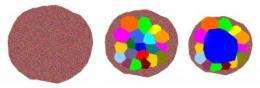
A gas of atoms arranged in a single, flat layer ordinarily has "thermal" behavior (left) in which the atoms act as individual entities. At lowered temperatures, the gas transforms into a "quasi-condensate" (middle) consisting of little islands (schematically represented as colored blobs) that fluctuate in time; within each island atoms act as a single coordinated entity. At lower temperatures still, the gas enters the superfluid "BKT" phase (right): the islands start to coalesce and atoms can flow frictionlessly within the merged area. Credit: Credit: Kristian Helmerson, JQI

(Physorg.com) -- If physicists lived in Flatland—the fictional two-dimensional world invented by Edwin Abbott in his 1884 novel—some of their quantum physics experiments would turn out differently (not just thinner) than those in our world. The distinction has taken another step from speculative fiction to real-world puzzle with a paper* from the Joint Quantum Institute (JQI) reporting on a Flatland arrangement of ultracold gas atoms. The new results, which don’t quite jibe with earlier Flatland experiments in Paris, might help clarify a strange property: “superfluidity.”

In three dimensions, cooling a of certain to sufficiently low temperatures turns them into a Bose-Einstein condensate (BEC). As predicted in the 1920s (and first demonstrated in 1995) the once individualistic gas atoms begin to move as a single, coordinated entity. But back in 1970, theorists predicted that something different would happen in two dimensions: an ultracold gas of interacting atoms would undergo the analogous “Berezinskii, Kosterlitz and Thouless” (BKT) transition, in which atoms don’t quite move in lockstep as they do in a BEC, but mysteriously share some of a BEC’s properties, such as , or frictionless flow.

In new experiments at the Joint Quantum Institute (JQI), a partnership of the National Institute of Standards and Technology (NIST) and the University of Maryland, a team of physicists led by JQI Fellow Kristian Helmerson has achieved the latest of the BKT transition. The JQI researchers trap and cool a micron-thick layer of atoms, confined to move in only two dimensions. At higher temperatures, the atoms have normal “thermal” behavior in which they act as individual entities, but then as the temperature lowers, the gas transforms into a “quasi-condensate,” consisting of little islands each behaving like a tiny BEC.

By further lowering the temperature, the gas makes the transition to a BKT where the islands begin to merge into a sort of “United States” of superfluidity. In this situation, an atom can flow unimpeded between neighboring “states” since the borders of the former islands are not well defined, but one can tell that the atom is “not in Kansas anymore,” in contrast to a BEC where one cannot pinpoint the location of a particular atom anywhere in the gas.

When a Paris group lowered the temperature of their 2-D gas in earlier experiments, they only saw a sharp transition from to a BKT superfluid, rather than the additional step of the non-superfluid quasi-condensate. But the Paris group used rubidium atoms, which are heavier and more strongly interacting, possibly exhibiting a qualitatively different behavior. These new results may cast light on superfluidity, which decades after its discovery still seems to hold new mysteries.

More information: * P. Cladé, C. Ryu, A. Ramanathan, K. Helmerson and W.D. Phillips. Observation of a 2D Bose-gas: From thermal to quasi-condensate to superfluid. Physical Review Letters, forthcoming.

Provided by National Institute of Standards and Technology (news : web)


print this article email this article download pdf blog this article bookmark this article     Stumble it Digg this share on Facebook retweet share on Reddit add to delicious
Rate this story - 4.5 /5 (8 votes)

Rank Filter

Move the slider to adjust rank threshold, so that you can hide some of the comments.


Display comments: newest first

  • QubitTamer - Mar 26, 2009
    • Rank: not rated yet
    Since there is no actual two dimensional domain other than in thought experiments to help people visualize higher dimensions than three, how is this relevant?

    Even if squished down each atom has actual dimension in length, width, and height as miniscule as it is...
  • anothergreenbus - Mar 29, 2009
    • Rank: not rated yet
    Alizee,
    Fascinating. Can you provide any links for additional information on the internet?

  • Alizee - Mar 29, 2009
    • Rank: not rated yet
    .. the islands start to coalesce and atoms can flow frictionlessly within the merged area..
    This spherical arrangement is a result of field gradient, which keeps clouds of atom in boson condensate together, rather then gravity.

    http://superstrun...apor.avi

    But we can met with the same picture at all scales, from superconductivity (where electrons are attracted to hole stripes) to galaxies, which can be understood as an islands of quasicondensate (stelar clusters and their planetary systems) with central chaotic portion at the center, represented by black hole. The dimensional scale doesn't fit, but the principle may remain the very same.

    http://superstrun...form.gif

March 25, 2009 all stories

Comments: 3

4.5 /5 (8 votes)
  • Stumble this up

  • Digg this

  • share this

  • hide
  • Related Stories

  • Scientists Announce First Observation of ‘Persistent Flow’ in a Gas
    created Nov 27, 2007 | popularity not rated yet | comments 0
  • Simply Weird Stuff: Making Supersolids with Ultracold Gas Atoms
    created Jan 13, 2009 | popularity not rated yet | comments 0
  • Atom 'noise' may help design quantum computers
    created Mar 02, 2007 | popularity not rated yet | comments 0
  • MIT physicists shed new light on superfluidity
    created Jul 20, 2006 | popularity not rated yet | comments 0
  • New Technique Reveals Hidden Properties of Ultracold Atomic Gases
    created Aug 06, 2008 | popularity not rated yet | comments 0


  • hide
  • Relevant PhysicsForums posts

  • Unitary Operators
    created 2 hours ago
  • Subatomic Reversibility of Time?
    created 8 hours ago
  • vacuum question
    created 11 hours ago
  • inertia
    created 12 hours ago
  • More from Physics Forums - General Physics

Other News

Superconductor magnet heat shield being developed

Superconductor magnet spacecraft heat shield being developed

Physics / General Physics

created 11 hours ago | popularity 5 / 5 (14) | comments 11

(PhysOrg.com) -- European space agencies and an aerospace giant are developing a new re-entry heat shield that will use superconductor magnets to generate a magnetic field strong enough to deflect the superhot ...


Bacteria

Plasma produces KO cocktail for MRSA

Physics / General Physics

created 12 hours ago | popularity 4.9 / 5 (10) | comments 2

MRSA (methicillin-resistant Staphylococcus Aureus) and other drug-resistant bacteria could face annihilation as low-temperature plasma prototype devices have been developed to offer safe, quick, easy and un ...


Restored machine to explore mysteries of Big Bang (AP)

Restored machine to explore mysteries of Big Bang

Physics / General Physics

created Nov 21, 2009 | popularity 4.6 / 5 (18) | comments 26

(AP) -- Scientists are preparing the world's largest atom smasher to explore the depths of matter after successfully restarting the $10 billion machine following more than a year of repairs.


Scientists react as they stand in front of a screen at CERN

First atoms reported smashed in Large Hadron Collider (Update)

Physics / General Physics

created Nov 23, 2009 | popularity 4.5 / 5 (30) | comments 22

Two circulating beams on Monday produced the first particle collisions in the world's biggest atom smasher, the Large Hadron Collider (LHC), three days after its restart, scientists announced.


nuclear power plant

Doubts raised on nuclear industry viability

Physics / General Physics

created Nov 19, 2009 | popularity 3 / 5 (22) | comments 19

(PhysOrg.com) -- The investment in nuclear power has been growing around the world over the last few years, being viewed as a means for countries to control their energy security, avoid the price fluctuations ...