Missing or mutated 'clock' gene linked to vascular disease
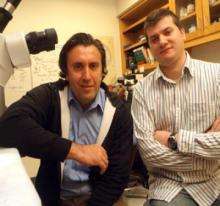
The circadian clocks that set the rhythmic motion of our bodies for wakeful days and sleepy nights can also set us up for vascular disease when broken, Medical College of Georgia researchers say.
Mice with mutated or missing "clock" genes are prone to thick, inflexible blood vessels with narrow passageways, unhealthy changes typically associated with risk factors such as smoking, high blood pressure and cholesterol, according to research in this week's issue of Circulation.
"Having a bad or broken clock seems to promote vascular disease," says Dr. Daniel Rudic, vascular biologist in the MCG Schools of Medicine and Graduate Studies and the study's corresponding author.
The findings suggest increased disease risk for those with mutated clocks, shift workers whose schedule are routinely in conflict with their natural rhythms, as well as others with poor sleep patterns. They also support the merit of developing time-released meds that are in sync with circadian rhythms.
Clock genes are ubiquitous and scientists are finding they seem to have different roles in different tissues. Clocks in the brain that regulate waking and sleeping interact with clocks throughout the body. But researchers are finding the body clocks also can act autonomously, playing a role in a variety of different conditions such as obesity and diabetes.
Inside blood vessels, MCG researchers found that clocks regulate key signaling that enables blood vessel dilation and remodeling. Mice with missing or mutated clock genes have significantly less AKT, an enzyme that promotes the blood-vessel relaxing molecule nitric oxide, and less of nitric oxide precursor eNOS. In animal models of vascular disease, the altered or missing clocks dramatically accelerated the unhealthy vascular response. In aged mice, the response is even worse, including a predisposition for developing clots.
Yet mice with mutated rather than missing clock gene fared much better in normal light-dark cycles than those in constant darkness. It was only in constant darkness that vascular injury occurred.
"The dysfunction is clearly light-cycle dependent, demonstrating these effects are related to circadian rhythm," Dr. Rudic says. The importance of circadian rhythm on vascular health indicates "inherent circadian defects may be prevented from producing pathology if one maintains a rhythmic environment," write Drs. John F. Keaney Jr. and David R. Weaver of the University of Massachusetts in an accompanying editorial.
But that may have nothing to do with a good night's sleep. "We believe there may be defects in the circadian rhythm that have nothing to do with behavioral aberrations," Dr. Rudic says. In fact, a subset of hypertensive people sleep just fine but a defective blood pressure rhythm precludes the usual nighttime dip - a risk factor for cardiovascular disease.
This suggests that clocks may work normally in the brain but malfunction in blood vessels and other tissues to bring on hypertension and vascular disease, the MCG researchers say.
The researchers want to better understand how the circadian clock controls signaling and vascular disease in blood vessels. Is the central clock in the brain sending bad information to the blood vessels or are the local blood vessel clocks the culprit? Conversely, can vascular disease disrupt the clock? Answering such questions will help determine whether therapy to block the damage is possible.
In fact, it may mostly be about timing. "We know blood pressure has a rhythm and we know contraction and relaxation of blood vessels have a rhythm," Dr. Rudic says. "What happens if you have a broken clock in the long term? What happens if you are a night shift worker or somebody who can't sleep? If our timing is off inside our blood vessels, we are vulnerable."
Dr. Ciprian B. Anea, MCG postdoctoral fellow in pharmacology and toxicology and the study's first author uses the sunflower, which opens just before the sun rises, to describe the importance of the circadian rhythm to well being. "It just opens, waiting for the sun to catch all the energy and save it for its metabolism." Left in the dark, a sunflower still keeps its schedule.
"This is how the circadian rhythm works," Dr. Anea says. "It prepares us for daylight, starts the metabolism in the cell. When you disturb the mechanism, bad things can happen."
"We are just scratching the surface of understanding the circadian clock and its impact in humans," Dr. Rudic says. "Clearly it's been established that heart attack and stroke typically happen in the morning when blood pressure tends to peak. We need to know more about what happens to these genes and clock proteins in conditions of human disease."
Source: Medical College of Georgia


