Rotation is key to understanding volcanic plumes
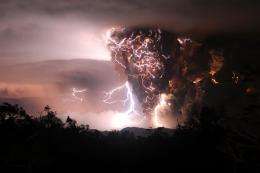
(PhysOrg.com) -- A 200-year-old report by a sea captain and a stunning photograph of the 2008 eruption of Mount Chaiten are helping scientists at the University of Illinois better understand strong volcanic plumes.
in a paper to appear in the March 26 issue of the journal Nature, the scientists show that the spontaneous formation of a "volcanic mesocyclone" - a cyclonically rotating columnar vortex - causes the volcanic plume to rotate about its axis. The rotation, in turn, triggers a sheath of lightning and creates waterspouts or dust devils. The origins of these volcanic phenomena were previously unexplained.
"Rotation is an essential element of a strong volcanic plume," said Pinaki Chakraborty, a postdoctoral researcher and the paper's lead author. "By taking into account the rotation, we can better predict the effects of volcanic eruptions."
In 2008, a photograph of the Mount Chaiten eruption in southern Chile showed what appeared to be a volcanic plume wrapped in a sheath of lightning. A search for references to other occurrences of lightning sheaths led Chakraborty, mechanical science and engineering professor Gustavo Gioia and geology professor Susan W. Kieffer to an obscure paper by a sea captain, published in 1811.
In that paper, the sea captain reported his observations of a volcanic vent that emerged from the sea in the Azores archipelago and formed a large volcanic plume.
According to the captain, the plume rotated on the water "like an (sic) horizontal wheel" and was accompanied by continuous "flashes of lightning" and a "quantity of waterspouts."
This conjunction of rotation, lightning and waterspouts (or dust devils on land) is characteristic of a familiar meteorological phenomenon seemingly unrelated to volcanic plumes: a tornadic thunderstorm.
The same process that creates a mesocyclone in a tornadic thunderstorm also creates a volcanic mesocyclone in a strong volcanic plume, Chakraborty said. "What happens in tornadic thunderstorms is analogous to what happens in strong volcanic plumes."
A strong volcanic plume consists of a vertical column of hot gases and dust topped with a horizontal "umbrella." A volcanic mesocyclone sets the entire plume rotating about its axis. The mesocyclone spawns waterspouts or dust devils, and groups the electric charges in the plume to form a sheath of lightning, as was so prominently displayed in the eruption of Mount Chaiten.
The rotation of strong volcanic plumes may be verified by observations from space, the scientists report. On June 15, 1991, the eruption of Mount Pinatubo in the Philippines was recorded by a satellite snapping hourly images. The images show that the edge of Pinatubo's umbrella was rotating about its center, consistent with the presence of a volcanic mesocyclone.
The images also show that after rotating for a while, the umbrella lost axial symmetry and became lobate in plan view. This loss of axial symmetry is another effect of the rotation, which destabilizes the edge of the umbrella and makes it lobate, the scientists report.
Lobate umbrellas have been found in satellite images of other volcanoes, including Mount Manam in Papua New Guinea, Mount Reventador in Ecuador and Mount Okmok in the Aleutian Islands.
Satellite images of future volcanic plumes taken at intervals of a few minutes would make it possible to trace the evolution of umbrellas in detail, Gioia said. In addition, some of the tools commonly used in the study of thunderstorms could be deployed for the study of volcanic eruptions.
"The structure and dynamics of volcanic mesocyclones, as well as the presence of lightning sheaths, might be verified with Doppler radar and lightning mapping arrays, two technologies that have been scarcely used in volcanology," Gioia said.
Provided by University of Illinois at Urbana-Champaign (news : web)


