New drug agent knocks out multiple enzymes in cancer pathway
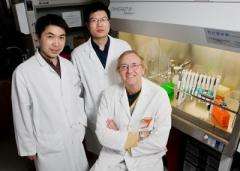
A team of 24 researchers from the U.S., Europe, Taiwan and Japan and led by University of Illinois scientists has engineered a new anti-cancer agent that is about 200 times more active in killing tumor cells than similar drugs used in recent clinical trials.
The study appears this week in the Journal of the American Chemical Society.
The new agent belongs to a class of drugs called bisphosphonates. These compounds were originally developed to treat osteoporosis and other bone diseases, but were recently found to also have potent anti-cancer and immune boosting properties.
Drug developers have tried for years to design drugs to inhibit cell survival pathways in tumor cells, focusing on a protein called Ras since nearly a third of all human cancers involve a mutation in the Ras gene that causes cell signaling to go awry. These efforts have met with limited success.
Bisphosphonates act on other enzymes, called FPPS and GGPPS, which are upstream of Ras in the cell survival pathway. Inhibiting these enzymes appears to be a more effective strategy for killing cancer cells.
When used in combination with hormone therapy in a recent clinical trial, the bisphosphonate drug zoledronate significantly reduced the recurrence of breast cancer in premenopausal women with estrogen-receptor-positive breast cancer. Similar results were reported previously for hormone-refractory prostate cancer.
But zoledronate quickly binds to bone, reducing its efficacy in other tissues.
"We're trying to develop bisphosphonates that will be very active but won't bind to the bone, because if they bind to the bone they're not going to go to breast, lung or other tissues," said University of Illinois chemistry professor Eric Oldfield, who led the new study.
Oldfield's team also wanted to design a compound that would inhibit multiple enzymes in the tumor cell survival pathway, rather than just one, an approach analogous to the use of multi-kinase inhibitors in cancer therapy.
Andrew Wang, of Academia Sinica, Taipei, and Illinois chemist Rong Cao began by producing crystallographic structures of the target enzymes and drug candidates, allowing the researchers to identify those features that would enhance the drugs' ability to bind to the enzymes. Using this and other chemical data, Illinois chemistry department research scientist Yonghui Zhang engineered new bisphosphonate compounds that bound tightly to multiple enzyme targets, but not to bone.
One of the new compounds, called BPH-715, proved to be especially potent in cell culture and effectively inhibited tumor cell growth and invasiveness.
Tadahiko Kubo, of Hiroshima University, then found that BPH-715 also killed tumor cells in mice. And Socrates Papapoulos, of Leiden University, the Netherlands, showed that the compound had a very low chemical affinity for bone.
In humans, compounds like BPH-715 and zoledronate have an added benefit in fighting cancer: They spur the proliferation of immune cells called gamma delta T-cells, which aid in killing tumor cells.
"The new drugs are about 200 times more effective than the drugs used in recent clinical trials at killing tumor cells and in activating gamma delta T-cells to kill tumor cells," Oldfield said. "They also prevent tumor progression in mice much better than do existing bisphosphonate molecules."
Source: University of Illinois at Urbana-Champaign (news : web)


