Erratic black holes regulate their growth (w/Videos)
March 25, 2009
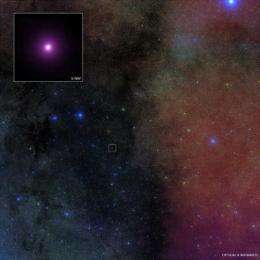
This optical and infrared image from the Digitized Sky Survey shows the crowded field around the micro-quasar GRS 1915+105 (GRS 1915 for short) located near the plane of our Galaxy. The inset shows a close-up of the Chandra image of GRS 1915, one of the brightest X-ray sources in the Milky Way galaxy. This micro-quasar contains a black hole about 14 times the mass of the Sun that is feeding off material from a nearby companion star. As the material swirls toward the black hole, an accretion disk forms. Powerful jets have also been observed in radio images of this system, along with remarkably unpredictable and complicated variability ranging from timescales of seconds to months. Credit: X-ray: NASA/CXC/Harvard/J. Neilsen et al. Optical: Palomar DSS2
(PhysOrg.com) -- New results from NASA's Chandra X-ray Observatory have made a major advance in explaining how a special class of black holes may shut off the high-speed jets they produce. These results suggest that these black holes have a mechanism for regulating the rate at which they grow.
Black holes come in many sizes: the supermassive ones, including those in quasars, which weigh in at millions to billions of times the mass of the Sun, and the much smaller stellar-mass black holes which have measured masses in the range of about 7 to 25 times the Sun's mass. Some stellar-mass black holes launch powerful jets of particles and radiation, like seen in quasars, and are called "micro-quasars".
The new study looks at a famous micro-quasar in our own Galaxy, and regions close to its event horizon, or point of no return. This system, GRS 1915+105 (GRS 1915 for short), contains a black hole about 14 times the mass of the Sun that is feeding off material from a nearby companion star. As the material swirls toward the black hole, an accretion disk forms.
This system shows remarkably unpredictable and complicated variability ranging from timescales of seconds to months, including 14 different patterns of variation. These variations are caused by a poorly understood connection between the disk and the radio jet seen in GRS 1915.
This video is not supported by your browser at this time.
This animation shows how radio jets may be suppressed in the micro- quasar GRS 1915. Material is being pulled from a red companion star into a black hole via a blue, rapidly rotating disk. The animation begins with a jet blowing material away from the black hole. Later, when the disk is heated by powerful radiation from close to the black hole, a wind is driven off the disk. As the wind strengthens, the jet apparently is shut down because the wind deprives the jet of material that would otherwise have fueled it. Credit: NASA/CXC/A. Hobart
Chandra, with its spectrograph, has observed GRS 1915 eleven times since its launch in 1999. These studies reveal that the jet in GRS 1915 may be periodically choked off when a hot wind, seen in X-rays, is driven off the accretion disk around the black hole. The wind is believed to shut down the jet by depriving it of matter that would have otherwise fueled it. Conversely, once the wind dies down, the jet can re-emerge."We think the jet and wind around this black hole are in a sort of tug of war," said Joseph Neilsen, Harvard graduate student and lead author of the paper appearing in the journal Nature. "Sometimes one is winning and then, for reasons we don't entirely understand, the other one gets the upper hand."
The latest Chandra results also show that the wind and the jet carry about the same amount of matter away from the black hole. This is evidence that the black hole is somehow regulating its accretion rate, which may be related to the toggling between mass expulsion via either a jet or a wind from the accretion disk. Self-regulation is a common topic when discussing supermassive black holes, but this is the first clear evidence for it in stellar-mass black holes.
This video is not supported by your browser at this time.
Micro-quasar GRS 1915+105, located near the plane of the Milky Way galaxy. Image credit: X-ray: NASA/CXC/Harvard/J. Neilsen et al. Optical: Palomar DSS2
"It is exciting that we may be on the track of explaining two mysteries at the same time: how black hole jets can be shut down and also how black holes regulate their growth," said co-author Julia Lee, assistant professor in the Astronomy department at the Harvard-Smithsonian Center for Astrophysics. "Maybe black holes can regulate themselves better than the financial markets!"Although micro-quasars and quasars differ in mass by factors of millions, they should show a similarity in behavior when their very different physical scales are taken into account.
"If quasars and micro-quasars behave very differently, then we have a big problem to figure out why, because gravity treats them the same," said Neilsen. "So, our result is actually very reassuring, because it's one more link between these different types of black holes."
The timescale for changes in behavior of a black hole should vary in proportion to the mass. For example, an hour-long timescale for changes in GRS 1915 would correspond to about 10,000 years for a supermassive black hole that weighs a billion times the mass of the Sun.
"We cannot hope to explore at this level of detail in any single supermassive black hole system," said Lee. "So, we can learn a tremendous amount about black holes by just studying stellar-mass black holes like this one."
It is not known what causes the jet to turn on again once the wind dies down, and this remains one of the major unsolved mysteries in astronomy.
"Every major observatory, ground and space, has been used to study this black hole for the past two decades," said Neilsen. "Although we still don't have all the answers, we think our work is a step in the right direction."
Source: Chandra X-ray Center
-
Spin of Supermassive Black Holes Measured for First Time
May 30, 2007 |
not rated yet |
0
-
Chandra finds black holes are 'green'
Apr 24, 2006 |
not rated yet |
0
-
A new way to weigh giant black holes
Jul 16, 2008 |
not rated yet |
0
-
Scientists find the reason behind black holes' light shows
Jun 21, 2006 |
not rated yet |
0
-
No matter their size black holes 'feed' in the same way
Dec 06, 2006 |
not rated yet |
0
-
Engineers build first sub-10-nm carbon nanotube transistor
Feb 01, 2012 |
4.9 / 5 (32) |
30
-
Something old, something new: Evolution and the structural divergence of duplicate genes
Jan 31, 2012 |
4.6 / 5 (7) |
1
-
The hidden nanoworld of ice crystals: Revealing the dynamic behavior of quasi-liquid layers
Jan 30, 2012 |
5 / 5 (4) |
1
-
Stock market network reveals investor clustering
Jan 27, 2012 |
3.9 / 5 (23) |
8
-
Of microchemistry and molecules: Electronic microfluidic device synthesizes biocompatible probes
Jan 26, 2012 |
5 / 5 (2) |
0
-
Never ending outer space.....
15 hours ago
-
Neutron Star fragments?
17 hours ago
-
stationary or not?
21 hours ago
-
Scale of the Universe
Feb 10, 2012
-
Titan's lack of impact craters
Feb 09, 2012
-
Real pictures of black hole eating a star?
Feb 08, 2012
- More from Physics Forums - General Astronomy
More news stories
Salvage workers begin pumping fuel from Italian shipwreck
Salvage workers Sunday began pumping fuel from the shipwrecked Italian cruise liner Costa Concordia, a day ahead of schedule, officials said.
2 minutes ago |
not rated yet |
0
Latin America mining boom clashes with conservation
Latin America is experiencing a mining boom as prices rise fuelled by a hike in global demand, but the region is also being hit by a wave of violent protests, strikes and rallies by environmentalists.
8 hours ago |
not rated yet |
0
Political leaders play key role in how worried Americans are by climate change: study
More than extreme weather events and the work of scientists, it is national political leaders who influence how much Americans worry about the threat of climate change, new research finds.
Feb 06, 2012 |
5 / 5 (6) |
73
NASA budget will axe Mars deal with Europe: scientists
US President Barack Obama's budget proposal to be submitted next week for 2013 will cut NASA's budget by 20 percent and eliminate a major partnership with Europe on Mars exploration, scientists said Thursday.
Space & Earth / Space Exploration
Feb 10, 2012 |
5 / 5 (3) |
55
Humans may have helped the decline of African rainforests 3000 years ago
(PhysOrg.com) -- Large areas of rainforests in Central Africa mysteriously disappeared over three thousand years ago, to be replaced by savannas. The prevailing theory has been that the cause was a change ...
Scientists discover molecular secrets of 2,000-year-old Chinese herbal remedy
For roughly two thousand years, Chinese herbalists have treated Malaria using a root extract, commonly known as Chang Shan, from a type of hydrangea that grows in Tibet and Nepal. More recent studies suggest that halofuginone, ...
New method to examine batteries -- MRI from the inside
There is an ever-increasing need for advanced batteries for portable electronics, such as phones, cameras, and music players, but also to power electric vehicles and to facilitate the distribution and storage of energy derived ...
A mitosis mystery solved: How chromosomes align perfectly in a dividing cell
Although the process of mitotic cell division has been studied intensely for more than 50 years, Whitehead Institute researchers have only now solved the mystery of how cells correctly align their chromosomes during symmetric ...
Starve a virus, feed a cure? Findings show how some cells protect themselves against HIV
A protein that protects some of our immune cells from the most common and virulent form of HIV works by starving the virus of the molecular building blocks that it needs to replicate, according to research published online ...
Researchers find extensive RNA editing in human transcriptome
In a new study published online in Nature Biotechnology, researchers from BGI, the world's largest genomics organization, reported the evidence of extensive RNA editing in a human cell line by analysis of RNA-seq data, demons ...
The proteins ensuring genome protection
Researchers from the University of Geneva (UNIGE), Switzerland, have discovered the crucial role of two proteins in developing a cell 'anti-enzyme shield'. This protection system, which operates at the level of molecular ...
Mar 25, 2009
Rank: 1.8 / 5 (5)
Mar 25, 2009
Rank: not rated yet
Mar 25, 2009
Rank: 5 / 5 (2)
Mar 26, 2009
Rank: not rated yet
Mar 31, 2009
Rank: not rated yet