Shuttle undocks from space station after 8 days
March 25, 2009 By MARCIA DUNN , AP Aerospace Writer
Shuttle Discovery undocks from space station (AP)

Enlarge

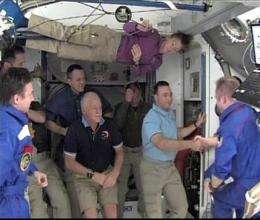
In this image from NASA Television, Wednesday, March 25, 2009, shuttle Discovery commander Lee Archambault shakes hands with international space station commander Mike Fincke, far right, as they depart the ISS. From left Yury Lonchakov, Steve Swanson, Richard Arnold, John Phillips and Tony Antonelli. At the top is Sandra Magnus. (AP Photo/NASA TV)

(AP) -- After eight days together, space shuttle Discovery pulled away from the international space station Wednesday, beaming down stunning photos of the orbiting outpost, finally balanced and boasting all its solar wings.

NASA was thrilled to see the space station with its new glistening pair of solar wings - the final ones that will boost electrical power and science research. The shuttle took a victory lap around the station, primarily for picture-taking, and then put itself on a course for a Saturday touchdown.

"The $100 billion photograph," flight director Kwatsi Alibaruho said, showing off one of the snapshots. He noted that was the space station price tag cited by senators during President Barack Obama's call to the astronauts the day before. NASA disputes that amount, "so that's a little joke we've got in Mission Control," he said.

With the installation last week of the last set of solar wings, the space station finally resembles the artist renderings from years past, balanced with four wings on both sides.

"You always saw it in the pictures and you just wondered if you're really ever going to get there," said Dan Hartman, a space station manager who's worked on the project for 15 years. He took "an extreme amount of pride and joy" in seeing the images sent down.

NASA expects the extra electrical power to drastically increase the amount of research in the various labs that make up the 220-mile-high outpost.

"You made the space station much better than it was before," Fincke told the shuttle astronauts just before their departure. "You gave us more power, symmetry - which is not to be underrated - and you gave us a new crew member."

That new member, Japanese astronaut Koichi Wakata, remained behind on the space station with Fincke and a Russian cosmonaut.

Sandra Magnus, whom Wakata replaced, kept waving as she disappeared down the hatch and floated into Discovery. Wednesday marked her 131st day in space; she moved into the space station in mid-November.

"All of you guys, this is the toughest part of the mission, at least for me," Fincke said. "On one hand, it's a moment of triumph ... and yet on the other hand, we're going to really be missing you."

The two crews embraced as they said goodbye and closed the hatches. The actual undocking occurred a few hours later, as the spacecraft soared over the Indian Ocean.

"Godspeed," called out Fincke. He added: "Come again."

Fincke and his crew will be getting company again in just a few days. A Russian Soyuz rocket is set to lift off Thursday with two new station crewmates and a billionaire tourist along for the ride; they'll arrive this weekend. Fincke then will return to Earth with Microsoft Word and Excel developer Charles Simonyi and cosmonaut Yuri Lonchakov.

Discovery is bringing back five months of experiments from the space station. The 80 to 90 vials of blood, urine and saliva samples were stuffed into the shuttle freezer or wrapped in ice packs.

Discovery also is returning four to five liters of recycled water made from the astronauts' urine and sweat. NASA wants to make sure the water is safe before space station astronauts start drinking it there; test results are expected in about a month.

The reclaimed water is an essential part of NASA's plan to double the size of the space station crew, to six, in just another two months.

Discovery supplied the space station with a new urine processor to replace the original one, which malfunctioned.

---

On the Net:

NASA: http://spaceflight.nasa.gov

©2009 The Associated Press. All rights reserved. This material may not be published, broadcast, rewritten or redistributed.


Rank 5 /5 (1 vote)
Related Stories
Relevant PhysicsForums posts
  • Never ending outer space.....
    created12 hours ago
  • Neutron Star fragments?
    created14 hours ago
  • stationary or not?
    created18 hours ago
  • Scale of the Universe
    createdFeb 10, 2012
  • Titan's lack of impact craters
    createdFeb 09, 2012
  • Real pictures of black hole eating a star?
    createdFeb 08, 2012
  • More from Physics Forums - General Astronomy

More news stories

Latin America mining boom clashes with conservation

Latin America is experiencing a mining boom as prices rise fuelled by a hike in global demand, but the region is also being hit by a wave of violent protests, strikes and rallies by environmentalists.

Space & Earth / Environment

created 5 hours ago | popularity not rated yet | comments 0

Political leaders play key role in how worried Americans are by climate change: study

More than extreme weather events and the work of scientists, it is national political leaders who influence how much Americans worry about the threat of climate change, new research finds.

Space & Earth / Environment

created Feb 06, 2012 | popularity 5 / 5 (6) | comments 72

NASA budget will axe Mars deal with Europe: scientists

US President Barack Obama's budget proposal to be submitted next week for 2013 will cut NASA's budget by 20 percent and eliminate a major partnership with Europe on Mars exploration, scientists said Thursday.

Space & Earth / Space Exploration

created Feb 10, 2012 | popularity 5 / 5 (3) | comments 55

Humans may have helped the decline of African rainforests 3000 years ago

(PhysOrg.com) -- Large areas of rainforests in Central Africa mysteriously disappeared over three thousand years ago, to be replaced by savannas. The prevailing theory has been that the cause was a change ...

Space & Earth / Environment

created Feb 10, 2012 | popularity 4.1 / 5 (14) | comments 20 | with audio podcast report

High planetary tilt lowers odds for life?

Highly-tilted worlds would have extreme seasons, subjecting life to alternating periods of scorching and subzero temperatures. This could make the development of all but hardiest, simplest creatures a long ...

Space & Earth / Space Exploration

created Feb 06, 2012 | popularity 4.8 / 5 (12) | comments 14 | with audio podcast


Google might launch Drive for cloud storage soon

(PhysOrg.com) -- Google's next big move, according to the Wall Street Journal, is a cloud storage service called Drive. Hardly first to the plate, Google is simply catching up to introducing its cloud reposi ...

Love a click away in Indonesia's Twitter Republic

He was a geeky kid from Yogyakarta, she a glamorous city girl in Jakarta. In a country with one of the world's most vibrant social networking scenes they fell in love on Twitter.

Europeans protest controversial Internet pact

Tens of thousands of people marched in protests in more than a dozen European cities Saturday against a controversial anti-online piracy pact that critics say could curtail Internet freedom.

Walney offshore wind farm is world's biggest (for now)

(PhysOrg.com) -- The Walney wind farm on the Irish Sea--characterized by high tides, waves and windy weather--officially opened this week. The farm is treated in the press as a very big deal as the Walney ...

Navy to begin tests on electromagnetic railgun prototype launcher

The Office of Naval Research (ONR)'s Electromagnetic (EM) Railgun program will take an important step forward in the coming weeks when the first industry railgun prototype launcher is tested at a facility ...

Explained: Sigma

It's a question that arises with virtually every major new finding in science or medicine: What makes a result reliable enough to be taken seriously? The answer has to do with statistical significance -- but ...