A venomous tale: Vipers shape lizards' tail-shedding abilities
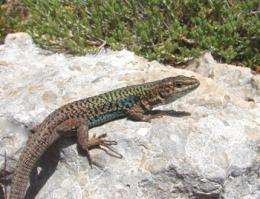
(PhysOrg.com) -- University of Michigan ecologists and their colleagues have answered a question that has puzzled biologists for more than a century: What is the main factor that determines a lizard's ability to shed its tail when predators attack? The answer, in a word: Venom.
Tail-shedding, known to scientists as caudal autotomy, is a common anti-predator defense among lizards. When attacked, many lizards jettison the wriggling appendage and flee. The predator often feasts on the tail while the lucky lizard scurries to safety. Later, the lizard simply grows a new tail.
The ease with which lizards shed their tails varies from species to species and from place to place. For more than a century, biologists have suspected that this variation is controlled mainly by predator pressure: As the number of local lizard-eaters rises, so does the need for this effective defense mechanism.
When lizards live alongside lots of creatures eager to devour them, they're more likely to evolve the ability to shed their tails easily, because this trait enables them to survive long enough to reproduce and pass their genes to the next generation.
However, tail loss carries long-term costs, including impaired mobility, lower social status and slower growth rates. So from an evolutionary perspective, it only makes sense to maintain tail-shedding ability if there are predators around.
The U-M-led team decided to test the long-held predator-pressure idea using a clever combination of laboratory experiments and field measurements made in mainland Greece and multiple offshore Aegean Sea islands inhabited by different combinations of predators.
Their conclusion? The predator-pressure hypothesis, while generally true, comes with an unexpected twist: Not all predators are created equal.
"The only predators that truly matter are vipers," said U-M vertebrate ecologist Johannes Foufopoulos, co-author of a study published online this week in the journal Evolution.
"In the Aegean, vipers are specialized lizard predators," said Foufopoulos, an assistant professor at the School of Natural Resources and Environment and the Department of Ecology and Evolutionary Biology. "So it makes sense, in retrospect, that the lizards' primary defense would be aimed against their main enemy, the viper. But no one had made this connection, until now."
This result is perhaps best explained by the peculiarities of viper attacks, Foufopoulos said. When non-venomous predators attack, tail-shedding is only useful in the relatively rare instances when the tail is firmly grasped by the predator.
But when a viper bares its fangs and strikes, even glancing contact with the lizard's tail can inject a lethal dose of venom. In that case, the ability to shed a tail within seconds---before venom reaches the lizard's vital organs---becomes a life-or-death matter.
"You lose your tail, but you come away with your life," Foufopoulos said. "And you can always grow another tail."
Though the study was conducted in the Mediterranean region, Foufopoulos said he suspects the results apply to other parts of the world---such as the American Southwest or Australia---where lizards coexist with venomous snakes.
Mainland Greece and the thousands of offshore islands of the Aegean are an ideal place to study how evolution shapes isolated animal populations, with each group adapting to conditions peculiar to its home island. The situation is reminiscent of Darwin's study of finch-beak variation on the Galapagos Islands.
Millions of years ago, when sea levels were lower than they are today, the islands of the Aegean were part of the mainland, and the entire region shared a similar variety of lizard predators. Today, those predators include mammals such as foxes and jackals, as well as vipers and birds such as hawks, falcons, shrikes, crows and ravens.
Over the millennia, sea levels rose and thousands of Aegean islands formed. Gradually, the diversity of the predator populations on those islands declined. Today, some of the Aegean islands are viper-free.
The U-M-led team looked for correlations between autotomy rates and the presence or absence of various types of lizard predators at the study's 10 collecting sites. The autotomy rate is a measure of the ease with which lizards shed their tails. The higher the rate, the easier the tail separates from the body.
The only strong signal that emerged from the study was the link to vipers.
The team found that viper-free islands are home to lizards that have largely lost the ability to shed their tails. Conversely, all the locations where vipers have survived are inhabited by lizards with high autotomy rates.
The study involved more than 200 insect-eating lizards from 15 species, most measuring 5 to 8 inches from snout to tail-tip.
To measure autotomy rates, the researchers combined field observations and laboratory measurements. In the field, lizards that have shed their tails and grown new ones can be distinguished from lizards that retain their original tails.
In the laboratory, researchers used calipers to gently pinch lizards' tails with a standardized level of pressure for 15 seconds. Laboratory autotomy rates for each species were expressed as the fraction of lizards that shed their tails during this procedure.
Understanding the distribution of tail autotomic ability among different lizard populations has important practical applications for conservation biologists. Because of the central importance of tail-shedding as a defense against predators, the expression of this ability can help predict which lizard populations are most vulnerable to the accidental introduction of non-native predators.
As island extinctions in other parts of the Mediterranean have already shown, lizards that have lost this capacity are ill-equipped to defend themselves and quickly succumb to invasive snakes.
More information: The Evolution article is available at: www3.interscience.wiley.com/jo … ue?CRETRY=1&SRETRY=0
Source: University of Michigan (news : web)


