Carbon dioxide forms polymeric materials under high pressure
March 25, 2009 Carbon dioxide forms polymeric materials under high pressure

Enlarge

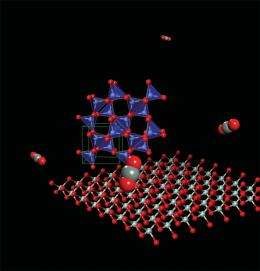
Carbon dioxide is a molecular gas at ambient conditions and an important consitituent of the Earth’s atmosphere. It is also a likely component in the Earth’s mantle, and it plays an important role in the life cycle. But at high pressure, carbon dioxide can transform to a solid.

The commonly known solid-state form of is the so called 'dry ice', which is a molecular crystal and has many important applications, e.g. food producation and storage, artificial fog in theatre and artificial rainfall, etc. Even more interesting, as the pressure increases and varies, the intra- and inter-molecular interactions of carbon dioxide change dramatically and this results in different crystal structures in polymeric dense phases with interesting physical properties, such as “super-hardness”. Thus carbon dioxide has become an extremely hot topic in science in the last decade.

Recently, a collaborative study between the research groups in Canada, Germany, Slovakia, Italy and USA achieved progress on this highly interested compound. Using  a novel computer-based simulation method called metadynamics combined with accurate quantum mechanical calculations, they found that a molecular solid called CO2-II transfers to a layered polymeric structure at a pressure of 60 GPa (1 GPa is approximately 10000 atmospheres) and temperature at 600 Kelvin.

Based on the good agreement between their calculated Raman spectra and X-ray diffraction patterns and the previous experimental values, a new interpretation of a previous experimental result is given. A recently identified VI found in experiment, assumed to be disordered stishovite-like structure, is instead interpreted as the result of an incomplete transformation from the molecular phase into a final layered polymeric structure. In addition, a new α-cristobalite-like CO2 as found in silicon dioxide, is predicted to be formed from CO2-III via an intermediate structure at 80 GPa and temperature lower than room temperature. Defects in the crystals increase with temperature and CO2 transforms to an amorphous form when temperature is higher than room temperature, consistent with previous experiments.

These results obtained from fully dynamical simulations reveal hitherto unknown microscopic transformation mechanisms, and illustrate the transformation from a molecular solid characterized by only intra-molecular bonding to a polymerized structure. The transformation takes place at pressures within the range found in the Earth’s mantle, where a significant amount of oxidized carbon is thought to be present, either in the form of carbonates or as a fluid. The large and abrupt changes in the bonding properties of CO2 reported here hint to possible discontinuities in the carbon chemistry of the mantle. Their article by Dr. Jian Sun et al. has been published in Proceedings of the National Academy of Sciences.

More information: Jian Sun, Dennis D. Klug, Roman Martonak, Javier Antonio Montoya, Mal-Soon Lee, Sandro Scandolo and Erio Tosatti: High-pressure polymeric phases of carbon dioxide. In: PNAS early edition, http://www.pnas.org_cgi_doi_10.1073_pnas.0812624106

Provided by Ruhr-Universitaet-Bochum


print this article email this article download pdf blog this article bookmark this article     Stumble it Digg this share on Facebook retweet share on Reddit add to delicious
Rate this story - 4.5 /5 (2 votes)


March 25, 2009 all stories

Comments: 0

4.5 /5 (2 votes)
  • Stumble this up

  • Digg this

  • share this

  • hide
  • Related Stories

  • Polymeric nitrogen synthesised
    created Aug 05, 2004 | popularity not rated yet | comments 0
  • Scientists Predict Novel Melt Curve Of Hydrogen Pointing At The Possible Existence Of A New Superfluid State
    created Oct 06, 2004 | popularity not rated yet | comments 0
  • Researchers shed light on physical properties of carbon at extreme conditions
    created Jan 24, 2006 | popularity not rated yet | comments 0
  • Putting the Squeeze on Nitrogen for High Energy Materials
    created Sep 03, 2008 | popularity not rated yet | comments 0
  • Miniature Gas Tank
    created Jan 28, 2005 | popularity not rated yet | comments 0


  • hide
  • Relevant PhysicsForums posts

  • wonder about atom characteristic
    created 6 hours ago
  • Proton mobility vs. conductance in ice
    created Nov 04, 2009
  • Transmission spectrum and DOS
    created Nov 04, 2009
  • monoatomic elements
    created Nov 04, 2009
  • More from Physics Forums - Atomic, Solid State, Comp. Physics

Other News

Stars Fueled by Dark Matter Could Hold Secrets to the Universe

Stars Fueled by Dark Matter Could Hold Secrets to the Universe

Physics / General Physics

created Nov 03, 2009 | popularity 4.5 / 5 (44) | comments 39

(PhysOrg.com) -- The first stars in the universe may have been very different from the stars we see today, yet they may hold clues to understanding some of the mysterious features of the universe. These "dark ...


Second Law of Thermodynamics May Explain Economic Evolution

Second Law of Thermodynamics May Explain Economic Evolution

Physics / General Physics

created Nov 02, 2009 | popularity 4.3 / 5 (28) | comments 25

(PhysOrg.com) -- Terms such as the "invisible hand," laissez-faire policy, and free-market principles suggest that economic growth and decline in capitalist societies seem to be somehow self-regulated. Now, ...


High-performance plasmas may make reliable, efficient fusion power a reality

High-performance plasmas may make reliable, efficient fusion power a reality

Physics / Plasma Physics

created Nov 02, 2009 | popularity 4.7 / 5 (34) | comments 27

In the quest to produce nuclear fusion energy, researchers from the DIII-D National Fusion Facility have recently confirmed long-standing theoretical predictions that performance, efficiency and reliability ...


'Teapot effect' solved

Solving Teapot Effect

Physics / General Physics

created Nov 02, 2009 | popularity 5 / 5 (9) | comments 10

(PhysOrg.com) -- A team of scientists from France have worked out why teapots dribble at low flow rates, and how to stop them. The effect is called the "teapot effect", and solving it could finally put an ...


Laser accelerated protons to the highest energies so far

Researchers use trident laser to accelerate protons to record energies

Physics / General Physics

created Nov 02, 2009 | popularity 4.3 / 5 (3) | comments 10

An international team of physicists at Los Alamos National Laboratory has succeeded in using intense laser light to accelerate protons to energies never before achieved. Using this technique, scientists can ...