Drop in daddy long legs is devastating bird populations
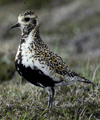
(PhysOrg.com) -- Warm summers are dramatically reducing populations of daddy long legs, which in turn is having a severe impact on the bird populations which rely on them for food.
New research by a team of UK scientists spells out for the first time how climate change may affect upland bird species like the golden plover - perhaps pushing it towards local extinction by the end of the century.
It also points a way forward to how we can attempt to strengthen habitats to help wildlife adapt to our changing climate and prevent such consequences.
Previous research has shown how changes in the timing of the golden plover breeding season as a result of increasing spring temperatures might affect their ability to match the spring emergence of their cranefly (daddy long legs) prey.
The new research, published today in the scientific journal Global Change Biology and led by Dr James Pearce Higgins of the Royal Society for the Protection of Birds (RSPB) Scotland, shows the true effects are much more severe.
Higher temperatures in late summer are killing the cranefly larvae, resulting in a drop of up to 95 per cent in the number of adult craneflies emerging the following spring. With these craneflies providing a crucial food source for a wide range of upland birds like the golden plover, this means starvation and death for many chicks.
Newcastle University's Dr Mark Whittingham, one of the authors of the research, said: "The population of Golden Plovers in our study will likely be extinct in around 100 years if temperature predictions are correct and the birds cannot adapt to feed on other prey sources.
"Our study models the impacts of climate change on the ecology of the animal. In this case we show that higher August temperatures, as predicted from climate change models, are correlated with lower numbers of daddy-long legs.
"Daddy long-leg abundance is key for Golden Plover chicks in terms of growth and survival. Worryingly, our work is likely to apply to other upland bird species that also rely on daddy-long legs as a prey resource, such as Curlew."
Dr James Pearce Higgins added: "Many studies predict dire effects of climate change upon wildlife but this study provides a rare example of where such predictions are based on a detailed understanding of a species' requirements, linking the effects of climate on food resources to changes in breeding success and population size.
"This is the most worrying development that I have found in my scientific career to date. However, by understanding these processes, we now have the chance to respond. If we can maintain good quality habitats for craneflies then we can help the birds too. For example, by blocking drainage ditches on our Forsinard reserve in the North of Scotland we hope to raise water levels and reduce the likelihood of the cranefly larvae drying out in hot summers.
"The fight against climate change will increasingly mean strengthening habitats to protect vulnerable species, as well as trying to reduce emissions."
More information: Impacts of climate on prey abundance account for fluctuations in a population of a northern wader at the southern edge of its range is published in the scientific journal Global Change Biology and is available at www3.interscience.wiley.com/jo … l/121684866/abstract
Source: Newcastle University


