New nanogenerator may charge iPods and cell phones with a wave of the hand
March 26, 2009 New nanogenerator may charge iPods and cell phones with a wave of the hand

Enlarge

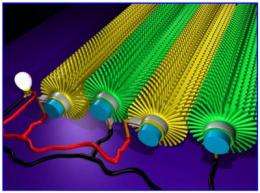
Pictured is a schematic illustration shows the microfiber-nanowire hybrid nanogenerator, which is the basis of using fabrics for generating electricity. Credit: Professor. Z. L. Wang and Dr. X. D. Wang, Georgia Institute of Technology.

Imagine if all you had to do to charge your iPod or your BlackBerry was to wave your hand, or stretch your arm, or take a walk? You could say goodbye to batteries and never have to plug those devices into a power source again.

In research presented here today at the American Chemical Society's 237th National Meeting, scientists from Georgia describe technology that converts mechanical energy from body movements or even the flow of blood in the body into that can be used to power a broad range of electronic devices without using batteries.

"This research will have a major impact on defense technology, environmental monitoring, biomedical sciences and even personal electronics," says lead researcher Zhong Lin Wang, Regents' Professor, School of Material Science and Engineering at the . The new "nanogenerator" could have countless applications, among them a way to run electronic devices used by the military when troops are far in the field.

The researchers describe harvesting energy from the environment by converting low-frequency vibrations, like simple body movements, the beating of the heart or movement of the wind, into electricity, using () that conduct the electricity. The ZnO nanowires are piezoelectric — they generate an electric current when subjected to mechanical stress. The diameter and length of the wire are 1/5,000th and 1/25th the diameter of a human hair.

In generating energy from movement, Wang says his team concluded that it was most effective to develop a method that worked at and was based on flexible materials. The ZnO nanowires met these requirements. At the same time, he says a real advantage of this technology is that the nanowires can be grown easily on a wide variety of surfaces, and the nanogenerators will operate in the air or in liquids once properly packaged. Among the surfaces on which the nanowires can be grown are metals, ceramics, polymers, clothing and even tents.

"Quite simply, this technology can be used to generate energy under any circumstances as long as there is movement," according to Wang.

To date, he says that there have been limited methods created to produce nanopower despite the growing need by the military and defense agencies for nanoscale sensing devices used to detect bioterror agents. The nanogenerator would be particularly critical to troops in the field, where they are far from energy sources and need to use sensors or communication devices. In addition, having a sensor which doesn't need batteries could be extremely useful to the military and police sampling air for potential bioterrorism attacks in the United States, Wang says.

While biosensors have been miniaturized and can be implanted under the skin, he points out that these devices still require batteries, and the new nanogenerator would offer much more flexibility.

A major advantage of this new technology is that many nanogenerators can produce electricity continuously and simultaneously. On the other hand, the greatest challenge in developing these nanogenerators is to improve the output voltage and power, he says.

Last year Wang's group presented a study on nanogenerators driven by ultrasound. Today's research represents a much broader application of nanogenerators as driven by low-frequency body movement.

Source: American Chemical Society (news : web)


Rate this story - 4.4 /5 (17 votes)

Rank Filter

Move the slider to adjust rank threshold, so that you can hide some of the comments.


Display comments: newest first

  • dirk_bruere - Mar 26, 2009
    • Rank: 4 / 5 (1)
    Efficiency? Power density?
  • Arikin - Mar 27, 2009
    • Rank: not rated yet
    Yes they don't mention the power density do they? They probably need more real life testing instead of just a schematic.

    Once we know that, can this be scaled up to larger power generation? Not just clothing. Try flexible skin on an electric car (reclaim some of electricity spent to move the car). Or rows of flag shaped material with these submerged in the rough northern seas.
  • el_gramador - Mar 27, 2009
    • Rank: not rated yet
    I would agree with dirk here. The only problem with making small scale devices is the problem of efficiency and power density. If those can't be scaled past a certain size the size of the generator must in turn be increased. It would probably help to have testing though too. As for flexible skin, unless they can make it impossible to destroy under an EM pulse I wouldn't go for it. As for fish, porous with large holes or not?

March 26, 2009 all stories

Comments: 3

4.4 /5 (17 votes)

  • hide
  • Related Stories


  • hide
  • Relevant PhysicsForums posts

  • Interception angle
    created 2 hours ago
  • Pressure created by clamping base and cover
    created 2 hours ago
  • How to find static friction
    created 8 hours ago
  • Calculating decible increases
    created 15 hours ago
  • More from Physics Forums - General Physics

Other News

Nanoscale Structures with Superior Mechanical Properties Developed

Nanoscale Structures with Superior Mechanical Properties Developed

Nanotechnology / Nanomaterials

created 16 hours ago | popularity 4.6 / 5 (9) | comments 1 | with audio podcast

(PhysOrg.com) -- Researchers at the California Institute of Technology have developed a way to make some notoriously brittle materials ductile -- yet stronger than ever -- simply by reducing their size.


Spray-on liquid glass

Spray-on liquid glass is about to revolutionize almost everything

Nanotechnology / Nanomaterials

created Feb 02, 2010 | popularity 4.7 / 5 (240) | comments 93 | with audio podcast report

(PhysOrg.com) -- Spray-on liquid glass is transparent, non-toxic, and can protect virtually any surface against almost any damage from hazards such as water, UV radiation, dirt, heat, and bacterial infections. ...


IBM Scientists Demonstrate World's Fastest Graphene Transistor

IBM Scientists Demonstrate World's Fastest Graphene Transistor

Nanotechnology / Nanophysics

created Feb 05, 2010 | popularity 4.9 / 5 (38) | comments 25 | with audio podcast

(PhysOrg.com) -- In a just-published paper in the magazine Science, IBM researchers demonstrated a radio-frequency graphene transistor with the highest cut-off frequency achieved so far for any graphene device ...


Conductive eTextiles: Stanford finds a new use for cloth

Conductive eTextiles: Researchers move from making batteries from paper to making batteries from cloth

Nanotechnology / Nanomaterials

created Feb 05, 2010 | popularity 4.3 / 5 (7) | comments 4 | with audio podcast

(PhysOrg.com) -- Stanford researchers have moved from making batteries from paper to making batteries from cloth. Your-T-shirt could become a lighted, moving display.


Carbon Based Chips May One Day Replace Silicon Transistors

Carbon Based Chips May One Day Replace Silicon Transistors

Nanotechnology / Nanomaterials

created Feb 03, 2010 | popularity 4.7 / 5 (18) | comments 3 | with audio podcast weblog

(PhysOrg.com) -- IBM researchers are hopeful that, over the next decade, silicon-based transistors will be replaced by carbon-based transistors. IBM has already laid out the ground work for carbon-based transistors.