Intruder alert: 'Smart Dew' will find you!
March 26, 2009
Intruder alert: Tel Aviv University's 'Smart Dew' will find you!

Enlarge

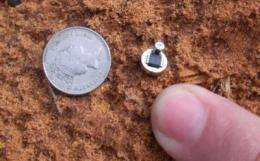
A Tel Aviv University researcher's fingertip (bottom right) points to a "Smart Dew" droplet. Credit: AFTAU

A remarkable new invention from Tel Aviv University — a network of tiny sensors as small as dewdrops called "Smart Dew" — will foil even the most determined intruder. Scattered outdoors on rocks, fence posts and doorways, or indoors on the floor of a bank, the dewdrops are a completely new and cost-effective system for safeguarding and securing wide swathes of property.

Prof. Yoram Shapira and his Tel Aviv University Faculty of Engineering team drew upon the space-age science of motes to develop the new security tool. Dozens, hundreds and even thousands of these sensors - each equipped with a controller and /receiver - can also be wirelessly networked to detect the difference between man, animal, car and truck.

"We've created a that has no scale limitations," says Prof. Shapira. This makes it especially useful for large farms or even the borders of nations where it's difficult, and sometimes impractical, to install fences or constantly patrol them.

"Most people could never afford the manpower to guard such large properties," explains Prof. Shapira. "Instead, we've created this Smart Dew to do the work. It's invisible to an intruder, and can provide an alarm that someone has entered the premises."

"The Cheapest and Smartest Solution on the Market"

Each individual "dew droplet" can detect an intrusion within a parameter of 50 meters (about 165 feet). And at a cost of 25 cents per "droplet," Prof. Shapira says that his solution is the cheapest and the smartest on the market.

A part of the appeal of Smart Dew is its near-invisibility, Prof. Shapira says. "Smart Dew is a covert monitoring system. Because the sensors in the Smart Dew wireless network are so small, you would need bionic vision to notice them. There would be so many tiny droplets over the monitored area that it would be impossible to find each and every one."

Electronic Ears, Noses, Skin and Eyes

Unlike conventional alarm systems, each droplet of Smart Dew can be programmed to monitor a different condition. Sounds could be picked up by a miniature microphone. The metal used in the construction of cars and tractors could be detected by a magnetic sensor. Smart Dew droplets could also be programmed to detect temperature changes, carbon monoxide emissions, vibrations or light.

Each droplet sends a radio signal to a "base station" that collects and analyzes the data. Like the signals sent out by cordless phones, RF is a safe, low-power solution, making Prof. Shapira's technology extremely cost-effective compared to other concepts.

"It doesn't require much imagination to envision the possibilities for this technology to be used," says Prof. Shapira. "They are really endless."

Source: Tel Aviv University (news : web)

4.5 /5 (19 votes)  

Filter


Move the slider to adjust rank threshold, so that you can hide some of the comments.


Display comments: newest first

QubitTamer
Mar 26, 2009

Rank: 5 / 5 (3)
Ubiquitous surveillance will be used to remove every last freedom we have. When these things shrink down to microscopic size they will be everywhere in the environment, secretly reporting our every movement, whether we are carrying metal, etc. Ubiquitous simple surveillance that will lead to the ultimate police state. A version of 1984 that not even Orwell could have had a nightmare of.
TJ_alberta
Mar 26, 2009

Rank: 4 / 5 (1)
looks like a microphone and a smt chip glued on to a hearing aid battery. really doubt that is a photo of a working prototype.
ealex
Mar 26, 2009

Rank: 4 / 5 (1)
It's all up to who uses it. This kind of technological advancement is inevitable.

Like with everything else it will either make us or break us.
RayCherry
Mar 26, 2009

Rank: not rated yet
RF Power Supply? Didn't Tesla try that?
Ausjin
Mar 26, 2009

Rank: 5 / 5 (2)
RF Power Supply? Didn't Tesla try that?

There are many wireless power systems out there now. They are generally just not considered practical since it is inefficient. With something that would require as little power as these, that does not matter though.
joefarah
Mar 26, 2009

Rank: 1 / 5 (1)
OK let's deploy them on the Afghan/Pakistan border.
barakn
Mar 26, 2009

Rank: 3.7 / 5 (3)
These can be located with an RF receiver and blocked by RF noise.
Fazer
Mar 26, 2009

Rank: 5 / 5 (1)
The 1984 scenario never happened, because in order to watch everyone, you'd need just as many intelligent watchers as those being watched. Without intelligent watchers to filter the data, you end up with vast quantities of data that is essentially just garbage. Improvements in artificial intelligence will "help" sift through all of this junk, but why bother? No one really cares what we all do every second of our lives...it's boring! And by the time an AI watcher is smart enough to accurately gauge our intentions, it will already be equivalent to a human being, and be too preoccupied with its own existence to care about watching humans.
dev2000
Mar 26, 2009

Rank: 4 / 5 (1)
I guess the inventors forgot about lawnmowers.

Or birds. Or rain.

Also, please rename product, thanks.
Tachyon8491
Mar 27, 2009

Rank: 5 / 5 (3)
Smart dew or Dumb Stew... I'm not convinced that this technology is more pragmatic than theoretical at present - e.g. implied ambiguity exists as one can read that it's capable of magnetic detection over 50m, what are they using, SQUIDs with magnetic beam focusing or you have to drive directly over them? Then they have sufficient power to report to a base station - over what distance, 30m or so with that antenna size? You need a few tens of thousand base stations over an area of say, 100 km sqr? And with tens of thousands of these lying around some geography, how long does their power source last usefully before you have to go around with a microscope and pop open the backs to replace the batteries, or are they just passively RF-powered? Then, if so, how do they generate sufficient RF power output over any useful distance? And then, without conspicuous structural sensor addition, other specialised electronic processing or modifications they can also do chemical, aerosol, suspended particulate, gas, acoustic and seismic detection and analysis? I don't doubt future feasability of multi-sensor, long-range networked intrusion monitoring, have worked on that myself, but this sounds a little sci-fi. How about a goose on a long bit of string instead: Smart Cackle?
smiffy
Mar 27, 2009

Rank: 2.5 / 5 (2)
My theory is that this an April Fool's joke, released prematurely by mistake. The device's name and Israeli origin are the tell-tale clues.
Newbeak
Mar 29, 2009

Rank: 1 / 5 (1)
Brings to mind something called Smart Water,which should revolutionize forensics,although it wouldn't be any use for intruder detection: http://tiny.cc/G3eGW
x646d63
Mar 29, 2009

Rank: 1 / 5 (1)
aroven
Mar 29, 2009

Rank: 2 / 5 (1)
RF Power Supply? Didn't Tesla try that?


The article doesn't say anything about using an RF power supply...
PaulLove
Mar 30, 2009

Rank: 3 / 5 (1)
Fazer, computers already do a large part of this for our intelligence services. Are they perfect no but they hit on key words flagging them for further examination. So you go from millions of hours of conversation to thousands. At the rate computing power is increasing do the same thing again with a tighter rule set on your smaller sample and reduce it to an even smaller sample. Take for example in the US, in Missouri where they recently instructed the Highway Patrol to regard anyone with a libertarian bumper sticker as a potential domestic terrorist. Combine something like a filter on conversations from any cell phone from say registered democrat/republican. Have you ever considered how much information you are requested to provide for informational purposes to provide lists to cross reference. When the net gets fine enough the requirements for tracking go way down.

Human talking in grid 19.57.67.90 no longer needs to be looked up to be identified because he was tracked as he left 19.58.67.90. Citizen 1960 As a Latino, Democrat, Vegetarian, Watcher of TVshow 24 has 4 filters applied to all conversations, probably has less than an hour a month of conversations that need to be monitored. Now if you say you never look at those conversations unless he has more than say 5 hits in a day or 40 in a month then you review them under the assumption that most conspiracies or deliberate patterns of violations will take multiple occurrences you radically reduce the expenditure of time. Then you only have 5-6 billion moving data points. Once it is in place terror will reinforce the system as most of the sheeple will cower down hoping that they won't be next. Look at Stalin he killed millions, so many in fact they dont' even have a good count imagine what he would have done with this assuming he didnt' just chip everyone.
legonadir
Apr 27, 2009

Rank: 1 / 5 (1)
How about we just follow the constitution and stop letting the federal government doing 90% of what it's doing now.

Freedom is never a bad idea.
Rank 4.5 /5 (19 votes)
Related Stories
Relevant PhysicsForums posts
  • How to calculate total compressibility in liquid porous solid system
    created5 hours ago
  • Need help reading 3-D
    createdFeb 11, 2012
  • A way to send and receive wireless data
    createdFeb 11, 2012
  • Calling function with no input argument
    createdFeb 10, 2012
  • Force free body diagram problem on gym equipment
    createdFeb 10, 2012
  • Empirical data regarding shower heads and water
    createdFeb 10, 2012
  • More from Physics Forums - General Engineering

More news stories

Google might launch Drive for cloud storage soon

(PhysOrg.com) -- Google's next big move, according to the Wall Street Journal, is a cloud storage service called Drive. Hardly first to the plate, Google is simply catching up to introducing its cloud reposi ...

Technology / Internet

created 14 hours ago | popularity 4.8 / 5 (5) | comments 5 | with audio podcast report

Iran blocks email, restricts net access: reports

Iran has further restricted access to the Internet and blocked popular email services for the past few days, in a move a top lawmaker said could "cost the regime dearly," media reports said on Sunday.

Technology / Internet

created 7 hours ago | popularity 5 / 5 (2) | comments 3

Love a click away in Indonesia's Twitter Republic

He was a geeky kid from Yogyakarta, she a glamorous city girl in Jakarta. In a country with one of the world's most vibrant social networking scenes they fell in love on Twitter.

Technology / Internet

created 15 hours ago | popularity 4 / 5 (1) | comments 0

Walney offshore wind farm is world's biggest (for now)

(PhysOrg.com) -- The Walney wind farm on the Irish Sea--characterized by high tides, waves and windy weather--officially opened this week. The farm is treated in the press as a very big deal as the Walney ...

Technology / Energy & Green Tech

created Feb 11, 2012 | popularity 4.1 / 5 (14) | comments 52 | with audio podcast weblog

Navy to begin tests on electromagnetic railgun prototype launcher

The Office of Naval Research (ONR)'s Electromagnetic (EM) Railgun program will take an important step forward in the coming weeks when the first industry railgun prototype launcher is tested at a facility ...

Technology / Engineering

created Feb 06, 2012 | popularity 4.5 / 5 (19) | comments 94 | with audio podcast


Scientists discover molecular secrets of 2,000-year-old Chinese herbal remedy

For roughly two thousand years, Chinese herbalists have treated Malaria using a root extract, commonly known as Chang Shan, from a type of hydrangea that grows in Tibet and Nepal. More recent studies suggest that halofuginone, ...

New method to examine batteries -- MRI from the inside

There is an ever-increasing need for advanced batteries for portable electronics, such as phones, cameras, and music players, but also to power electric vehicles and to facilitate the distribution and storage of energy derived ...

A mitosis mystery solved: How chromosomes align perfectly in a dividing cell

Although the process of mitotic cell division has been studied intensely for more than 50 years, Whitehead Institute researchers have only now solved the mystery of how cells correctly align their chromosomes during symmetric ...

Overeating may double risk of memory loss

New research suggests that consuming between 2,100 and 6,000 calories per day may double the risk of memory loss, or mild cognitive impairment (MCI), among people age 70 and older. The study was released today and will be ...

Lab study raises questions over nano-particle impact

Tests involving chickens have raised questions about the impact on health from engineered nano-particles, the ultra-fine grains commonly used in drugs and processed foods, scientists said on Sunday.

Starve a virus, feed a cure? Findings show how some cells protect themselves against HIV

A protein that protects some of our immune cells from the most common and virulent form of HIV works by starving the virus of the molecular building blocks that it needs to replicate, according to research published online ...