Why certain fishes went extinct 65 million years ago
March 26, 2009 Study unravels why certain fishes went extinct 65 million years ago

Enlarge

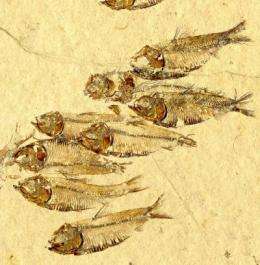
Fossil herrings from the Eocene Green River Formation of the western United States where Colorado, Utah and Nevada meet. Herrings are one of the small-bodied groups of bony fishes that survived the end-Cretaceous extinction and persist to this day in marine environments. Credit: Photo by Matt Friedman

Large size and a fast bite spelled doom for bony fishes during the last mass extinction 65 million years ago, according to a new study to be published March 31, 2009, in the Proceedings of the National Academy of Sciences.

Today, those same features characterize large predatory bony fishes, such as tuna and billfishes, that are currently in decline and at risk of themselves, said Matt Friedman, author of the study and a graduate student in at the University of Chicago.

"The same thing is happening today to ecologically similar fishes," he said. "The hardest hit species are consistently big predators."

Studies of modern fishes demonstrate that large is linked to large prey size and low rates of population growth, while fast-closing jaws appear to be adaptations for capturing agile, evasive prey—in other words, other fishes. The provides some remarkable evidence supporting these estimates of function: with preserved stomach contents that record their last meals.

When an asteroid struck the earth at the end of the Cretaceous about 65 million years ago, the resultant impact clouded the earth in soot and smoke. This blocked photosynthesis on land and in the sea, undermined food chains at a rudimentary level, and led to the extinction of thousands of species of flora and fauna, including dinosaurs.
Study unravels why certain fishes went extinct 65 million years ago
Enlarge

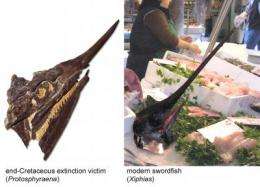
The fossil fish on the left is not related to the modern swordfish on the right, which is for sale at a fish market. Nevertheless, the swordfish developed a size and shape similar to the fossil fish and appears to be vulnerable to extinction for some of the same reasons that the fossil form was vulnerable: it is a large predator. Credit: Photo by Matt Friedman

Scientists had speculated that during that interval large predatory fishes might have been more likely than other fishes to go extinct because they tended to have slowly increasing populations, live more spread out, take longer to mature, and occupy at the tops of food chains. Today, ecologically similar fishes appear to be the least able to rebound from declining numbers due to overfishing.

To build the database he needed to test this prediction, Friedman traveled around the world measuring the body size and of 249 genera of fossil fishes that lived during the late Cretaceous. These kinds of direct measurements are possible in fossil fishes because many are represented by complete, articulated individuals. This is unlike the fossil record of most other vertebrates, where bones, teeth and other parts of the skeleton are often scattered and found in isolation.

This study is the first to test this theory with hard data and to quantify the relationship between body size, jaw function and vulnerability of fishes during the Cretaceous extinction, according to Friedman.

"Anyway you sliced it, the data showed that if you were a big fish with a fast bite you were toast," he said.

Ironically, today's large fishes with fast bites evolved relatively shortly after the end-Cretaceous extinction, apparently filling the functional and ecological roles vacated by the victims of that mass extinction. Although the two groups of fishes are not related to each other, their fates may end up being similar.

The paper is called "Ecomorphological selectivity among marine teleost fishes during the end-Cretaceous extinction" and will appear in issue 13 of PNAS. In it, Friedman describes the results of his study as robust because the large-bodied, predatory fishes that are disproportionately devastated also have the best fossil records. "In other words, we can be convinced that these forms really do die off here, and that their disappearance can't be chalked up to a lousy fossil record," Friedman noted.

Nevertheless, fossil fishes are not well studied because paleontologists, as a group, tend to be drawn to other animals, such as dinosaurs. Therefore, many large-scale patterns of fish evolution remain unclear.

The fossil fishes included in the study are diverse in form, and range in length from about 20 feet to less than one inch.

"This study demonstrates that fossil datasets are germane to modern diversity and evolution by allowing us to calibrate what characteristics might relate to extinction vulnerability today," Friedman said. "Echoes of the end-Cretaceous extinction reverberate 65 million years later."

Source: University of Chicago Medical Center


print this article email this article download pdf blog this article bookmark this article     Stumble it Digg this share on Facebook retweet share on Reddit add to delicious
Rate this story - 4.5 /5 (11 votes)

Rank Filter

Move the slider to adjust rank threshold, so that you can hide some of the comments.


Display comments: newest first

  • el_gramador - Mar 27, 2009
    • Rank: not rated yet
    I wonder if extrapolated to humans with the constantly increasing population and omnivorous prey habits, would lead to anything similar? I know fish can't escape life underwater, but humans have that extra bit of finesse to figure out how.

March 26, 2009 all stories

Comments: 1

4.5 /5 (11 votes)
  • Stumble this up

  • Digg this

  • share this

  • hide
  • Related Stories

  • Chinese report important fish fossil find
    created May 05, 2006 | popularity not rated yet | comments 0
  • Discovery of 450 Million Years Old 'Missing Link'
    created Apr 27, 2005 | popularity not rated yet | comments 0
  • Ancient predator had strongest bite of any fish, rivaling bite of large alligators and T. rex
    created Nov 28, 2006 | popularity not rated yet | comments 0
  • How fishes conquered the ocean
    created Jan 24, 2007 | popularity not rated yet | comments 0
  • 'Incredibly lucky' find yields important fish fossil
    created Sep 07, 2007 | popularity not rated yet | comments 0


  • hide
  • Relevant PhysicsForums posts

Other News

Studies show marine reserves can be an effective tool for managing fisheries

Biology / Ecology

created 1hour ago | popularity not rated yet | comments 0

Studies conducted in California and elsewhere provide support for the use of marine reserves as a tool for managing fisheries and protecting marine habitats, according to biologists at the University of California, Santa ...


Study shows that some malignant tumors can be shut down after all

Biology / Cell & Microbiology

created 2 hours ago | popularity 5 / 5 (1) | comments 0

Oncologists have had their hands tied because more than half of all human cancers have mutations that disable a protein called p53. As a critical anti-cancer watchdog, p53 masterminds several cancer-fighting operations within ...


What is the meaning of 'one'? Evolutionary biologists argue for new meaning of 'organismality'

Biology / Evolution

created 2 hours ago | popularity 5 / 5 (1) | comments 1

Rice University evolutionary biologists David Queller and Joan Strassmann argue in a new paper that high cooperation and low conflict between components, from the genetic level on up, give a living thing its "organismality," ...


Researchers show how to divide and conquer 'social network' of cells

Researchers show how to divide and conquer 'social network' of cells

Biology / Biotechnology

created 3 hours ago | popularity not rated yet | comments 0

On Noah's Ark animals came in twos: male and female. In human bodies trillions of cells are coupled, too, and so are the molecules from which they are composed. Yet these don't come in twos, they are regrouped ...


Drought resistance explained

Drought resistance explained

Biology / Cell & Microbiology

created 1hour ago | popularity 5 / 5 (1) | comments 0

Much as adrenaline coursing through our veins drives our body's reactions to stress, the plant hormone abscisic acid (ABA) is behind plants' responses to stressful situations such as drought, but how it does ...