Does prebiotic material exist in space?
March 26, 2009
Spanish and French astrophysicists have identified a band in the infrared range that serves to track the presence of organic material rich in oxygen and nitrogen in the interstellar dust grains. Should any telescope detect this band, the presence in space of aminoacids and other substances, which are the precursors to life, could be confirmed.
"We have proved in the laboratory that an organic material of prebiotic interest known as yellow stuff possesses a very characteristic absorption band that can be searched for in zones in space which have dust grains in order to try and identify similar substances", Guillermo Muñoz, a researcher at the Centre for Astrobiology (INTA-CSIC), points out to SINC.
The scientist explains that the dust grains observed in the interstellar clouds and around the young stars are usually "surrounded by tiny mantles of ice rich in water and other simple molecules, such as carbon monoxide (CO), methanol (CH3OH) or ammonia (NH3), upon which light and cosmic rays fall".
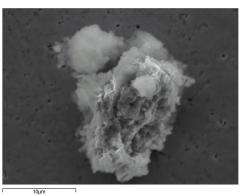
Muñoz and his French colleague Emmanuel Dartois, from the Institute of Space Astrophysics in Paris (France), have recreated these interstellar conditions in the laboratory by mixing various gases at a very low pressure and temperature (-263ºC), and then irradiating the interstellar ice which is formed with ultraviolet light. As a result yellow stuff is generated, a yellowish substance rich in carbon but with hydrogen, nitrogen and a lot of associated oxygen. This material is composed of numerous organic molecules, such as carboxylic acids, glycine and other aminoacids (molecules that are essential to the composition of proteins).
The yellow stuff absorption band is situated within the 3.4 micrometres of the mid-infrared spectrum and when represented on a graph its profile has two characteristic peaks. "This makes it possible to detect this band in planet-forming regions similar to our solar nebula and Solar System bodies", Muñoz points out.
"Moreover the synthesis of organic compounds by ice irradiation could be related to the presence of this substance in comets, such as the Halley comet, and could explain also the isotopic composition of the carbonaceous material detected in interplanetary dust and in types of meteorities rich in carbon which are known as carbonaceous chondrites", he adds.
Until now scientists have not observed the yellow stuff infrared band in interstellar space, and the same is true for Solar System bodies, but they do postulate that this could be due to the limitations in present techniques. In the case of carbonaceous chondrites and interplanetary dust, both contain carbon associated with heavy hydrogen isotopes (deuterium above all, 2H) and nitrogen (15N) characteristic of chemical reactions at very low temperatures, such as those generated in irradiated ice, but that type of meteoritic carbon is different to yellow stuff.
The prebiotic substances derived from the irradiation of ice lose their organic character and high hydrogen, nitrogen and oxygen content when heated at more than 300ºC; this occurs in the proximities of the Sun. "That type of heated yellow stuff, which still maintains a high content of heavy isotopes, could be the sort that is found to form part of the carbonaceous chondrites and interplanetary dust", Muñoz points out to SINC.
The Rosetta space probe belonging to the European Space Agency will try to detect aminoacids and other molecules of prebiotic interest in the central core of the Comet 67P/Churyumov-Gerasimenko, when the probe arrives there in 2014.
More information: Guillermo M. Muñoz Caro y Emmanuel Dartois. “A tracer of organic matter of prebiotic interest in space, made from UV and thermal processing of ice mantles”. Astronomy and Astrophysics 494 (1): 109-115, 2009.
Provided by Plataforma SINC
-
Meteorites discovered to carry interstellar carbon
May 04, 2006 |
not rated yet |
0
-
Organic molecules transport strongest spectral signature of interplanetary dust particles
Feb 24, 2005 |
not rated yet |
0
-
Researcher Presents Origin-Of-Life Theory for Young Earth
Aug 14, 2007 |
not rated yet |
0
-
Researcher presents origin-of-life theory for young Earth, supports life on other planets
Oct 02, 2007 |
not rated yet |
0
-
Interplanetary dust particles: reproducing GEMS-like structure in the laboratory
Feb 14, 2006 |
not rated yet |
0
-
Engineers build first sub-10-nm carbon nanotube transistor
Feb 01, 2012 |
4.9 / 5 (31) |
30
-
Something old, something new: Evolution and the structural divergence of duplicate genes
Jan 31, 2012 |
4.6 / 5 (7) |
1
-
The hidden nanoworld of ice crystals: Revealing the dynamic behavior of quasi-liquid layers
Jan 30, 2012 |
5 / 5 (3) |
1
-
Stock market network reveals investor clustering
Jan 27, 2012 |
3.9 / 5 (23) |
8
-
Of microchemistry and molecules: Electronic microfluidic device synthesizes biocompatible probes
Jan 26, 2012 |
5 / 5 (1) |
0
-
Titan's lack of impact craters
Feb 09, 2012
-
Real pictures of black hole eating a star?
Feb 08, 2012
-
Hypothetical way to travel faster than light, but not technically exceed lightspeed
Feb 06, 2012
-
How do scientists monitor the Sun's activity?
Feb 05, 2012
-
Search patterns in observational studies
Feb 05, 2012
-
Derivation of Pogson's law
Feb 03, 2012
- More from Physics Forums - General Astronomy
More news stories
Humans may have helped the decline of African rainforests 3000 years ago
(PhysOrg.com) -- Large areas of rainforests in Central Africa mysteriously disappeared over three thousand years ago, to be replaced by savannas. The prevailing theory has been that the cause was a change ...
Could Venus be shifting gear?
(PhysOrg.com) -- ESAs Venus Express spacecraft has discovered that our cloud-covered neighbour spins a little slower than previously measured. Peering through the dense atmosphere in the infrared, the ...
Space & Earth / Space Exploration
6 hours ago |
5 / 5 (5) |
7
|
Mars Science Laboratory computer issue resolved
(PhysOrg.com) -- Engineers have found the root cause of a computer reset that occurred two months ago on NASA's Mars Science Laboratory and have determined how to correct it.
Space & Earth / Space Exploration
7 hours ago |
5 / 5 (5) |
3
|
Clam fields found at deep, low-temperature Mariana vents
(PhysOrg.com) -- Scientists have marveled at the unusual life forms thriving at high temperature hydrothermal vents of the deep ocean.
Space & Earth / Earth Sciences
7 hours ago |
not rated yet |
0
|
Two new moons for Jupiter
Advances in technology have lead to the discovery of new planets outside of our Solar System, and now even new moons in our own backyard.
Space & Earth / Space Exploration
6 hours ago |
not rated yet |
4
Complex wiring of the nervous system may rely on a just a handful of genes and proteins
Researchers at the Salk Institute have discovered a startling feature of early brain development that helps to explain how complex neuron wiring patterns are programmed using just a handful of critical genes. ...
The power of estrogen -- male snakes attract other males
A new study has shown that boosting the estrogen levels of male garter snakes causes them to secrete the same pheromones that females use to attract suitors, and turned the males into just about the sexiest ...
Human cognitive performance suffers following natural disasters, researchers find
Not surprisingly, victims of a natural disaster can experience stress and anxiety, but a new study indicates that it might also cause them to make more errors - some serious - in their daily lives. In their upcoming Human Fa ...
New error-correcting codes guarantee the fastest possible rate of data transmission
Error-correcting codes are one of the triumphs of the digital age. Theyre a way of encoding information so that it can be transmitted across a communication channel such as an optical fiber o ...
Both maternal and paternal age linked to autism
Older maternal and paternal age are jointly associated with having a child with autism, according to a recently published study led by researchers at The University of Texas Health Science Center at Houston (UTHealth).
Curry spice component may help slow prostate tumor growth
Curcumin, an active component of the Indian curry spice turmeric, may help slow down tumor growth in castration-resistant prostate cancer patients on androgen deprivation therapy (ADT), a study from researchers ...