Nanoparticles in cosmetics/personal care products may have adverse environmental effects
Using aquatic microbes as their "canary-in-a-cage," scientists from Ohio today reported that nanoparticles now being added to cosmetics, sunscreens, and hundreds of other personal care products may be harmful to the environment.
Their report was part of symposia that included almost two dozen papers at the 237th National Meeting of the American Chemical Society where scientists grappled to understand the environmental and human health effects of nanotechnology. Hundreds of products utilizing these microscopic particles — 1/5,000th the diameter of a human hair — already are on the market. With many more poised for debut, scientists are seeking to avoid unwanted health and environmental effects in advance.
The study by Cyndee Gruden, Ph.D. and Olga Mileyeva-Biebesheimer focused on nano-titanium dioxide (nano-TiO2) particles found in cosmetics, sunscreens, and other personal care products. The particles are added to those products for their highly beneficial effects in blocking ultraviolet light in sunlight. Excess exposure can cause premature aging of the skin and skin cancer.
Gruden, who is with the University of Toledo, explained that the particles are washed down the drain in homes as people bathe and end up in municipal sewage treatment plants. From there, they can enter lakes, rivers, and other water sources where microorganisms serve essential roles in maintaining a healthy environment.
"When they enter a lake, what happens?" Gruden asked. "Would they enter an organism or bind to it? Maybe they kill it — or have nothing to do with it at all. These are important questions for determining the effects that nanoparticles may have on the environment. Right now, we're not really sure of the answers."
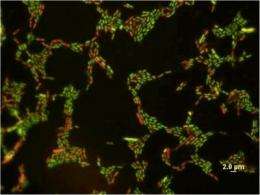
Gruden studied survival of Escherichia coli (E. coli) bacteria when exposed in laboratory cultures to various amounts of nano-TiO2. She found surprisingly large reductions in survival in samples exposed to small concentrations of the nanoparticles for less than an hour. "How fast the impact was surprised me," she said. The findings open the door to future research, including studies to determine whether the same effects occur in the natural environment.
Gruden's method for pinpointing damage from nanoparticles uses fluorescence to identify when the cell membrane in microbes undergo damage. When membranes — a crucial part of the microbe — are damaged, the cells emit a faint red glow. "Methods based upon fluorescence allow us to obtain results faster, maybe with greater sensitivity," she said, adding that this approach could speed scientific efforts to understand the threshold at which nanoparticles become toxic to microbes.
In a second study on nanotoxicity at the ACS National Meeting, scientists from Utah described development of a new biosensor that flashes like a beacon upon detecting nanoparticles in the environment.
Anne Anderson and colleagues at Utah State University and the University of Utah have inserted genes into a strain of Pseudomonas putida (P. putida) — a beneficial soil microbe — so that it emits light upon contact with nanoparticles of heavy metals. They are with Utah State University. The bacteria glow brightly when it is in its normal healthy state. The glow dims upon exposure to toxic substances.
"The novelty of the biosensor is we're able to get responses very, very quickly," she said, "and we can get those answers in the absence of other factors that could bind the challenging compounds." Anderson noted that traditional approaches in measuring bacterial cell growth may take two days. "At the snap of your finger you can see some of these things take place."
Anderson's group discovered that P. putida cannot tolerate silver, copper oxide and zinc oxide nanoparticles. Toxicity occurred at levels as low as micrograms per liter. That's equivalent to two or three drops of water in an Olympic-sized swimming pool. Anderson warns it could spell danger for aquatic life. "If you look up the Environmental Protection Agency's risk level of Copper to fish and other aquatic organisms, you are at that point of toxicity."
There's much debate in the science community about nanoparticle toxicity, Anderson said. Some scientists believe that nanoparticles in nature will aggregate together or bind onto silt and/or other organic matter, greatly reducing their toxicity. "We don't know if that's true or not," she said. So other members of this Utah research group currently are investigating that aspect of the issue.
Although the public is ultimately responsible for understanding the risks of consumer products, Gruden said, science plays a large role in highlighting possible hazards. "It is the scientist's job to perform good research and let the findings speak for themselves," she said. And so far the promises of nanotechnology need more evaluation. "To date, it's unclear whether the benefits of nanotech outweigh the risks associated with environmental release and exposure to nanoparticles."
Source: American Chemical Society (news : web)


