New form of destructive terrorist material unlikely, chemists report (w/Video)
March 26, 2009 New form of destructive terrorist material unlikely, chemists report

Enlarge

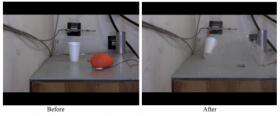
Detonation of 0.5 grams of triacetone triperoxide (TATP) — a trivial sample size compared to quantities in modern-day terrorist materials — emits a shock wave that destroys a nearby water balloon. At the 237th ACS National Meeting, chemists are reporting that a new, more powerful explosive related to TATP is unlikely. Credit: Gerard Harbison, Ph.D.

(PhysOrg.com) -- Concerns that terrorists could produce a new and particularly dangerous form of the explosive responsible for airport security screening of passengers’ shoes and restrictions on liquids in carryon baggage are unfounded, scientists reported today.

Speaking here at the 237th National Meeting of the American Chemical Society, Gerard Harbison, Ph.D., and colleagues described using computer simulations to analyze a variety of potential peroxide-based explosives in the same chemical class as triacetone triperoxide (TATP). That powerful, easy-to-make explosive was used by the “shoe bomber,” Richard Reid, in his failed attempt to blow up a transatlantic airline flight in 2001. TATP has also been used by suicide bombers in the Palestinian Intifada.

“Our analysis indicates that potentially new and destructive terrorist materials, which would tax our detection capabilities, may be too unstable for a practical synthesis,” said Harbison, a chemist at the University of Nebraska-Lincoln. “We consider it unlikely that any of the previous syntheses were actually successful, and the Internet myths about TeATeP are nothing more than that. So the good news is basically this is something we don’t have to worry about.”

FLV player

Video of the TATP explosion narrated by Harbison.

The group investigated 20 of various compounds and found that all substances larger than TATP are likely too sensitive to be used as weapons. “The energies we’re seeing in the analysis are extreme enough,” Harbison said, adding that a review of previous TeATeP synthesis reports raised many questions. “If you look at the actual literature on people who claim to have made TeATeP, it’s very ambiguous. We think probably what happened when people thought they were making TeATeP was that they were actually making TATP.”

This synthesis error is common and often fatal, Harbison said. When trying to make TATP, a less stable relative, diacetone diperoxide, often is created. “The nice thing about doing this on the computer is first it’s safe, and our results are so close to what’s been experimentally measured that we have a great deal of confidence with what we’re doing,” Harbison said. “We’re really at the stage where we can evaluate threats — potential molecules that might be dangerous — and we can really make some sort of judgment about whether those molecules are going to present a hazard in the future. We can test things with computers at a level of reliability that’s comparable to personally doing the synthesis and evaluating material yourself.”

There’s a lot of research that deals with known threats, Harbison said. But his groups’ research focuses on the idea that emerging threats will always exist. “Presumably you’d like to anticipate the threats before they come along. We’re now pushing it a little further and discussing potential threats.

“Using computational chemistry, we can narrow down the domain of potential hazards, things that aren’t going to be on the horizon. I think we now know so much more about not just what works for improvised-explosive-device detection but also what doesn’t work, and we don’t have to try it out (experimentally). We did five years ago.”

Provided by American Chemical Society (news : web)


print this article email this article download pdf blog this article bookmark this article     Stumble it Digg this share on Facebook retweet share on Reddit add to delicious
Rate this story - 4.4 /5 (5 votes)


March 26, 2009 all stories

Comments: 0

4.4 /5 (5 votes)
  • Stumble this up

  • Digg this

  • share this

  • hide
  • Related Stories

  • Better airport security scanner developed
    created Feb 07, 2007 | popularity not rated yet | comments 0
  • New analytical tool developed for liquid explosives detection
    created Oct 13, 2006 | popularity not rated yet | comments 0
  • Scientists create tiny mass spectrometer
    created Mar 09, 2006 | popularity not rated yet | comments 0
  • Sniffing out a broad-spectrum of airborne threats in seconds
    created Jun 09, 2008 | popularity not rated yet | comments 0
  • New technique can detect biological, chemical and explosive agents
    created Mar 16, 2007 | popularity not rated yet | comments 0


  • hide
  • Relevant PhysicsForums posts

  • MO diagram of NO
    created 10 hours ago
  • limiting reagent
    created 13 hours ago
  • preparation of acetanilide
    created 13 hours ago
  • Putting every element in a box
    created Nov 25, 2009
  • More from Physics Forums - Chemistry

Other News

Sandia CR5

Machine Converts CO2 into Gasoline, Diesel, and Jet Fuel

Chemistry / Biochemistry

created Nov 23, 2009 | popularity 4.6 / 5 (31) | comments 20

(PhysOrg.com) -- Researchers at Sandia National Laboratories have built a machine that uses the sun's energy to convert carbon dioxide waste from power plants into transportation fuels such as gasoline, diesel, ...


New hydrogen-storage method discovered

New hydrogen-storage method discovered

Chemistry / Materials Science

created Nov 22, 2009 | popularity 4.3 / 5 (42) | comments 15

Scientists at the Carnegie Institution have found for the first time that high pressure can be used to make a unique hydrogen-storage material. The discovery paves the way for an entirely new way to approach ...


New chemical reaction offers opportunities for drug development

Chemistry / Biochemistry

created Nov 26, 2009 | popularity not rated yet | comments 2

Researchers led by Conway Fellow, Professor Pat Guiry have solved a chemistry problem that has stumped researchers worldwide for more than a decade. The results have earned the group the cover story of the leading scientific ...


Research sheds light on workings of anti-cancer drug

Chemistry / Analytical Chemistry

created Nov 26, 2009 | popularity not rated yet | comments 0

(PhysOrg.com) -- The copper sequestering drug tetrathiomolybdate (TM) has been shown in studies to be effective in the treatment of Wilson disease, a disease caused by an overload of copper, and certain metastatic cancers. ...


Chemists get custom-designed microscopic particles to self-assemble in liquid crystal

Chemists get custom-designed microscopic particles to self-assemble in liquid crystal

Chemistry / Materials Science

created Nov 25, 2009 | popularity 5 / 5 (5) | comments 0

(PhysOrg.com) -- The scientists anticipate their "LithoParticles" will have significant applications in photonics, optical communications and other areas.