Research reveals old timers in the frog world
March 26, 2009 Research reveals old timers in the frog world

Enlarge

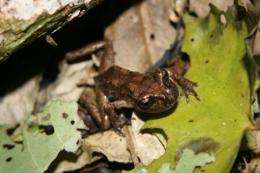
(PhysOrg.com) -- Research at Victoria University has revealed remarkable longevity in wild populations of New Zealand native frogs, particularly in the threatened Maud Island frog (Leiopelma pakeka).

A study by Associate Professor Ben Bell and his team over the past 25 years shows that the three oldest known frogs are two males reaching at least 35 and 37 years, and a female at least 34 years old.

Associate Professor Bell says this is one of the longest running field studies on any , and Maud Island frogs have proven to be some of the oldest known frogs in the wild.

“What I thought might be a five year study is still ongoing, with many frogs surviving over 25 years. We also studied Archey’s frog and Hochstetter’s frog in the Coromandel Ranges, and discovered these species are long-lived also. Our oldest known Archey’s frog is 23 years old, and Hochstetter’s frog is 12 years old.”

Associate Professor Bell is Director of Victoria University’s Centre for Biodiversity and Restoration Ecology, and his study of Archey’s frog in the Coromandel Ranges alerted conservation agencies to the species’ sudden decline in the late 1990s. His team discovered that the species was infected with the pathological there.

Back on Maud Island there has been no major decline in frogs, although the research team continues to monitor and to test for the occurrence of the chytrid fungus. Rigorous quarantine measures are taken by the Department of Conservation and by frog researchers to reduce risks of disease striking the population.

Associate Professor Bell says all the Maud Island frog skin swab samples they have DNA tested for amphibian chytrid fungus proved negative, but they will remain vigilant.

He says the team also initiated a trial translocation of 100 frogs to a restored site at Boat Bay on Maud Island 25 years ago, which had proven successful.

He has also collaborated with Associate Professor Shirley Pledger from Victoria’s School of Mathematics, Statistics and Operations Research to determine population trends and survival rates of native frogs.

He works with Karori Wildlife Sanctuary in establishing Maud Island frog populations there. Eleven froglets that bred in the Sanctuary were successfully reared to the small frog stage at Victoria University last year, before being returned to the Sanctuary. Ten more young were discovered this year, and will be returned to the Sanctuary after completing their development at Victoria University. The research team also found three tiny frogs that had just completed their development on Maud Island this March, suggesting that breeding occurs there in early summer, as in the Karori Wildlife Sanctuary.

Provided by Victoria University


print this article email this article download pdf blog this article bookmark this article     Stumble it Digg this share on Facebook retweet share on Reddit add to delicious
Rate this story - 5 /5 (1 vote)


March 26, 2009 all stories

Comments: 0

5 /5 (1 vote)
  • Stumble this up

  • Digg this

  • share this

  • hide
  • Related Stories

  • Deadly frog fungus found in Japan
    created Jun 13, 2007 | popularity not rated yet | comments 0
  • Laos said to harbor many new frog species
    created Apr 20, 2006 | popularity not rated yet | comments 0
  • Frogs with disease-resistance genes may escape extinction
    created Jul 16, 2008 | popularity not rated yet | comments 0
  • Rare frog caught on film during Manchester rainforest expedition
    created Sep 08, 2008 | popularity not rated yet | comments 0
  • Rare frog find gives herpetologist hope
    created Sep 11, 2008 | popularity not rated yet | comments 0


  • hide
  • Relevant PhysicsForums posts

Other News

Scientists successfully reprogram blood cells

Biology / Cell & Microbiology

created 21 minutes ago | popularity 5 / 5 (1) | comments 0

Researchers have transplanted genetically modified hematopoietic stem cells into mice so that their developing red blood cells produce a critical lysosomal enzyme -preventing or reducing organ and central nervous system damage ...


Nano bubble gum for enhancing drug delivery in gut

Biology / Biotechnology

created 1hour ago | popularity not rated yet | comments 0

Of the many characteristic traits a drug can have, one of the most desirable is the ability for a drug to be swallowed and absorbed into the bloodstream through the gut. Some drugs, like over-the-counter aspirin, lend themselves ...


Study shows that some malignant tumors can be shut down after all

Biology / Cell & Microbiology

created 3 hours ago | popularity 5 / 5 (1) | comments 0

Oncologists have had their hands tied because more than half of all human cancers have mutations that disable a protein called p53. As a critical anti-cancer watchdog, p53 masterminds several cancer-fighting operations within ...


What is the meaning of 'one'? Evolutionary biologists argue for new meaning of 'organismality'

Biology / Evolution

created 4 hours ago | popularity 5 / 5 (1) | comments 1

Rice University evolutionary biologists David Queller and Joan Strassmann argue in a new paper that high cooperation and low conflict between components, from the genetic level on up, give a living thing its "organismality," ...


Researchers show how to divide and conquer 'social network' of cells

Researchers show how to divide and conquer 'social network' of cells

Biology / Biotechnology

created 5 hours ago | popularity not rated yet | comments 0

On Noah's Ark animals came in twos: male and female. In human bodies trillions of cells are coupled, too, and so are the molecules from which they are composed. Yet these don't come in twos, they are regrouped ...