'Painter' supercomputer comes to life at Louisiana Tech
March 26, 2009 'Painter' supercomputer comes to life at Louisiana Tech

Enlarge

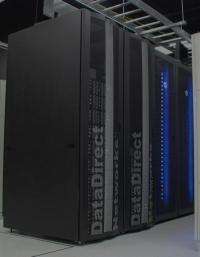
This is LONI's "Painter" supercomputer at Louisiana Tech University. Credit: Louisiana Tech University

The Louisiana Optical Network Initiative (LONI) gained another 4.77 teraflops of computing power recently with the activation of the "Painter" supercomputer housed in the Data Replication Center at Louisiana Tech University.

Painter is the fifth of six Dell Linux Clusters that comprise the LONI system, a state-of-the-art fiber optics network running throughout Louisiana, and connecting Louisiana and Mississippi research universities to one another as well as National LambdaRail and Internet2.

"This supercomputer will help support scientific calculations and data processing by several different disciplines on the Louisiana Tech campus," says Dr. Zeno Greenwood, associate professor of physics. "Painter will give us much, much more and incredibly faster computing than we ever had previously."

Painter's 4.77 teraflops will contribute to the 85 teraflops of total computing power LONI will have upon activation of all its state-wide nodes.

is an acronym meaning trillion floating point operation per second; a measure that describes how many multiplications can be performed within one second. To put it in perspective, Painter's performance power is nearly 500 times greater than that of an average desktop PC.

Louisiana Tech's research efforts, both on and off campus, will greatly benefit from the power and speed generated by Painter.

"[Tech's] high energy physics group will do theoretical simulations and perform large, complicated analyses with Painter," says Greenwood. "This will be in support of the giant coming on line this summer at CERN (European Organization for Nuclear Research)."

The is named in honor of Jack Painter, professor emeritus of civil engineering, who was instrumental in bringing the LGP-30, Louisiana Tech's very first computer, to the campus in the 1950's. With a clock rate of 120 kHz, the LGP-30 was a binary computer, performing without an operating system and at a rate of up to 400 additions per second, which is 12.5 billion times slower than the Painter supercomputer.

Source: Louisiana Tech University


print this article email this article download pdf blog this article bookmark this article     Stumble it Digg this share on Facebook retweet share on Reddit add to delicious
Rate this story - 4.5 /5 (6 votes)

Rank Filter

Move the slider to adjust rank threshold, so that you can hide some of the comments.


Display comments: newest first

  • Soylent - Mar 27, 2009
    • Rank: 5 / 5 (1)
    "To put it in perspective, Painter's performance power is nearly 500 times greater than that of an average desktop PC."

    Or 4 to 8 high end graphics cards, provided your algorithm is embarrasingly parallel enough to fully utilize them.
  • Noumenon - Mar 30, 2009
    • Rank: not rated yet
    Or just get two NVidia Tesla systems, each with 960 cores, and 250 times faster than a standard PC.

    My system has two GTX280 GPU's, each with 240 cores,.. I may have to play with CUDA and PhysX.

March 26, 2009 all stories

Comments: 2

4.5 /5 (6 votes)
  • Stumble this up

  • Digg this

  • share this

  • hide
  • Related Stories

  • IBM: World's most powerful computer
    created Nov 14, 2005 | popularity not rated yet | comments 0
  • IBM To Build Supercomputer For U.S. Government
    created Feb 03, 2009 | popularity not rated yet | comments 0
  • Study: Louisiana moving down and south
    created Dec 19, 2006 | popularity not rated yet | comments 0
  • New computer does Windows 3,000 times faster
    created Jun 18, 2008 | popularity not rated yet | comments 0
  • Rising Sea Greater Danger to Louisiana than Sinking Land
    created Nov 27, 2006 | popularity not rated yet | comments 0


  • hide
  • Relevant PhysicsForums posts

  • Laser plasma emission
    created Nov 26, 2009
  • Achromat lens - magnifying LCD
    created Nov 25, 2009
  • Control System
    created Nov 24, 2009
  • Base Isolation Systems in Skyscrapers?
    created Nov 23, 2009
  • More from Physics Forums - General Engineering

Other News

ASUS Debuts Eee PC T91MT -- First Netbook to Go Multi-touch

ASUS Debuts Eee PC T91MT -- First Netbook to Go Multi-touch

Electronics / Consumer & Gadgets

created 13 hours ago | popularity not rated yet | comments 0

ASUS today launched the Eee PC T91MT, the world's first convertible tablet netbook to feature a multi-touch screen that supports Windows 7 Multi-Touch gestures.


Gift Guide: Accessories to jazz up mobile phones (AP)

Gift Guide: Accessories to jazz up mobile phones

Electronics / Consumer & Gadgets

created 17 hours ago | popularity not rated yet | comments 1

People you know have spent small fortunes on shiny new smart phones such as the iPhone 3GS, a BlackBerry or the Droid. But the devices still don't have all the features they want.


Bling bling with your ring ring: Dekoden craze sees cell phones get a touch of glitz, glamour

Electronics / Consumer & Gadgets

created 16 hours ago | popularity not rated yet | comments 0

Cell phone owners are ringing the changes and putting a smile on their dial by adorning their mobiles with ornamental stickers, charms and beads -- and the craze just keeps getting bigger.


Review: A riff on robotics with self-tuning guitar (AP)

Review: A riff on robotics with self-tuning guitar

Electronics / Consumer & Gadgets

created Nov 25, 2009 | popularity 3.7 / 5 (7) | comments 4

(AP) -- New cars have been tuning themselves for the better part of two decades now, so it should feel less impressive that Gibson has built a guitar that can smoothly do the same.


Qualcomm's next e-book to use a mirasol display

Qualcomm's next e-book to use a mirasol display

Electronics / Consumer & Gadgets

created Nov 20, 2009 | popularity 4.7 / 5 (11) | comments 2

(PhysOrg.com) -- Qualcomm subsidiary Mirasol is developing a new e-book reader with a color display that uses ambient light. The reader will be capable of displaying video smoothly, but the new features will ...