Tesla unveils groundbreaking electric car
March 26, 2009 by Rob Woollard
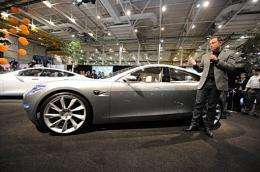
Tesla Motors Chairman and CEO Elon Musk introduces the new Tesla Model S all-electric sedan in Hawthorne, California. Musk said the state-of-the-art, five-seat sedan will be the world's first mass-produced, highway-capable electric car.
US automaker Tesla Motors unveiled Thursday its state-of-the-art five-seat sedan, billed as the world's first mass-produced, highway-capable electric car.
Tesla chief executive Elon Musk said the company, which last year released its breakthrough two-seat Roadster, aims to have its sleek Model S sedan roll off assembly lines by 2011.
The futuristic zero-emission vehicle will be powered by lithium-ion battery packs capable of traveling between 160 and 300 miles (257 and 482 kilometers) per charge.
The car has an anticipated base price of 57,400 dollars but will cost less than 50,000 after a federal tax credit of 7,500 dollars, Musk said.
While the price tag is steep compared to other mass-market sedans, Tesla has stressed that tax incentives, relatively inexpensive maintenance and the lack of fueling costs will make the car competitive with cheaper rival sedans.
Musk told reporters he hoped the car would lead a new generation of vehicles that would help the auto industry wean itself off foreign oil.
"What we really wanted to show the car industry is that it is possible to create a compelling electric car at a compelling price ... We hope the industry will follow our lead," Musk said.
"It's incredibly important that we wean ourselves off oil as soon as possible and that we make the transition to electric vehicles rapidly."
Musk said Tesla aimed to manufacture around 20,000 units per year from an undisclosed factory location in Southern California and said the vehicle could be charged at home in just four hours.
"Even at 20,000 cars per year, we won't come close to affecting the electricity grid and you will be able to charge this car at home," he added.
"It's capable of taking a wide range of currents and voltages, and the charge is built into the car so you don't have to worry about 'Is there a charger at the destination that I'm driving to?'"
Tesla said its new model would become the "car of choice for environmentally conscious and discriminating drivers throughout North America and Europe." It expects to roughly split initial sales between the two continents before expanding into Asia in 2012.
Tesla's other zero-emission car, the two-seat Roadster, is on sale in Europe and the United States.
The company said last year it had ramped up production of the high-performance vehicle, which has a price tag of about 100,000 dollars, due to soaring demand.
Founded in 2003, Tesla specializes in the environmentally-friendly, electric cars that several car manufacturers are starting to produce.
Troubled automotive giant General Motors is developing its own electric sedan, the Chevrolet Volt, which it expects to go on sale in 2011 for about 40,000 dollars a unit.
Thursday's unveiling came against the backdrop of a teetering US auto industry while President Barack Obama has said his administration wants to see a million electric cars on the roads by 2015.
Auto industry analysts were cautious about whether Tesla's Model S suggested that electric vehicles were the future of the US auto industry, saying hybrid vehicles and low fuel prices could stymie their growth.
Jim Hossack of California-based AutoPacific Consulting said Tesla's latest prototype was "something of a technical marvel" but questioned whether it could revolutionize the US auto industry.
"The problem is our fuel price. If you're going to launch an electric vehicle you probably want to do it in a market where fuel prices are high," Hossack told AFP.
"At the moment in the US, they're cheap, a quarter of what they are in Europe or Japan. Hybrids might be better positioned to be the dominant technology."
While Model S production would demonstrate that an electric car can be mass produced, Hossack noted that "we can also put a man on the moon. And it turns out it's expensive."
(c) 2009 AFP


That said... the electricity still needs to be produced by renewable sources. But at least with electric cars we can centralize the source and control of power generation.
Not a very good car for the masses, just another toy for the wealthy.
It allready exists, its called Better Place, they are currently "partnered" with Renault-Nissan and are going to test the technology in Isreal.
http://www.cfo.co..._2984789
(Now for a wackier idea -- could they drain and refill the battery acid? That could be fun..)
Though I like their service a lot, I'm a little wary of the prepaid payment model they're planning to use (I'd much prefer to see it work like a gas station).. but hopefully it's just to help it get off the ground.
Isn't that the way the automobile started in the first place?
Um. Lack of fueling costs? Is Tesla providing a lifetime supply of free electricity with each purchase, then? ;-)
Okay, let's figure up the actual fuel savings, then. Can someone check my math, here? If you assume that electricity costs $0.15/kWh, electric engines are 90% efficient, and gas engines are 25% efficient, then I calculate that the cost of electricity equivalent to a gallon of gasoline is about $1.53. (Gasoline contains 36.6 kWh of energy per gallon.)
To ensure the above numbers are accurate, we must compare the Tesla against a hybrid vehicle with a regenerative braking system comparable to that of the Model S, which will run you maybe $25,000.
At today's gas prices of $1.95/gallon in the US, it would take 54,400 gallons of gas (or about 2.5 million miles of driving a hybrid) to cover the extra $25,000 you'd pay for one of these things. So I wouldn't say the fuel savings are going to make the Model S attractive.
But Tesla's CEO claims (on another website) that the Model S can go 230 miles on $5 USD! So is my math horribly wrong, here? The CEO's numbers make little sense to me. At $0.15/kWh, $5 only buys you 33.3 kWh. Driving at 60 mph over 230 miles would cost you 55 kWh in air resistance alone (assuming a 120 lb drag, which is conservative.) And that's not even counting the energy loss in the gear box and road friction, or due to speed and altitude changes while driving.
A paper on the website claims the Tesla Roadstar runs 0,11kWh/km so 33,3kWh translates to 303km or 190 miles. Assume electricity at $0,12/kwh (cheap but not exceptional) and you reach 230 miles for $5.
But I'm afraid that your $1,53 v.s. $1,95 comparison stands. Of course most experts agree that the current $2 is low (because of low oil prices). And in Europe the situation is very different because of pollution taxes (I pay $5,80 at the pump in Holland).
But Tesla in not synonymous with electric cars. Tesla has made electric cars sexy but they've not made them cheap. For cheap electric cars you should look at companies like BYD who say they will offer a good looking car "like this" for $22.000,-.
The IEEE has a nice position paper on the savings that you can achieve by driving electric called PLUG-IN ELECTRIC HYBRID VEHICLES. They really make a good case for them.
How much current does your electric stove or air conditioner use?
At home you don't use a standard outlet.....
Electric cars will be the new fad. When demand rises and production rises to meet the demand, prices wil plummet, just like any other electronic toy.
;P but at least the USA is coal rich unlike Oil.
If only they could put working scrubbers on the smoke stacks. Instead they spew out 90% of the toxic pollution in the environment. Quite dumb really as the cost of a scrubber is low when compared with the cost of health care for all the cancers etc.
@Mercury. a new SUV? Remember this is a new car. 20 to 25k isn't an suv it's a CUV and that's a different horse altogether, nothing against them, but it's still not a real answer.
to everyone comparing this to hybrids, again don't compare to the prius or civic hybrid it's not the same class, you don't compare a neon to a suburban and say look how much better the neon is, they do different things. And as for the batteries there are a fortune of uses after the battery is "dead" Dead for a high speed battery for a car application still offers a second life as a UPS or other low drain application for years to come.
@Damon, you are right but you are leaving out a little, an EV can bypass some additional losses, alternator, water pump, driveshaft, transmission, directional changes at the axel if you uses 2 motors, one per wheel. 25% is efficiency at the engine output not the axel.
And will everyone remember that Tesla has said this car will be an alternative to a $2000 dollar used 95 civic. it's not going to compete price wise with a used beater car. It' isn't the car that will give all the homeless a better place to sleep. It is affordable. Not cheap. There is a huge difference. Tesla hasn't said this car is the best choice for everyone. In the same vein as saying this car is more expensive than a accord, it also doesn't have the towing power of a chevy 2500 with a duramax and allison 5 speed, so clearly it's under powered too. grow up people. and remember I'm usually the one who is against electric cars, but as I'v ealways said, if you can make a electric car that can get me to work without having to stop to recharge and make it at a reasonable price I'll support it and buy one. I probably won't trash my 2005 car for an EV today since the waste and irony of getting a "green" car by trashing a ton of steel and plastic isn't lost on me, but for my sext set of wheels this will be high on the list. I'll at the very least have to look at the numbers before I buy anything.